
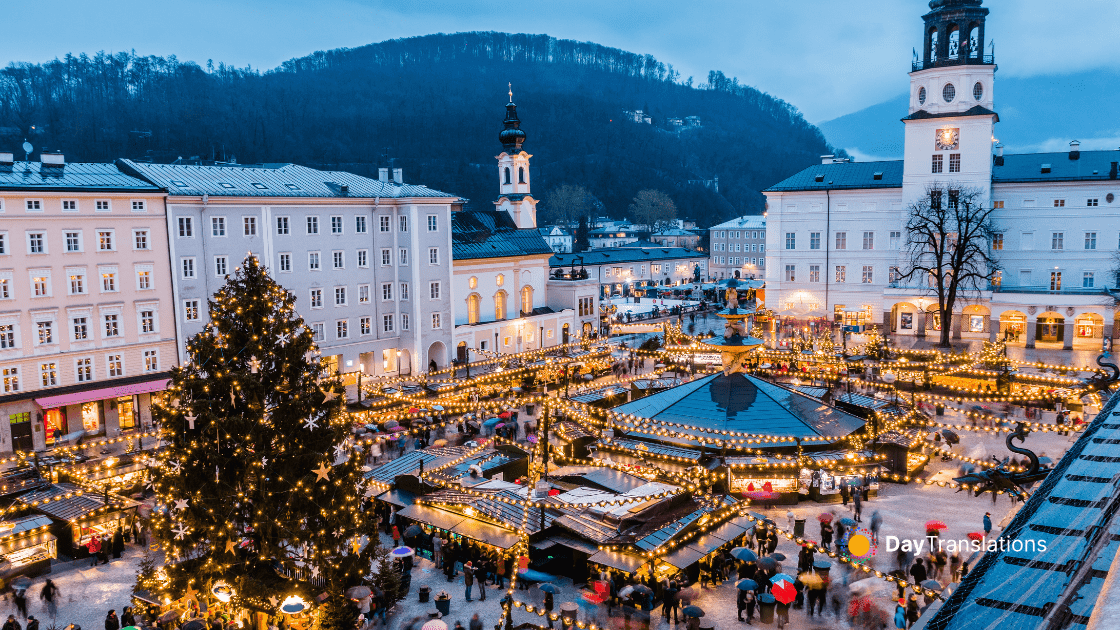
The Republic of Austria is located in Central Europe. It is bordered by Germany and the Czech Republic to the north, Slovakia and Hungary to the east, Slovenia and Italy to the south, and Switzerland and Liechtenstein to the west. The majority of the population speaks German, which is also the country’s official language. Other local official languages are Croatian, Hungarian and Slovene.
The origins of Austria date back to the time of the Roman Empire when a Celtic kingdom was conquered by the Romans in approximately 15 BC and later became Noricum, a Roman province, in the mid 1st century AD – an area which mostly encloses today’s Austria. In 788 AD, the Frankish king Charlemagne conquered the area and introduced Christianity. Under the native Habsburg dynasty, Austria became one of the great powers of Europe. In 1867, the Austrian Empire was reformed into Austria-Hungary.
The Austro-Hungarian Empire collapsed in 1918 with the end of World War I. The First Austrian Republic was established in 1919. In the 1938 Anschluss, Austria was occupied and annexed by Nazi Germany. This lasted until the end of World War II in 1945, after which Austria was occupied by the Allies and its former democratic constitution was restored. In 1955, the Austrian State Treaty re-established Austria as a sovereign state, ending the occupation. In the same year, the Austrian Parliament created the Declaration of Neutrality which declared that the country would become permanently neutral.
Today, Austria is a parliamentary representative democracy comprising nine federal states. The capital and largest city, with a population exceeding 1.6 million, is Vienna.
In this Country Profile
:: Background of Austria ::
Once the center of power for the large Austro-Hungarian Empire, Austria was reduced to a small republic after its defeat in World War I. Following annexation by Nazi Germany in 1938 and subsequent occupation by the victorious Allies in 1945, Austria’s status remained unclear for a decade. A State Treaty signed in 1955 ended the occupation, recognized Austria’s independence, and forbade unification with Germany. A constitutional law that same year declared the country’s “perpetual neutrality” as a condition for Soviet military withdrawal. The Soviet Union’s collapse in 1991 and Austria’s entry into the European Union in 1995 have altered the meaning of this neutrality. A prosperous, democratic country, Austria entered the EU Economic and Monetary Union in 1999.
:: Geography of Austria ::
Location: Central Europe, north of Italy and Slovenia
Geographic coordinates: 47 20 N, 13 20 E
Area:
total: 83,871 sq km
land: 82,445 sq km
water: 1,426 sq km
Area – comparative: slightly smaller than Maine
Land boundaries: 2,562 km
Border countries: Czech Republic 362 km, Germany 784 km, Hungary 366 km, Italy 430 km, Liechtenstein 35 km, Slovakia 91 km, Slovenia 330 km, Switzerland 164 km
Coastline: 0 km (landlocked)
Maritime claims: none (landlocked)
Climate: temperate; continental, cloudy; cold winters with frequent rain and some snow in lowlands and snow in mountains; moderate summers with occasional showers
Terrain: in the west and south mostly mountains (Alps); along the eastern and northern margins mostly flat or gently sloping
Elevation extremes:
lowest point: Neusiedler See 115 m
highest point: Grossglockner 3,798 m
Natural resources: oil, coal, lignite, timber, iron ore, copper, zinc, antimony, magnesite, tungsten, graphite, salt, hydropower
Land use:
arable land: 16.59%
permanent crops: 0.85%
other: 82.56% (2005)
Irrigated land: 40 sq km (2003)
Total renewable water resources: 84 cu km (2005)
Freshwater withdrawal (domestic/industrial/agricultural):
total: 3.67 cu km/yr (35%/64%/1%)
per capita: 448 cu m/yr (1999)
Natural hazards: landslides; avalanches; earthquakes
Environment – current issues: some forest degradation caused by air and soil pollution; soil pollution results from the use of agricultural chemicals; air pollution results from emissions by coal- and oil-fired power stations and industrial plants and from trucks transiting Austria between northern and southern Europe
Environment – international agreements: party to: Air Pollution, Air Pollution-Nitrogen Oxides, Air Pollution-Persistent Organic Pollutants, Air Pollution-Sulfur 85, Air Pollution-Sulphur 94, Air Pollution-Volatile Organic Compounds, Antarctic Treaty, Biodiversity, Climate Change, Climate Change-Kyoto Protocol, Desertification, Endangered Species, Environmental Modification, Hazardous Wastes, Law of the Sea, Ozone Layer Protection, Ship Pollution, Tropical Timber 83, Tropical Timber 94, Wetlands, Whaling; signed, but not ratified: none of the selected agreements
Geography – note: landlocked; strategic location at the crossroads of central Europe with many easily traversable Alpine passes and valleys; major river is the Danube; population is concentrated on eastern lowlands because of steep slopes, poor soils, and low temperatures elsewhere
:: People of Austria ::
Population: 8,217,280 (July 2011 est.)
Age structure:
0-14 years: 14% (male 590,855/female 563,300)
15-64 years: 67.7% (male 2,793,725/female 2,769,840)
65 years and over: 18.2% (male 627,456/female 872,104) (2011 est.)
Median age:
total: 43 years
male: 41.9 years
female: 44 years (2011 est.)
Population growth rate: 0.034% (2011 est.)
Birth rate: 8.67 births/1,000 population (2011 est.)
Death rate: 10.14 deaths/1,000 population (July 2011 est.)
Net migration rate: 1.81 migrant(s)/1,000 population (2011 est.)
Urbanization:
urban population: 68% of total population (2010)
rate of urbanization: 0.6% annual rate of change (2010-15 est.)
Sex ratio:
at birth: 1.051 male(s)/female
under 15 years: 1.05 male(s)/female
15-64 years: 1.01 male(s)/female
65 years and over: 0.71 male(s)/female
total population: 0.95 male(s)/female (2011 est.)
Infant mortality rate:
total: 4.32 deaths/1,000 live births
male: 5.23 deaths/1,000 live births
female: 3.35 deaths/1,000 live births (2011 est.)
Life expectancy at birth:
total population: 79.78 years
male: 76.87 years
female: 82.84 years (2011 est.)
Total fertility rate: 1.4 children born/woman (2011 est.)
HIV/AIDS – adult prevalence rate: 0.3% (2009 est.)
HIV/AIDS – people living with HIV/AIDS: 15,000 (2009 est.)
HIV/AIDS – deaths: fewer than 100 (2009 est.)
Nationality: noun: Austrian(s) adjective: Austrian
Ethnic groups: Austrians 91.1%, former Yugoslavs 4% (includes Croatians, Slovenes, Serbs, and Bosniaks), Turks 1.6%, German 0.9%, other or unspecified 2.4% (2001 census)
Religions: Roman Catholic 73.6%, Protestant 4.7%, Muslim 4.2%, other 3.5%, unspecified 2%, none 12% (2001 census)
Languages: German (official nationwide) 88.6%, Turkish 2.3%, Serbian 2.2%, Croatian (official in Burgenland) 1.6%, other (includes Slovene, official in Carinthia, and Hungarian, official in Burgenland) 5.3% (2001 census)
Literacy:
definition: age 15 and over can read and write
total population: 98%
male: NA
female: NA
School life expectancy (primary to tertiary education):
total: 15 years
male: 15 years
female: 15 years (2008)
Education expenditures: 5.4% of GDP (2007)
Geography of Austria: Important Geographical Information about Austria
In this Country Profile
Austria is a small, predominantly mountainous country in Central Europe, approximately between Germany, Italy and Hungary. It has a total area of 83,859 km², about twice the size of Switzerland and slightly smaller than the state of Maine.
The landlocked country shares national borders with Switzerland (164 km) and the tiny principality of Liechtenstein (35 km) to the west, Germany (784 km) and the Czech Republic (362 km) and Slovakia (91 km) to the north, Hungary to the east (346 km), and Slovenia(311 km) and Italy (430 km) to the south (total: 2563 km).
The westernmost third of the somewhat pear-shaped country consists of a narrow corridor between Germany and Italy that is between thirty-two and sixty km wide. The rest of Austria lies to the east and has a maximum north–south width of 280 km. The country measures almost 600 km in length, extending from Lake Constance (German Bodensee) on the Austrian-Swiss-German border in the west to the Neusiedler See on the Austrian-Hungarian border in the east. The contrast between these two lakes – one in the Alps and the other a typical steppe lake on the westernmost fringe of the Hungarian Plain – illustrates the diversity of Austria’s landscape.
Land-use patterns in Austria change from Alpine to non-Alpine regions. Approximately one-tenth of Austria is barren or unproductive, that is, extremely Alpine or above the tree line. Just over 40% of Austria is covered by forests, the majority of which is in Alpine regions. Less than one-fifth of Austria is arable and suitable for conventional agriculture. The percentage of arable land in Austria increases in the East as the country becomes less alpine. More than one-fifth of Austria is pasture and meadow located at varying altitudes. Almost half of this grassland consists of high Alpine pastures.
Historically, high Alpine pastures have been used during the summer for grazing dairy cattle, thus making space available at lower altitudes for cultivating and harvesting fodder for winter. Many of the high pastures are at altitudes of more than 1,000 m. Although agriculture in mountainous areas was at one time economically viable, in recent decades it has survived only with the help of extensive subsidies. A concern of farmers in these mountainous regions is that membership of the European Union might entail a curtailment of these subsidies and the end of Alpine agriculture. If this occurs, many areas will be reclaimed by nature after centuries of cultivation.
Although the Alps are beautiful, they make many areas of Austria uninhabitable. Austria’s so-called areas of permanent settlement – regions that are cultivated, continuously inhabited, and used for transportation, but do not include forests, Alpine pastures, or barren land – cover only 40% or 35,000 km² of the country. The great majority of the area of permanent settlement is in the Danube valley and the lowlands or hilly regions north, east, and south of the Alps, where approximately two-thirds of the population lives.
In the country’s predominantly Alpine provinces, most of the population live in river valleys: Bregenz on the shores of Lake Constance in Vorarlberg; Innsbruck on the Inn River in Tyrol; Salzburg on the Salzach River in Salzburg; and Klagenfurt on the Wörthersee lake in Carinthia. The higher the Alps are, the less inhabitable they become in terms of soil, microclimate, and vegetation. Conversely, the lower and broader the Alpine valleys are, the more densely populated they become. Tyrol illustrates most clearly the relationship between Alpine geography and habitation. As the most mountainous province (less than 3% of the land is arable), it is the most sparsely inhabited, with an area of permanent settlement of only 15%. Because of the Alps, the country as a whole is one of the least densely populated states of Western and Central Europe. With ninety-three inhabitants per square kilometer, Austria has a population density similar to that of the former Yugoslavia. Austria’s national borders and geography have corresponded very little. Since the fall of the Roman Empire, the Alps and the Danube have not served to mark political boundaries. Even within Austria, provincial borders were only occasionally set by the ranges and ridges of the Alps.
Although the Alps did not mark political boundaries, they often separated groups of people from one another. Because in the past the Alps were impassable, inhabitants isolated in valleys or networks of valleys developed distinct regional subcultures. Consequently, the inhabitants of one valley frequently maintained dialects, native or traditional dress, architectural styles and folklore that substantially differed from those of the next valley. Differences were great enough that the origins of outsiders could easily be identified. However, mass media, mobility, prosperity, and tourism have eroded the distinctness of Alpine regional subcultures to a great extent by reducing the isolation that gave them their particular character.
Despite the Alps, Austria has historically been a land of transit. The Danube valley, for centuries Central Europe’s aquatic link to the Balkan Peninsula and the “Orient” in the broadest sense of the word, has always been an avenue of east–west transit. However, Europe’s division into two opposing economic and military blocs after World War II diminished Austria’s importance as a place of transit. Since the opening of Eastern Europe in 1989, the country has begun to re-assume its historical role. By the early 1990s, it had already experienced a substantial increase in the number of people and vehicles crossing its eastern frontiers.
Within the Alps, four passes and the roads that run through them are of particular importance for north–south transit. The Semmering Pass on the provincial border of Lower Austria and Styria connects the Viennese Basin with the Mürz and Mur valleys, thus providing northeast-southwest access to Styria and Slovenia, and, via Carinthia, to Italy.
The Pyrhn Pass between the provinces of Upper Austria and Styria and the Tauern Pass between the Hohe Tauern range and the Niedere Tauern range of the Central Alps in Salzburg, provide access to the Mur Valley in Styria and the Drau Valley in Carinthia, respectively. The highways that run through these passes are important northwest-southeast lines of communication through the Alps. The Pyrhn highway has been nicknamed the Fremdarbeiterweg (“foreign workers’ route”) because millions of Gastarbeiter (“guest workers”) in Germany use it to return to their homes in the Balkans and Turkey for vacation. Many Germans and northern Europeans also use it in the summer months to reach the Adriatic coast. After the outbreak of hostilities in Yugoslavia in the summer of 1991, however, a substantial amount of this traffic was re-routed through the Danube Valley and Hungary.
The most important pass in the Austrian Alps is the Brenner Pass, located on the Austrian-Italian border in Tyrol. At 1,370 m, it is one of the lowest Alpine passes. The route up the Inn valley and over the Brenner Pass has been historically an important and convenient route of north–south transit between Germany and Italy, and provides the most direct route between Europe’s two most highly industrialized regions: Germany and northern Italy.
Information about the Austrian Flag: Colors and Meaning of the Flag of Austria
In this Country Profile
The national flag of Austria contains three equal horizontal bands of red (top), white, and red; the flag design is certainly one of the oldest – if not the oldest – national banners in the world.
According to tradition, in 1191, following a fierce battle in the Third Crusade, Duke Leopold V of Austria’s white tunic became completely blood-spattered; upon removal of his wide belt or sash, a white band was revealed; the red-white-red color combination was subsequently adopted as his banner.
Extensive List of Languages of Austria: Spoken and Extinct Languages
In this Country Profile
Austrian Sign Language [asq] Alternate names: Austro-Hungarian Sign Language. Dialects: Partially intelligible with French Sign Language [fsl]. Related to Russian Sign Language [rsl]. Sign language used in class and that used by adults outside class are different. Classification: Deaf sign language
Bavarian [bar] 7,000,000 in Austria (2005). Population total all countries: 13,259,000. Central Bavarian in the Alps and Lower Austria and Salzburg; North Bavarian north of Regensburg, to Nuremburg and Western Bohemia, Czech Republic; South Bavarian in Bavarian Alps, Tyrol, Styria, including the Heanzian dialect of Burgenland, Carinthia, northern Italy, and part of Gottschee. Also in Czech Republic, Germany, Italy. Alternate names: Bairisch, Bavarian Austrian, Bayerisch, Ost-Oberdeutsch. Dialects: Central Bavarian (Danube Bavarian), North Bavarian (Upper Franconian), South Bavarian, Salzburgish. Classification: Indo-European, Germanic, West, High German, German, Upper German, Bavarian-Austrian
Croatian [hrv] 19,400 in Austria (2001 census). Burgenland and Vienna. Dialects: Burgenland Croatian. Classification: Indo-European, Slavic, South, Western
German, Standard [deu] 7,500,000 in Austria (J. A. Hawkins 1987). Dialects: Kärntnerisch. Classification: Indo-European, Germanic, West, High German, German, Middle German, East Middle German
German, Swiss [gsw] 300,000 in Austria (1991 Annemarie Schmidt). West, Vorarlberg. Alternate names:Alemannic, Alemannisch. Dialects: High Alemannisch (Hochalemannisch). Classification: Indo-European, Germanic, West, High German, German, Upper German, Alemannic
Hungarian [hun] 25,900 in Austria (2001 census). Vienna, Lower Austria, Styria, Burgenland. Alternate names: Magyar. Dialects: Oberwart. Classification: Uralic
Romani, Sinte [rmo] 4,350 in Austria (2001 census). Alternate names: Rommanes, Sinte, Sinti. Classification:Indo-European, Indo-Iranian, Indo-Aryan, Central zone, Romani, Northern
Slovene [slv] 18,000 in Austria (2001 census). Southwest, Carinthia (Kärnten) and Steiermark (Styria).Alternate names: Slovenian, “Windisch”. Classification: Indo-European, Slavic, South, Western
Walser [wae] 8,080 in Austria (2000). Vorarlberg (Grosses Walsertal: Blons, Fontanella, Raggal, St. Gerold, Sonntag, Thüringerberg); Kleinwalsertal (Mittleberg); Brandnertal (Brand); Montafon (Silbertal); Reintal (Laterns); Tannberg (Schricken, Lech, Warth); Tirol: Paznauntal (Galtnr). 14 communities. Alternate names: Walscher. Classification: Indo-European, Germanic, West, High German, German, Upper German, Alemannic
:: Reference ::
Gordon, Raymond G., Jr. (ed.), 2005. Ethnologue: Languages of the World, Fifteenth edition. Dallas, Tex.: SIL International. Online version: http://www.ethnologue.com/
Famous Austrian People: Austrian Artists, Scientists, Leaders, Musicians, Politicians and Athletes
In this Country Profile
Austria is home to outstanding individuals who made a difference with their remarkable achievements. The following people made their mark on both the local and international scenes. They are just some of many famous Austrians who have lifted Austria’s name worldwide and made a difference in our world. Their purpose and stories inspired awe if not greatness.
:: List of Famous People from Austria ::
Wolfgang Amadeus Mozart
Wolfgang Amadeus Mozart was a prolific and influential composer of the Classical era, who composed over 600 works, many acknowledged as pinnacles of symphonic, concertante, chamber, piano, operatic, and choral music. He is among the most enduringly popular of classical composers.
Mozart showed prodigious ability from his earliest childhood in Salzburg. Already competent on keyboard and violin, he composed from the age of five and performed before European royalty. At 17, he was engaged as a court musician in Salzburg, but grew restless and travelled in search of a better position, always composing abundantly. While visiting Vienna in 1781, he was dismissed from his Salzburg position. He chose to stay in the capital, where he achieved fame but little financial security. During his final years in Vienna, he composed many of his best-known symphonies, concertos, and operas, and portions of the Requiem, which was largely unfinished at the time of Mozart’s death. The circumstances of his early death have been much mythologized.
Mozart learned voraciously from others, and developed a brilliance and maturity of style that encompassed the light and graceful along with the dark and passionate. His influence on subsequent Western art music is profound.
Joseph Haydn
Joseph Haydn was one of the most prolific and prominent composers of the Classical period. He is often called the “Father of the Symphony” and “Father of the String Quartet” because of his important contributions to these forms. He was also instrumental in the development of the piano trio and in the evolution of sonata form.
Franz Peter Schubert
Although he died at an early age, Franz Schubert was a tremendously prolific composer. He wrote some 600 Lieder, nine symphonies (including the famous “Unfinished Symphony”), liturgical music, operas, some incidental music, and a large body of chamber and solo piano music. Appreciation of his music during his lifetime was limited, but interest in Schubert’s work increased dramatically in the decades following his death at the age of 31.Franz Liszt, Robert Schumann, Johannes Brahms and Felix Mendelssohn, among others, discovered and championed his works in the 19th Century. Today, Schubert is admired as one of the leading exponents of the early Romantic era in music and he remains one of the most frequently performed composers.
Johann Strauss, Sr.
Johann Strauss I was an Austrian Romantic composer famous for his waltzes, and for popularizing them alongside Joseph Lanner, thereby setting the foundations for his sons to carry on his musical dynasty. His most famous piece is probably the Radetzky March (named after Joseph Radetzky von Radetz), while his most famous waltz is probably the Lorelei Rheinklänge op. 154.
Johann Strauss, Jr.
Johann Strauss II was an Austrian composer of light music, particularly dance music and operettas. He composed over 500 waltzes, polkas, quadrilles, and other types of dance music, as well as several operettas and a ballet. In his lifetime, he was known as “The Waltz King”, and was largely then responsible for the popularity of the waltz in Vienna during the 19th century.
Some of Johann Strauss’s most famous works include The Blue Danube, Kaiser-Walzer, Tales from the Vienna Woods, the Tritsch-Tratsch-Polka, and the Pizzicato Polka. Among his operettas, Die Fledermaus and Der Zigeunerbaron are the most well-known.
Fritz Lang
Fritz Lang was an Austrian-American filmmaker, screenwriter, and occasional film producer and actor. One of the best known émigrés from Germany’s school of Expressionism, he was dubbed the “Master of Darkness” by the British Film Institute. His most famous films are the groundbreaking Metropolis (the world’s most expensive silent film at the time of its release) and M, made before he moved to the United States, his iconic precursor to the film noir genre.
Otto Preminger
Otto Preminger was an Austro–Hungarian-American theatre and film director.
After moving from the theatre to Hollywood, he directed over 35 feature films in a five-decade career. He rose to prominence for stylish film noir mysteries such as Laura (1944) and Fallen Angel (1945). In the 1950s and 1960s, he directed a number of high-profile adaptations of popular novels and stage works. Several of these pushed the boundaries of censorship by dealing with topics which were then taboo in Hollywood, such as drug addiction (The Man with the Golden Arm,1955), rape (Anatomy of a Murder, 1959), and homosexuality (Advise & Consent, 1962). He was twice nominated for the Best Director Academy Award. He also had a few acting roles.
Billy Wilder
Billy Wilder was an Austria/Hungarian-born American filmmaker, screenwriter, producer, and journalist, whose career spanned more than 50 years and 60 films. He is regarded as one of the most brilliant and versatile filmmakers of Hollywood’s golden age. Wilder is one of only five people who have won Academy Awards as producer, director, and writer for the same film (The Apartment).
Wilder became a screenwriter in the late 1920s while living in Berlin. After the rise of Adolf Hitler, Wilder, who was Jewish, left for Paris, where he made his directorial debut. He relocated to Hollywood in 1933, and in 1939 he had a hit as a co-writer of the screenplay to the screwball comedy Ninotchka. Wilder established his directorial reputation after helming Double Indemnity (1944), a film noir he co-wrote with mystery novelist Raymond Chandler. Wilder earned the Best Director and Best Screenplay Academy Awards for the adaptation of a Charles R. Jackson story The Lost Weekend, about alcoholism. In 1950, Wilder co-wrote and directed the critically acclaimed Sunset Boulevard.
From the mid-1950s on, Wilder made mostly comedies. Among the classics Wilder created in this period are the farces The Seven Year Itch (1955) and Some Like It Hot (1959), satires such as The Apartment (1960), and the romantic comedy Sabrina (1954). He directed fourteen different actors in Oscar-nominated performances. Wilder was recognized with the AFI Life Achievement Award in 1986. In 1988, Wilder was awarded the Irving G. Thalberg Memorial Award. In 1993, he was awarded the National Medal of Arts. Wilder holds a significant place in the history of Hollywood censorship for expanding the range of acceptable subject matter.
Adolf Hitler
Adolf Hitler was an Austrian-born German politician and the leader of the National Socialist German Workers Party (German: Nationalsozialistische Deutsche Arbeiterpartei, abbreviated NSDAP), commonly known as the Nazi Party. He was Chancellor of Germany from 1933 to 1945, and served as head of state as Führer und Reichskanzler from 1934 to 1945. Hitler is most remembered for his central leadership role in the rise of fascism in Europe, World War II and the Holocaust.
A decorated veteran of World War I, Hitler joined the precursor of the Nazi Party (DAP) in 1919, and became leader of NSDAP in 1921. He attempted a failed coup d’etat known as the Beer Hall Putsch, which occurred at the Bürgerbräukeller beer hall in Munich on November 8–9, 1923. Hitler was imprisoned for one year due to the failed coup, and wrote his memoir, “My Struggle” (in German Mein Kampf), while imprisoned. After his release on December 20, 1924, he gained support by promoting Pan-Germanism, anti-semitism, anti-capitalism, and anti-communism with charismatic oratory and propaganda. He was appointed chancellor on January 30, 1933, and transformed the Weimar Republic into the Third Reich, a single-party dictatorship based on the totalitarian and autocratic ideology of Nazism.
Hitler ultimately wanted to establish a New Order of absolute Nazi German hegemony in continental Europe. To achieve this, he pursued a foreign policy with the declared goal of seizing Lebensraum (“living space”) for the Aryan people; directing the resources of the state towards this goal. This included the rearmament of Germany, which culminated in 1939 when the Wehrmacht invaded Poland. In response, the United Kingdom and France declared war against Germany, leading to the outbreak of World War II in Europe.
Within three years, German forces and their European allies had occupied most of Europe, and most of Northern Africa, and the Japanese forces had occupied parts of East and Southeast Asia and the Pacific Ocean. However, with the reversal of the Nazi invasion of the Soviet Union, the Allies gained the upper hand from 1942 onwards. By 1944, Allied armies had invaded German-held Europe from all sides. Nazi forces engaged in numerous violent acts during the war, including the systematic murder of as many as 17 million civilians, including an estimated six million Jews targeted in the Holocaust and between 500,000 and 1,500,000 Roma, added to the Poles, Soviet civilians, Soviet prisoners of war, people with disabilities, homosexuals, Jehovah’s Witnesses, and other political and religious opponents.
In the final days of the war, during the Battle of Berlin in 1945, Hitler married his long-time mistress Eva Braun and, to avoid capture by Soviet forces, the two committed suicide less than two days later on 30 April 1945, and their corpses were burned.
Arnold Schwarzenegger
Arnold Schwarzenegger is an Austrian-American bodybuilder, actor, model, businessman and politician who served as the 38th Governor of California (2003–2011).
Schwarzenegger began weight training at 15. He was awarded the title of Mr. Universe at age 20 and went on to win the Mr. Olympia contest a total of seven times. Schwarzenegger has remained a prominent presence in the sport of bodybuilding and has written several books and numerous articles on the sport.
Schwarzenegger gained worldwide fame as a Hollywood action film icon, noted for his lead roles in such films as Conan the Barbarian, The Terminator and Commando. He was nicknamed the “Austrian Oak” and the “Styrian Oak” in his bodybuilding days, “Arnie” during his acting career and more recently the “Governator” (a portmanteau of “Governor” and “Terminator”).
As a Republican, he was first elected on October 7, 2003, in a special recall election (referred to in Schwarzenegger campaign propaganda as a “Total Recall”) to replace then-Governor Gray Davis. Schwarzenegger was sworn in on November 17, 2003, to serve the remainder of Davis’s term. Schwarzenegger was then re-elected on November 7, 2006, in California’s 2006 gubernatorial election, to serve a full term as governor, defeating Democrat Phil Angelides, who was California State Treasurer at the time. Schwarzenegger was sworn in for his second term on January 5, 2007.