
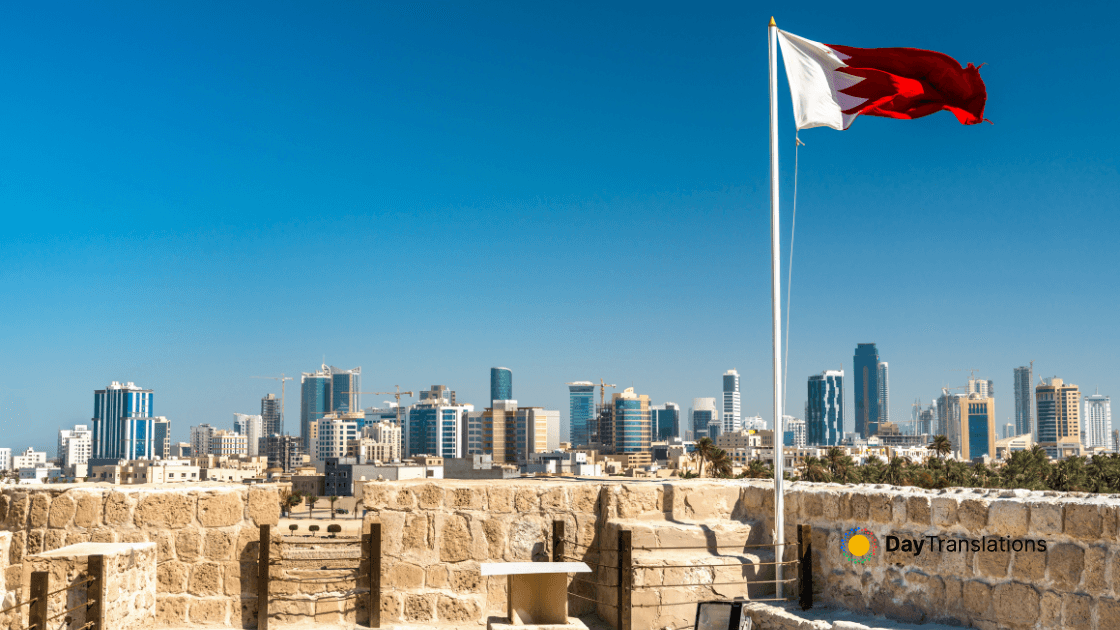
The Kingdom of Bahrain is the smallest country in the Persian Gulf, through which much of the Western world’s petroleum must transit to head out to open ocean. Renowned for its oil refining industry and pearls, Bahrain was the first Gulf state to discover oil and to build a refinery in 1932.
However, Bahrain’s thriving economy is less dependent on oil than most of its neighbors. Being perceived as one of the most stable and transparent countries in the Persian Gulf, the Kingdom has become a leading financial and business center where global banking institutions and fund management companies have established operations.
Bahrain’s excellent network of communications and transport make it a perfect choice for many companies which market this country as the gateway to the Gulf region and the Arab world.
In this Country Profile
:: Background of Bahrain ::
In 1783, the al-Khalifa family captured Bahrain from the Persians. In order to secure these holdings, it entered into a series of treaties with the UK during the 19th century that made Bahrain a British protectorate. The archipelago attained its independence in 1971. Bahrain’s small size and central location among Persian Gulf countries require it to play a delicate balancing act in foreign affairs among its larger neighbors. Facing declining oil reserves, Bahrain has turned to petroleum processing and refining and has transformed itself into an international banking center. King HAMAD bin Isa al-Khalifa, after coming to power in 1999, pushed economic and political reforms to improve relations with the Shia community. Shia political societies participated in 2010 parliamentary and municipal elections. Al Wifaq, the largest Shia political society, won the largest number of seats in the elected chamber of the legislature. However, Shia discontent has resurfaced in recent years with street demonstrations and occasional low-level violence.
:: Geography of Bahrain ::
Location: Middle East, archipelago in the Persian Gulf, east of Saudi Arabia
Geographic coordinates: 26 00 N, 50 33 E
Area:
total: 760 sq km
land: 760 sq km
water: 0 sq km
Area – comparative: 3.5 times the size of Washington, DC
Land boundaries: 0 km
Coastline: 161 km
Maritime claims:
territorial sea: 12 nm
contiguous zone: 24 nm
continental shelf: extending to boundaries to be determined
Climate: arid; mild pleasant winters; very hot humid summers
Terrain: mostly low desert plain rising gently to low central escarpment
Elevation extremes:
lowest point: Persian Gulf 0 m
highest point: Jabal ad Dukhan 122 m
Natural resources: oil, associated and non-associated natural gas, fish, pearls
Land use:
arable land: 2.82%
permanent crops: 5.63%
other: 91.55% (2005)
Irrigated land: 40 sq km (2003)
Total renewable water resources: 0.1 cu km (1997)
Freshwater withdrawal (domestic/industrial/agricultural):
total: 0.3 cu km/yr (40%/3%/57%)
per capita: 411 cu m/yr (2000)
Natural hazards: periodic droughts; dust storms
Environment – current issues: desertification resulting from the degradation of limited arable land, periods of drought, and dust storms; coastal degradation (damage to coastlines, coral reefs, and sea vegetation) resulting from oil spills and other discharges from large tankers, oil refineries, and distribution stations; lack of freshwater resources (groundwater and seawater are the only sources for all water needs)
Environment – international agreements: party to: Biodiversity, Climate Change, Climate Change-Kyoto Protocol, Desertification, Hazardous Wastes, Law of the Sea, Ozone Layer Protection, Wetlands; signed, but not ratified: none of the selected agreements
Geography – note: close to primary Middle Eastern petroleum sources; strategic location in Persian Gulf, through which much of the Western world’s petroleum must transit to reach open ocean.
:: People of Bahrain ::
Population: 738,004 (July 2008 est.)
note: includes 235,108 non-nationals (July 2010 est.)
Age structure:
0-14 years: 25.9% (male 95,258/female 93,256)
15-64 years: 70.1% (male 293,340/female 217,815)
65 years and over: 4% (male 15,274/female 13,766) (2010 est.)
Median age:
total: 30.4 years
male: 33.5 years
female: 27.1 years (2010 est.)
Population growth rate: 1.243% (2010 est.)
Birth rate: 16.81 births/1,000 population (2010 est.)
Death rate: 4.37 deaths/1,000 population (July 2010 est.)
Net migration rate: 0 migrant(s)/1,000 population (2010 est.)
Urbanization:
urban population: 89% of total population (2008)
rate of urbanization: 1.8% annual rate of change (2005-10 est.)
Sex ratio:
at birth: 1.03 male(s)/female
under 15 years: 1.02 male(s)/female
15-64 years: 1.33 male(s)/female
65 years and over: 1.13 male(s)/female
total population: 1.24 male(s)/female (2010 est.)
Infant mortality rate:
total: 14.76 deaths/1,000 live births
male: 17.01 deaths/1,000 live births
female: 12.44 deaths/1,000 live births (2010 est.)
Life expectancy at birth:
total population: 75.4 years
male: 72.87 years
female: 78.01 years (2010 est.)
Total fertility rate: 2.47 children born/woman (2010 est.)
HIV/AIDS – adult prevalence rate: 0.2% (2001 est.)
HIV/AIDS – people living with HIV/AIDS: fewer than 600 (2007 est.)
HIV/AIDS – deaths: fewer than 200 (2003 est.)
Nationality: noun: Bahraini(s) adjective: Bahraini
Ethnic groups: Bahraini 62.4%, non-Bahraini 37.6% (2001 census)
Religions: Muslim (Shia and Sunni) 81.2%, Christian 9%, other 9.8% (2001 census)
Languages: Arabic (official), English, Farsi, Urdu
Literacy:
definition: age 15 and over can read and write
total population: 86.5%
male: 88.6%
female: 83.6% (2001 est.)
School life expectancy (primary to tertiary education):
total: 14 years
male: 14 years
female: 15 years (2006)
Education expenditures: 2.9% of GDP (2008)
Geography of Bahrain: Important Geographical Information about Bahrain
In this Country Profile
The Kingdom of Bahrain is an archipelago consisting of one large island and about thirty-five smaller islands strategically located near the western shores of the Persian Gulf. Only four of these islands are actually inhabited. Being mostly a low-lying and barren desert, the country is usually characterized by recurrent draughts and dust storms. However, fruit trees such as date palm, pomegranates and figs grow along the fertile northern coast. The interior contains the highest point in the island – Jabal ad Duhhan, “The Mountain of Smoke” – which stands at 134 meters (440 feet) above the sea level.
Bahrain occupies an area of 760 square kilometers. Bahrain Island, also known as Al Bahrayn in Arabic, is the largest island where the capital Manama is located. The island accounts for 83% of the country´s total area. The neighboring islands of Muharraq, which covers an area of 18 square kilometers, and Sitrah are connected by causeway to Bahrain Island. Muharraq is the island where the country’s second largest city, Al Muharraq, is located. Bahrain International Airport is also based there.
Connected to Saudi Arabia via the King Fahd Causeway, Bahrain also shares maritime borders with Qatar. After the territorial disputes with Qatar were finally ruled out by the International Court of Justice, Bahrain was given sovereignty over the gas-rich archipelago of Hawar and the island of Qit’at Jaradah, situated off the west coast of Qatar.
Bahrain’s seabed is home to extensive coral reefs which are mainly distributed along the northern and eastern coastlines. The reefs include Fasht Al Adhom; west Fasht Al Dibal; Khwar Fasht; north Jabari; Fasht Al Jarim; Samahij; and Abul Thama. Unfortunately, the increasing urbanization of the northern and eastern coastal areas due to land reclamation is damaging valuable shallow coastal resources, including coral reefs. It is calculated that about 182,000 square meters of reef area were lost between 1985 and 1992.
Information about the Bahraini Flag: Colors and Meaning of the Flag of Bahrain
In this Country Profile
The Bahraini flag is red and white, which are the traditional colors of the Gulf States.
The country’s flag consists of a white serrated band (five white points which represent the five pillars of Islam) on the hoist side, separated from a red area on the right. It is worth noting that the Bahraini flag had eight white points until 2002, but they were reduced to five to avoid confusion with the Qatari flag.
Extensive List of Languages of Bahrain: Spoken and Extinct Languages
In this Country Profile
Arabic, Baharna Spoken [abv] 300,000 in Bahrain (1995). Population total all countries: 310,000. Also in Oman. Alternate names: Baharna, Baharnah, Bahraini Shi’ite Arabic. Classification: Afro-Asiatic, Semitic, Central, South, Arabic
Arabic, Gulf Spoken [afb] 100,000 in Bahrain (1995). Alternate names: Gulf Arabic, Khaliji. Dialects: Bahraini Gulf Arabic. Classification: Afro-Asiatic, Semitic, Central, South, Arabic
Arabic, Standard [arb] Middle East, North Africa. Classification: Afro-Asiatic, Semitic, Central, South, Arabic
:: Reference ::
courtesy of Lewis, M. Paul (ed.), 2009. Ethnologue: Languages courtesy of Lewis, M. Paul (ed.), 2009. Ethnologue: Languages of the World, Sixteenth edition. Dallas, Tex.: SIL International. Online version: http://www.ethnologue.com
Famous Bahraini People: Bahraini Artists, Scientists, Leaders, Musicians, Politicians and Athletes
In this Country Profile
Bahrain is a melting pot of cultures, ethnicities and religions with outstanding individuals who made a difference with their remarkable achievements. Below you will find some brief stories of remarkable Bahraini people with one thing in common: they are not easy to stereotype.
:: List of Famous People from Bahrain ::
Ahmed ibn Muhammad ibn Khalifa
Commonly known as Ahmed al-Fateh (Ahmed the Conqueror), he became the first monarch of the incumbent royal family of the Kingdom of Bahrain, the Al Khalifa dynasty, after defeating the Persians who had invaded the island of Zubara, home of the Al Khalifa tribe, in the late 18th century.
Salman ibn Hamad ibn Isa Al Khalifa
Crown Prince of Bahrain, Shaikh Salman ibn Hamad ibn Isa Al Khalifa, is also the Honorary President of the Bahrain Motor Federation and he was the key person who initiated the construction of the well-known Bahrain International Circuit, which was opened in 2004.
Ibrahim Al Arrayed
Ibrahim Al Arrayed was one of Bahrain’s most renowned poets who made an outstanding contribution in the fields of language, poetry and diplomacy. He was also elected as Chairman of the Constituent Assembly in 1972 to draft the country’s first constitution after independence.
Jamal Abdul Rahim
Jamal Abdul Rahim is one of Bahrain’s most established and highly regarded contemporary artists whose work has been displayed in numerous national and international exhibitions.
Ali Bahar
Ali Bahar is a well known Bahraini Western music performer and founder of the band called Al Ekhwa, “The Brothers”, one of the most successful music bands in the Arab world. Al Ekhwa attracted 116,000 people during a live performance in Oman, setting the highest audience record ever for an Arabic band live show.
Maryam Yusuf Jamal
Born in Ethiopia, Maryam Yusuf Jamal is a Bahraini middle distance runner. She won the gold medal in the 1500m at the World Championships in 2007 and 2009. During her participation at the Asian Games, Maryam Yusuf Jamal also won the gold in the 1500m in 2010 and 2006, as well as the gold in the 800m in 2006. She notched two more victories at the Asian Cross Country Championships in both 2007 and 2009.
Hisham Abdulqader Abdulla
Hisham Abulla is a Bahraini sport legend in volleyball who won several trophies for the national team in the 1990s.