
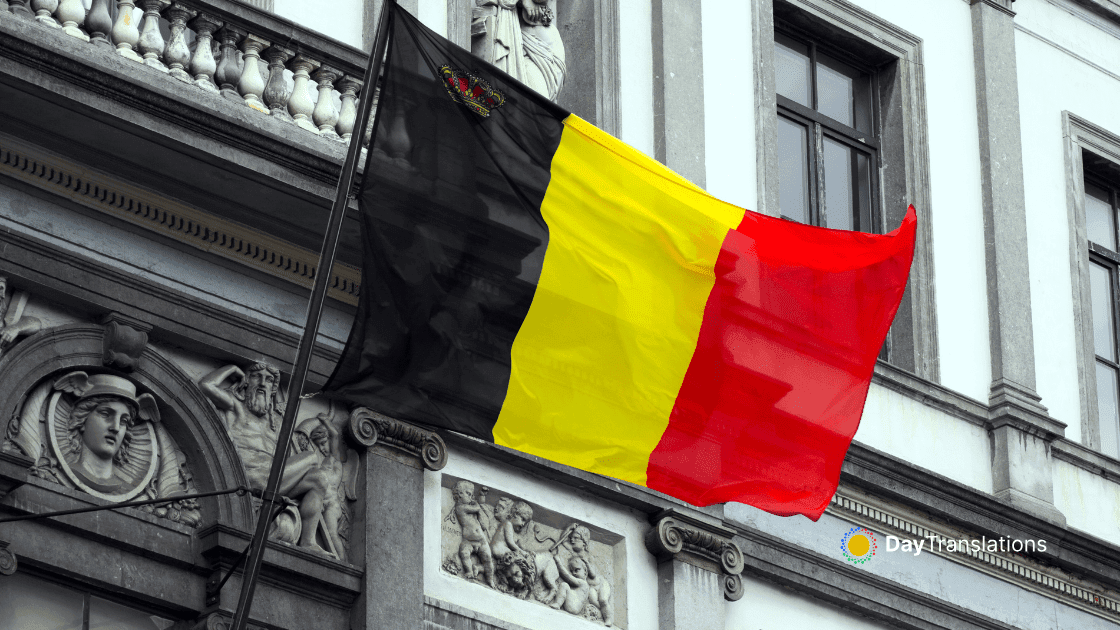
The Kingdom of Belgium is a state in Western Europe. Belgium covers an area of 30,528 square kilometers (11,787 sq mi), and it has a population of about 10.8 million people. Straddling the cultural boundary between Germanic and Latin Europe, Belgium is home to two main linguistic groups, the Dutch-speakers, mostly Flemish, and the French-speakers, mostly Walloons, plus a small group of German-speakers. Belgium’s two largest regions are the Dutch-speaking region of Flanders in the north and the French-speaking southern region of Wallonia. The Brussels-Capital Region, officially bilingual, is a mostly French-speaking enclave within the Flemish Region. A small German-speaking Community exists in eastern Wallonia. Belgium’s linguistic diversity and related political and cultural conflicts are reflected in the political history and a complex system of government.
Historically, Belgium, the Netherlands and Luxembourg were known as the Low Countries, which used to cover a somewhat larger area than the current Benelux group of states. The region was called Belgica in Latin because of the Roman province Gallia Belgica which covered more or less the same area. From the end of the Middle Ages until the 17th century, it was a prosperous centre of commerce and culture. From the 16th century until the Belgian Revolution in 1830, when Belgium seceded from the Netherlands, many battles between European powers were fought in the area of Belgium, causing it to be dubbed the battleground of Europe, a reputation strengthened by both World Wars.
Upon its independence, Belgium eagerly participated in the Industrial Revolution and, during the course of the 20th century, possessed a number of colonies in Africa. The second half of the 20th century was marked by the rise of communal conflicts between the Flemings and the Francophones fuelled by cultural differences on the one hand and an asymmetrical economic evolution of Flanders and Wallonia on the other hand. These still-active conflicts have caused far-reaching reforms of the formerly unitary Belgian state into a federal state which might lead to a partition of the country.
In this Country Profile
:: Background of Belgium ::
Belgium became independent from the Netherlands in 1830; it was occupied by Germany during World Wars I and II. The country prospered in the past half century as a modern, technologically advanced European state and member of NATO and the EU. Tensions between the Dutch-speaking Flemings of the north and the French-speaking Walloons of the south have led in recent years to constitutional amendments granting these regions formal recognition and autonomy.
:: Geography of Belgium ::
Location: Western Europe, bordering the North Sea, between France and the Netherlands
Geographic coordinates: 50 50 N, 4 00 E
Area:
total: 30,528 sq km
land: 30,278 sq km
water: 250 sq km
Area – comparative: about the size of Maryland
Land boundaries: 1,385 km
Border countries: Czech France 620 km, Germany 167 km, Luxembourg 148 km, Netherlands 450 km
Coastline: 66.5 km
Maritime claims:
territorial sea: 12 nm
contiguous zone: 24 nm
exclusive economic zone: geographic coordinates define outer limit
continental shelf: median line with neighbors
Climate: temperate; mild winters, cool summers; rainy, humid, cloudy
Terrain: flat coastal plains in northwest, central rolling hills, rugged mountains of Ardennes Forest in southeast
Elevation extremes:
lowest point: North Sea 0 m
highest point: Botrange 694 m
Natural resources: construction materials, silica sand, carbonates
Land use:
arable land: 27.42%
permanent crops: 0.69%
other: 71.89%
note: includes Luxembourg (2005)
Irrigated land: 400 sq km (2003)
Total renewable water resources: 20.8 cu km (2005)
Freshwater withdrawal (domestic/industrial/agricultural):
total: 7.44 cu km/yr (13%/85%/1%)
per capita: 714 cu m/yr (1998)
Natural hazards: flooding is a threat along rivers and in areas of reclaimed coastal land, protected from the sea by concrete dikes
Environment – current issues: the environment is exposed to intense pressures from human activities: urbanization, dense transportation network, industry, extensive animal breeding and crop cultivation; air and water pollution also have repercussions for neighboring countries; uncertainties regarding federal and regional responsibilities (now resolved) had slowed progress in tackling environmental challenges
Environment – international agreements: party to: Air Pollution, Air Pollution-Nitrogen Oxides, Air Pollution-Persistent Organic Pollutants, Air Pollution-Sulfur 85, Air Pollution-Sulfur 94, Air Pollution-Volatile Organic Compounds, Antarctic-Environmental Protocol, Antarctic-Marine Living Resources, Antarctic Seals, Antarctic Treaty, Biodiversity, Climate Change, Climate Change-Kyoto Protocol, Desertification, Endangered Species, Environmental Modification, Hazardous Wastes, Law of the Sea, Marine Dumping, Marine Life Conservation, Ozone Layer Protection, Ship Pollution, Tropical Timber 83, Tropical Timber 94, Wetlands, Whaling; signed, but not ratified: none of the selected agreements
Geography – note: crossroads of Western Europe; most West European capitals within 1,000 km of Brussels, the seat of both the European Union and NATO
:: People of Belgium ::
Population: 10,431,477 (July 2011 est.)
Age structure:
0-14 years: 15.9% (male 846,706/female 812,486)
15-64 years: 66.1% (male 3,475,404/female 3,416,060)
65 years and over: 18% (male 783,895/female 1,096,926) (2011 est.)
Median age:
total: 42.3 years
male: 41 years
female: 43.6 years (2011 est.)
Population growth rate: 0.071% (2011 est.)
Birth rate: 10.06 births/1,000 population (2011 est.)
Death rate: 10.57 deaths/1,000 population (July 2011 est.)
Net migration rate: 1.22 migrant(s)/1,000 population (2011 est.)
Urbanization:
urban population: 97% of total population (2010)
rate of urbanization: 0.4% annual rate of change (2010-15 est.)
Sex ratio:
at birth: 1.045 male(s)/female
under 15 years: 1.04 male(s)/female
15-64 years: 1.02 male(s)/female
65 years and over: 0.71 male(s)/female
total population: 0.96 male(s)/female (2011 est.)
Infant mortality rate:
total: 4.33 deaths/1,000 live births
male: 4.86 deaths/1,000 live births
female: 3.78 deaths/1,000 live births (2011 est.)
Life expectancy at birth:
total population: 79.51 years
male: 76.35 years
female: 82.81 years (2011 est.)
Total fertility rate: 1.65 children born/woman (2011 est.)
HIV/AIDS – adult prevalence rate: 0.2% (2009 est.)
HIV/AIDS – people living with HIV/AIDS: 14,000 (2009 est.)
HIV/AIDS – deaths: fewer than 100 (2009 est.)
Nationality: noun: Belgian(s) adjective: Belgian
Ethnic groups: Fleming 58%, Walloon 31%, mixed or other 11%
Religions: Roman Catholic 75%, other (includes Protestant) 25%
Languages: Dutch (official) 60%, French (official) 40%, German (official) less than 1%, legally bilingual (Dutch and French)
Literacy:
definition: age 15 and over can read and write
total population: 99%
male: 99%
female: 99%
School life expectancy (primary to tertiary education):
total: 16 years
male: 16 years
female: 16 years (2008)
Education expenditures: 6.1% of GDP (2007)
Geography of Belgium: Important Geographical Information about Belgium
In this Country Profile
The Kingdom of Belgium is a sovereign state located in Western Europe, bordering the North Sea. Belgium shares borders with France (620 km), Germany (167 km), Luxembourg (148 km) and the Netherlands (450 km). Belgium comprises the regions of Flanders, Wallonia and Brussels.
:: Belgium’s Geography and Regions ::
Belgium has three main geographical regions: the coastal plain in the north-west, the central plateau, and the Ardennes uplands in the south-east. The coastal plain consists mainly of sand dunes and polders. Polders are areas of land, close to or below sea level that have been reclaimed from the sea, from which they are protected by dikes or, further inland, by fields that have been drained with canals. The second geographical region, the central plateau, lies further inland. This is a smooth, slowly rising area that has many fertile valleys and is irrigated by many waterways. Here one can also find rougher land, including caves and small gorges. The third geographical region, called the Ardennes, is more rugged than the first two. It is a thickly forested plateau, very rocky and not very good for farming, which extends into northern France and in Germany where it is named Eifel. This is where much of Belgium’s wildlife can be found. Belgium’s highest point, the Signal de Botrange is located in this region at only 694 meters (2,277 ft). Belgium has relatively few natural lakes, and none of any great size.Notable natural regions include the Ardennes, Campine and High Fens.
All of Belgium is drained into the North Sea, except the municipality of Momignies (Macquenoise), which is drained by the Oise River into the English Channel. A total of 3 streams cross Belgium: the Scheldt (200 km in Belgium, 350 km in total), the Meuse (183 km in Belgium, 925 km in total) and the Yser (50 km in Belgium, 78 km in total). The main rivers in Belgium include the Rupel, Senne, Sambre, Lesse, Ourthe, Lys and Dijle. The main lakes include the Lake Genval, Lake Bütgenbach, Lake Eau d’Heure and Lake Robertville. Belgium has also many artificial waterways or canals, among others the Brussels-Scheldt Maritime Canal, the Brussels-Charleroi Canal, the Canal du Centre and the Albert Canal.
The Belgian climate, like most of northwest Europe, is maritime temperate, with significant precipitation in all seasons (Köppen climate classification: Cfb; the average temperature is 3 °C (37.4 °F) in January, and 18 °C (64.4 °F) in July; the average precipitation is 65 mm (2.6 in) in January, and 78 mm (3.1 in) in July). Belgium has mild winters and cool summers and is rainy, humid and cloudy.
Belgium’s highest point is the Signal de Botrange at 694 metres above the sea level. Other hills in Belgium include the Kemmelberg (159 m high) and the Koppenberg (77 m high) both known as being climbed by professional cyclist during the annual cycling road races of respectively Gent–Wevelgem and the Tour of Flanders.
Information about the Belgian Flag: Colors and Meaning of the Flag of Belgium
In this Country Profile
The national flag of Belgium contains three equal vertical bands of black (hoist side), yellow, and red; the vertical design was based on the flag of France; the colors are those of the arms of the duchy of Brabant (yellow lion with red claws and tongue on a black field).
:: Meaning of the Belgian Flag ::
On August 26, 1830, the day after the rioting at the Brussels Opera, and the start of the Belgian Revolution the flag of France was flown from the city hall of Brussels. This was hastily replaced by a tricolor of red, yellow and black horizontal stripes made at a nearby fabric store, similar to the one used during the Brabantian Revolution. As a result, article 193 of the Constitution of Belgium describes the colors of the Belgian Nation as Red, Yellow and Black instead of the order used in the official flag.
On January 23, 1831, the stripes were changed from horizontal to vertical, and October 12 saw the flag attain its modern form, with the black placed at the hoist side of the flag. It is suggested that the change was to more clearly distinguish the flag of Belgium from the flag of the Netherlands, which also has three horizontal stripes, especially important during naval battles. Some think the change to vertical was a gesture of sympathy with the French, again clearly separating them from the Dutch.
Extensive List of Languages of Belgium: Spoken and Extinct Languages
In this Country Profile
Dutch [nld] 4,620,000 in Belgium (1990 WA). West Vlaanderen, Oost Vlaanderen, Antwerpen, Limburg, Vlaams-Brabant, and bilingual part (10% to 20%) of Brussels. Alternate names: Nederlands. Dialects: Brabants, Oost-Vlaams. Classification: Indo-European, Germanic, West, Low Saxon-Low Franconian, Low Franconian
Flemish Sign Language [vgt] 6,000 (2005 M. Vermeerbergen). Alternate names: VGT. Dialects: West Flanders, East Flanders, Antwerp, Flemish Brabant, Limburg. Most similar to French Belgian Sign Language [sfb]. A variety of regional dialects developed in different deaf schools. Influence from spoken Dutch, particularly in mouthing. Classification: Deaf sign language
French [fra] 4,000,000 in Belgium (Harris 1987). Hainaut, Namur, Liège, Luxembourg, Brabant-Walloon provinces, southern hills, and bilingual part of Brussels. Lorraine in Luxembourg Province south.Alternate names: Français. Dialects: Lorraine. Classification: Indo-European, Italic, Romance, Italo-Western, Western, Gallo-Iberian, Gallo-Romance, Gallo-Rhaetian, Oïl, French
French Belgian Sign Language [sfb] Alternate names: Langue des Signes Belge Francophone, LSFB. Dialects: Most similar to Flemish Sign Language [vgt]. Major difference is in the mouthings; sometimes people can understand the other language moderately well, but others have difficulty, especially (as in television) where there is no adjustment to the language of the addressee. Regional dialects developed in different deaf schools. Classification: Deaf sign language
German, Standard [deu] 150,000 in Belgium (Hawkins 1987). Liège Province, Eupen and Sankt-Vith cantons, municipalities: Eupen, Kelmis, Lontzen, Raeren, Amel, Bnlingen, Bntchenbach, Sankt-Vith, and Burg-Reuland. Classification: Indo-European, Germanic, West, High German, German, Middle German, East Middle German
Limburgish lim] 600,000 in Belgium (2001). Hasselt, Genk, Maaseik, Voeren, Eupen. Alternate names:Limburgan, Limburgian, Limburgic, Limberger, Limburgs Plat. Classification: Indo-European, Germanic, West, High German, German, Middle German, West Middle German, Rhenisch Franconian
Luxembourgeois [ltz] 30,000 in Belgium (1998). Luxembourg Province, Arlon and Bastogne area. Alternate names:Letzburgisch. Classification: Indo-European, Germanic, West, High German, German, Middle German, West Middle German, Moselle Franconian
Picard [pcd] Most of Hainaut Province, Tournai, Mons, Ath. Alternate names: Chtimi, Rouchi. Dialects:Belgian Picard. Classification: Indo-European, Italic, Romance, Italo-Western, Western, Gallo-Iberian, Gallo-Romance, Gallo-Rhaetian, Oïl, French
Vlaams [vls] 6,000,000 in Belgium (2007 M. De Belder). Population total all countries: 6,141,560. Flanders. Also in Canada, France, Netherlands, United States. Alternate names: Flamand, Flemish. Dialects: Westvlaams, Oostvlaams, Antwerps, Limburgs, Brabants. Considered a variant of Dutch [nld]. Similar to German, English, Frisian. Classification: Indo-European, Germanic, West, Low Saxon-Low Franconian, Low Franconian
Walloon [wln] 1,120,000 (1998), decreasing. Few monolinguals. 320,000 young people (1998). 1,220,000 to 1,920,000 young people can understand it (1998). Wallonia. Central Walloon: Namur, Wavre, and Dinant; Eastern Walloon: Liège, Malmedy, Verviers, Huy, and Waremme; Western Walloon: Charleroi, Nivelles, and Philippeville; Southern Walloon: the Ardennes region, Marche, and Neufchâteau. Also spoken in Luxembourg until recently. It is or was spoken in parts of northern France, and in Green Bay, Wisconsin, USA. Alternate names: Wallon. Dialects: Central Walloon, Eastern Walloon, Western Walloon, Southern Walloon. Developed between the 8th and 12th centuries from remnants of Latin brought to the region by Roman soldiers, merchants, and settlers. Eastern subdialect considered the most difficult to understand. Classification: Indo-European, Italic, Romance, Italo-Western, Western, Gallo-Iberian, Gallo-Romance, Gallo-Rhaetian, Oïl, French
:: Reference ::
Gordon, Raymond G., Jr. (ed.), 2005. Ethnologue: Languages of the World, Fifteenth edition. Dallas, Tex.: SIL International. Online version: http://www.ethnologue.com/
Famous Belgian People: Belgian Artists, Scientists, Leaders, Musicians, Politicians and Athletes
In this Country Profile
Belgium is home to outstanding individuals who made a difference with their remarkable achievements. The following people made their mark on both the local and international scenes. They are just some of many famous Belgians who have lifted Belgium’s name worldwide and made a difference in our world. Their purpose and stories inspired awe if not greatness.
:: List of Famous People from Belgium ::
Peter Paul Rubens
Peter Paul Rubens was a prolific seventeenth-century Flemish Baroque painter, and a proponent of an extravagant Baroque style that emphasized movement, color, and sensuality. He is well-known for his Counter-Reformation altarpieces, portraits, landscapes, and history paintings of mythological and allegorical subjects. In addition to running a large studio in Antwerp that produced paintings popular with nobility and art collectors throughout Europe, Rubens was a classically educated humanist scholar, art collector, and diplomat who was knighted by both Philip IV, King of Spain, and Charles I, King of England.
Jacques Brel
Jacques Romain Georges Brel was a Belgian singer-songwriter. Brel composed and recorded his songs almost exclusively in French, although he recorded a number of songs in Dutch.
Brel’s songs are not especially well known in the English-speaking world except in translation and through the interpretations of other singers, most famously Scott Walker and Judy Collins. Others who have sung his work in English include Karen Akers, Marc Almond, Momus/Nick Currie, Beirut, Bellowhead, David Bowie, Ray Charles, John Denver, The Dresden Dolls, Gavin Friday, Alex Harvey, Terry Jacks, Barb Jungr, The Kingston Trio, Jack Lukeman, Amanda McBroom, Rod McKuen, Sensational Alex Harvey Band, Spencer Moody, Camille O’Sullivan, Dax Riggs, Nina Simone, Frank Sinatra, Dusty Springfield, Andy Williams, Sandler and Young, Nirvana, Dave Van Ronk, Shirley Horn, Brian Molko and James Dean Bradfield. In French-speaking countries, Brel is also remembered as an actor and director.
Jacques Brel has sold over 25 million records worldwide, including over 12 million albums and singles in France and Belgium.
Audrey Hepburn
Born in Ixelles, Belgium, as Audrey Kathleen Ruston, famous British actress and humanitarian Audrey Hepburn spent her childhood chiefly in the Netherlands, including German-occupied Arnhem, Netherlands, during the Second World War. She studied ballet in Arnhem and then moved to London in 1948, where she continued to train in ballet and worked as a photographer’s model. She appeared in several European films before starring in the 1951 Broadway play Gigi. Hepburn played the lead female role in Roman Holiday (1953), winning an Academy Award, a Golden Globe and a BAFTA for her performance. She also won a Tony Award for her performance in Ondine (1954). Hepburn is one of the few entertainers who have won an Oscar, Emmy, Grammy, and Tony Award. She was named to the International Best Dressed List Hall of Fame in 1961.
Hepburn became one of the most successful film actresses in the world and performed with notable leading men such as Gregory Peck, Rex Harrison, Humphrey Bogart, Gary Cooper, Cary Grant, Henry Fonda, William Holden, Burt Lancaster, Fred Astaire, James Garner, Peter O’Toole and Albert Finney. She won BAFTA Awards for her performances in The Nun’s Story (1959) and Charade (1963) and received Academy Award nominations for Sabrina (1954), The Nun’s Story (1959), Breakfast at Tiffany’s (1961) and Wait Until Dark (1967).
She starred as Eliza Doolittle in the film version of My Fair Lady (1964), becoming only the third actor to receive $1,000,000 for a film role. From 1968 to 1975 she took a break from film-making to spend more time with her two sons. In 1976, she starred with Sean Connery in Robin and Marian. In 1989, she made her last film appearance in Steven Spielberg’s Always.
Pieter Bruegel the Elder
Pieter Bruegel the Elder was a Flemish Renaissance painter and printmaker known for his landscapes and peasant scenes (Genre Painting). He is sometimes referred to as “Peasant Bruegel” to distinguish him from other members of the Brueghel dynasty, but is also the one generally meant when the context does not make clear which “Bruegel” is being referred to. From 1559 he dropped the ‘h’ from his name and started signing his paintings as Bruegel.
Jan Brueghel the Elder
Jan Brueghel the Elder was a Flemish painter, son of Pieter Bruegel the Elder and father of Jan Brueghel the Younger. Nicknamed “Velvet” Brueghel, “Flower” Brueghel, and “Paradise” Brueghel, of which the latter two were derived from his floral still lifes which were his favored subjects, while the former may refer to the velveteen sheen of his colors or to his habit of wearing velvet.
Anthony van Dyck
Anthony van Dyck was a Flemish Baroque artist who became the leading court painter in England. He is most famous for his portraits of King Charles I of England and Scotland and his family and court, painted with a relaxed elegance that was to be the dominant influence on English portrait-painting for the next 150 years. He also painted biblical and mythological subjects, displayed outstanding facility as a draftsman, and was an important innovator in watercolor and etching.
René Magritte
René Magritte was a Belgian surrealist artist. He became well known for a number of witty and thought-provoking images. His intended goal for his work was to challenge observers’ preconditioned perceptions of reality and force viewers to become hypersensitive to their surroundings.
Jean-Claude Van Damme
Jean-Claude Camille François Van Varenberg, professionally known as Jean-Claude Van Damme, is a Belgian martial artist and actor. Van Damme is best known for his martial arts action movies. His most successful films include Bloodsport (1988), Kickboxer (1989), Double Impact (1991), Universal Soldier (1992), Hard Target (1993), Timecop (1994), and JCVD (2008). Due to his physique and his Belgian background, he is known as “The Muscles from Brussels.”
After studying martial arts intensively from the age of ten, Van Damme achieved national success in Belgium as a martial artist and bodybuilder, earning the “Mr. Belgium” bodybuilding title. He emigrated to the United States in 1982 to pursue a career in film, and achieved success with Bloodsport (1988), based on a story written by Frank Dux. He attained subsequent box office success with Timecop (1994), which grossed over $100 million worldwide and became his most financially successful film.
Hergé
Georges Prosper Remi, better known by the pen name Hergé, was a Belgian comic books writer and artist. “Hergé” is the French pronunciation of “RG”, his initials reversed. His best known and most substantial work is The Adventures of Tintin comic book series, which he wrote and illustrated from 1929 until his death in 1983, leaving the twenty-fourth Tintin adventure Tintin and Alph-Art unfinished. His work remains a strong influence on comics, particularly in Europe. He was inducted into the Comic Book Hall of Fame in 2003. Hergé has become one of the most famous Belgians worldwide and Tintin is still an international success. Hergé’s work was heavily influenced by his involvement since his youth with Scouting. The long-awaited Hergé Museum was opened in Louvain-La-Neuve on 2 June 2009.
Peyo
Belgian comic books artist Pierre Culliford, also known as Peyo, was the creator of The Smurfs comic strip. The Smurfs secured their place in North American pop culture in 1981, when the Saturday-morning cartoon The Smurfs, produced by Hanna-Barbera Productions in association with SEPP International S.A., aired on NBC from 1981 to 1989. The show became a major success for NBC, spawning spin-off television specials on an almost yearly basis. The Smurfs was nominated multiple times for Daytime Emmy awards, and won Outstanding Children’s Entertainment Series in 1982–1983.