
The Republic of Costa Rica is a country in Central America, bordered by Nicaragua to the north, Panama to the east and south, the Pacific Ocean to the west and south and the Caribbean Sea to the east.
Costa Rica is the only Latin American country included in the list of the world’s 22 older democracies. Costa Rica has consistently been among the top Latin American countries in the Human Development Index, ranked 62nd in the world in 2010, and is cited by the UNDP as one of the countries that has attained much higher human development than other countries at the same income levels. The country is ranked 3rd in the world, and 1st among the Americas, in terms of the 2010 Environmental Performance Index.
With a $2.2 billion per year tourism industry, Costa Rica is the most visited nation in the Central American region, with two million foreign visitors in 2008. Since 1999, tourism earns more foreign exchange than the combined exports of the country’s three main cash crops: bananas, pineapples and coffee.
In this Country Profile
Coffee production has played a key role in Costa Rica’s history and economy and by 2006 was the third cash crop export. The largest coffee growing areas are in the provinces of San José, Alajuela, Heredia, Puntarenas, and Cartago. Costa Rica is famous for its gourmet coffee beans, with Costa Rican Tarrazú among the finest Arabica coffee beans in the world used for making espresso coffee, together with Jamaican Blue Mountain, Guatemalan Antigua and Ethiopian Sidamo.
In recent times pharmaceuticals, financial outsourcing, software development, and ecotourism have become the prime industries in Costa Rica’s economy. High levels of education among its residents make the country an attractive investing location.
Professional Spanish translation and interpreting services are crucial to any foreign companies and individuals with business interests in Costa Rica. We can gladly provide you with the finest and most accurate Spanish language translations to help you in your job or your business. We aim to have you absolutely satisfied!
:: Background of Costa Rica ::
Although explored by the Spanish early in the 16th century, initial attempts at colonizing Costa Rica proved unsuccessful due to a combination of factors, including: disease from mosquito-infested swamps, brutal heat, resistance by natives, and pirate raids. It was not until 1563 that a permanent settlement of Cartago was established in the cooler, fertile central highlands. The area remained a colony for some two and a half centuries. In 1821, Costa Rica became one of several Central American provinces that jointly declared their independence from Spain. Two years later it joined the United Provinces of Central America, but this federation disintegrated in 1838, at which time Costa Rica proclaimed its sovereignty and independence. Since the late 19th century, only two brief periods of violence have marred the country’s democratic development. In 1949, Costa Rica dissolved its armed forces. Although it still maintains a large agricultural sector, Costa Rica has expanded its economy to include strong technology and tourism industries. The standard of living is relatively high. Land ownership is widespread.
:: Geography of Costa Rica ::
Location: Central America, bordering both the Caribbean Sea and the North Pacific Ocean, between Nicaragua and Panama
Geographic coordinates: 10 00 N, 84 00 W
Area:
total: 51,100 sq km
land: 51,060 sq km
water: 40 sq km
note: includes Coconut Island (Isla del Coco)
Area – comparative: slightly smaller than West Virginia
Land boundaries: 639 km
Border countries: Nicaragua 309 km, Panama 330 km
Coastline: 1,290 km
Maritime claims:
territorial sea: 12 nm
exclusive economic zone: 200 nm
continental shelf: 200 nm
Climate: tropical and subtropical; dry season (December to April); rainy season (May to November); cooler in highlands
Terrain: coastal plains separated by rugged mountains including over 100 volcanic cones, of which several are major volcanoes
Elevation extremes:
lowest point: Pacific Ocean 0 m
highest point: Cerro Chirripo 3,810 m
Natural resources: hydropower
Land use:
arable land: 4.4%
permanent crops: 5.87%
other: 89.73% (2005)
Irrigated land: 1,080 sq km (2003)
Total renewable water resources: 112.4 cu km (2000)
Freshwater withdrawal (domestic/industrial/agricultural):
total: 2.68 cu km/yr (29%/17%/53%)
per capita: 619 cu m/yr (2000)
Natural hazards: occasional earthquakes, hurricanes along Atlantic coast; frequent flooding of lowlands at onset of rainy season and landslides; active volcanoes
volcanism: Arenal (elev. 1,670 m, 5,479 ft), which erupted in 2010, is the most active volcano in Costa Rica; a 1968 eruption destroyed the town of Tabacon; Irazu (elev. 3,432 m, 11,260 ft), situated just east of San Jose, has the potential to spew ash over the capital city as it did between 1963 and 1965; other historically active volcanoes include Miravalles, Poas, Rincon de la Vieja, and Turrialba
Environment – current issues: deforestation and land use change, largely a result of the clearing of land for cattle ranching and agriculture; soil erosion; coastal marine pollution; fisheries protection; solid waste management; air pollution
Environment – international agreements: party to: Biodiversity, Climate Change, Climate Change-Kyoto Protocol, Desertification, Endangered Species, Environmental Modification, Hazardous Wastes, Law of the Sea, Marine Dumping, Ozone Layer Protection, Wetlands, Whaling; signed, but not ratified: Marine Life Conservation
Geography – note: four volcanoes, two of them active, rise near the capital of San Jose in the center of the country; one of the volcanoes, Irazu, erupted destructively in 1963-65
:: People of Costa Rica ::
Population: 4,576,562 (July 2011 est.)
Age structure:
0-14 years: 24.6% (male 574,876/female 549,664)
15-64 years: 69.1% (male 1,588,940/female 1,571,573)
65 years and over: 6.4% (male 135,017/female 156,492) (2011 est.)
Median age:
total: 28.8 years
male: 28.4 years
female: 29.2 years (2011 est.)
Population growth rate: 1.308% (2011 est.)
Birth rate: 16.54 births/1,000 population (2011 est.)
Death rate: 4.33 deaths/1,000 population (July 2011 est.)
Net migration rate: 0.87 migrant(s)/1,000 population (2011 est.)
Urbanization:
urban population: 64% of total population (2010)
rate of urbanization: 2.1% annual rate of change (2010-15 est.)
Sex ratio:
at birth: 1.05 male(s)/female
under 15 years: 1.05 male(s)/female
15-64 years: 1.01 male(s)/female
65 years and over: 0.86 male(s)/female
total population: 1.01 male(s)/female (2011 est.)
Infant mortality rate:
total: 9.45 deaths/1,000 live births
male: 10.3 deaths/1,000 live births
female: 8.56 deaths/1,000 live births (2011 est.)
Life expectancy at birth:
total population: 77.72 years
male: 75.1 years
female: 80.46 years (2011 est.)
Total fertility rate: 1.93 children born/woman (2011 est.)
HIV/AIDS – adult prevalence rate: 0.3% (2009 est.)
HIV/AIDS – people living with HIV/AIDS: 9,800 (2009 est.)
HIV/AIDS – deaths: fewer than 500
Nationality: noun: Costa Rican(s) adjective: Costa Rican
Ethnic groups: white (including mestizo) 94%, black 3%, Amerindian 1%, Chinese 1%, other 1%
Religions: Roman Catholic 76.3%, Evangelical 13.7%, Jehovah’s Witnesses 1.3%, other Protestant 0.7%, other 4.8%, none 3.2%
Languages: Spanish (official), English
Literacy:
definition: age 15 and over can read and write
total population: 94.9%
male: 94.7%
female: 95.1% (2002 est.)
School life expectancy (primary to tertiary education):
total: 12 years
male: 12 years
female: 12 years (2005)
Education expenditures: 5% of GDP (2008)
Geography of Costa Rica: Important Geographical Information about Costa Rica
In this Country Profile
Costa Rica is located on the Central American isthmus, lying between latitudes 8° and 12° N, and longitudes 82° and 86°W. It borders the Caribbean Sea (to the east) and the Pacific Ocean (to the west), with a total of 1,290 kilometers (800 mi) of coastline, 212 km (132 mi) on the Caribbean coast and 1,016 km (631 mi) on the Pacific.
:: Costa Rica’s Geography and Regions ::
Costa Rica borders Nicaragua to the north (309 km or 192 mi of border) and Panama to the south-southeast (639 km or 397 mi of border). In total, Costa Rica comprises 51,100 square kilometers (19,700 sq mi) plus 589 square kilometers (227 sq mi) of territorial waters.
The highest point in the country is Cerro Chirripó, at 3,819 meters (12,530 ft), and is the fifth highest peak in Central America. The highest volcano in the country is the Irazú Volcano (3,431 m or 11,257 ft). The largest lake in Costa Rica is Lake Arenal.
Costa Rica also comprises several islands. Cocos Island (24 square kilometers / 9.3 square miles) stands out because of its distance from continental landmass, 300 mi (480 km) from Puntarenas, but Calero Island is the largest island of the country (151.6 square kilometers / 58.5 square miles). Over 25% of Costa Rica’s national territory is protected by SINAC (the National System of Conservation Areas), which oversees all of the country’s protected areas. Costa Rica also possesses the greatest density of species in the world.
The nation’s terrain is coastal plain separated by rugged mountains, the Cordillera Central and the Cordillera de Talamanca, which form the spine of the country and separate the Pacific and Caribbean watersheds. Costa Rica claims an exclusive economic zone of 200 nautical miles (370.4 km; 230.2 mi) and a territorial sea of 12 nautical miles (22.2 km; 13.8 mi).
The spine of the country produces many major river systems. Rivers draining into the Caribbean include Colorado, Pacuare, Parismina, Reventazon, and Sixaola; rivers draining into the Lake Nicaragua or the San Juan River (Rio San Juan), whose waters eventually drains into the Caribbean, include Sapoá, Frío, San Carlos, and Sarapiquí; rivers draining into the Pacific Ocean include Abangeres, Guacimal, Sierpe, Tempisque, and Térraba. In the eastern half of the country, the San Juan River forms the northern border with Nicaragua.
Because Costa Rica is located only about eight degrees north of the equator, the climate is tropical year round. However, this varies depending on elevation and rainfall. Therefore, it is greatly affected by the geography of Costa Rica. Costa Rica’s seasons are defined by how much it rains during a particular period. The year can be easily split into two periods, known to the residents as Verano, summer and Invierno, winter. The verano season is from December to May, and is the time of year when it is not as wet. Invierno is the period from May to November, and during this time, in many locations, it rains constantly. The location that receives the most rain is the Caribbean (northeast) slopes of the Central Cordillera mountains, with an annual rainfall of over 5,000 mm (196.9 in). Humidity is also higher on the Caribbean side than on the Pacific side. The main annual temperature on the coastal lowlands is around 27 °C (81 °F), 21 °C (70 °F) in the main populated areas of the Central Cordillera, and below 10 °C (50 °F) on the summits of the highest mountains.
Information about the Costa Rican Flag: Colors and Meaning of the Flag of Costa Rica
In this Country Profile
:: Meaning of the Costa Rican Flag ::
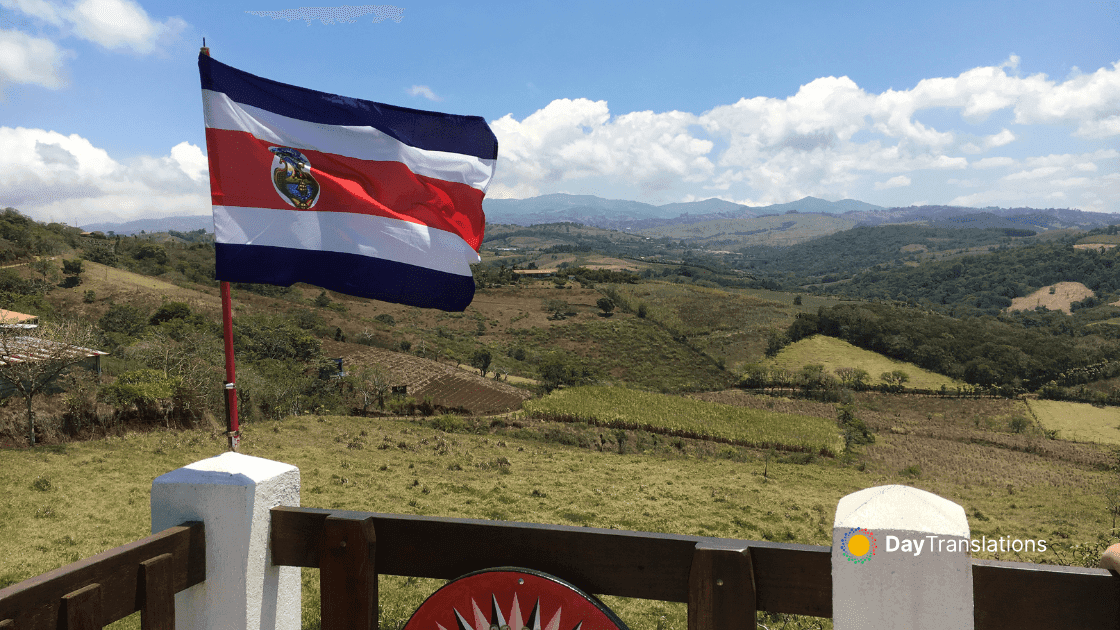
The national flag of Costa Rica contains five horizontal bands of blue (top), white, red (double width), white, and blue, with the coat of arms in a white elliptical disk toward the hoist side of the red band; Costa Rica retained the earlier blue-white-blue flag of Central America until 1848 when, in response to revolutionary activity in Europe, it was decided to incorporate the French colors into the national flag and a central red stripe was added.
Note: Somewhat resembles the flag of North Korea; similar to the flag of Thailand but with the blue and red colors reversed.
The blue color is said to stand for the sky, opportunity, and perseverance, white denotes peace, happiness, and wisdom, while red represents the blood shed for freedom, as well as the generosity and vibrancy of the people.
Extensive List of Languages of Costa Rica: Spoken and Extinct Languages
In this Country Profile
:: Languages of Costa Rica (Europe) ::
Boruca [brn] 5 (1986 SIL). 30 to 35 nonfluent speakers. Ethnic population: 1,000 (1991). South coast between Playa Bonita and Golfito. Alternate names: Borunca, Brunca, Brunka, Burunca. Classification: Chibchan, Talamanca Nearly extinct.
Bribri [bzd] 11,000 (2002). Ethnic population: 12,172 (2000). South, Limón Province, Canton of Talamanca, along Lari, Telire, Uren rivers; Puntarenas Province, Canton of Buenos Aires.Alternate names: Talamanca. Dialects: Salitre-Cabagra, Amubre-Katsi, Coroma. Most similar to, but unintelligible with Cabécar [cjp], Maleku Jaika [gut], and Teribe [tfr]. At least 3 major dialects which are inherently mutually intelligible. Classification: Chibchan, Talamanca
Cabécar [cjp] 8,840 (2000). 7,072 monolinguals (80%). Ethnic population: 9,308 (2000). Turrialba region.Alternate names: Chirripó. Dialects: Chirripó, Telire, Estrella, Ujarrás. Classification: Chibchan, Talamanca
Costa Rican Sign Language [csr] Dialects: May be related to Providencia Sign Language [prz]. Lexical similarity: 60% with ASL [ase]. Classification: Deaf sign language
Limón Creole English [jam] 55,100 in Costa Rica (1986). East of San José, principally along the railroad between Siquirres and Limón, south of Limón along the road. Alternate names: Southwestern Caribbean Creole English. Classification: Creole, English based, Atlantic, Western
Maléku Jaíka [gut] 750 (2000). Ethnic population: 1,074 (2000). Northern. Alternate names: Guatuso. Classification: Chibchan, Rama
Ngäbere [gym] 5,090 in Costa Rica (2000). Ethnic population: 5,360 (2000). Alternate names: Guaymí. Classification: Chibchan, Guaymi
Plautdietsch [pdt] 100 in Costa Rica (Minnich 1974). Sarapiqui area. Alternate names: Low German, Mennonite German. Classification: Indo-European, Germanic, West, Low Saxon-Low Franconian, Low Saxon
Spanish [spa] 3,300,000 in Costa Rica (1995). Alternate names: Castellano, Español. Classification:Indo-European, Italic, Romance, Italo-Western, Western, Gallo-Iberian, Ibero-Romance, West Iberian, Castilian
Teribe [tfr] 5 in Costa Rica (1991 SIL). Ethnic population: 35 to 300 in Costa Rica (1991 SIL). Southeast, north coast. Alternate names: Terraba. Classification: Chibchan, Talamanca
:: Reference ::
Gordon, Raymond G., Jr. (ed.), 2005. Ethnologue: Languages of the World, Fifteenth edition. Dallas, Tex.: SIL International. Online version: http://www.ethnologue.com/
Famous Costa Rican People: Costa Rican Artists, Scientists, Leaders, Musicians, Politicians and Athletes
In this Country Profile
Costa Rica is a melting pot of cultures and ethnicities with outstanding individuals who made a difference with their remarkable achievements. The following people made their mark on both the local and international scenes. They are just some of many famous Costa Ricans who have lifted Costa Rica’s name worldwide and made a difference in our world. Their purpose and stories inspired awe if not greatness.
:: List of Famous People from Costa Rica ::
Francisco Amighetti
Francisco Amighetti was a prominent Costa Rican painter influenced by Mexican, US and European art as well as Japanese prints. In addition to his paintings, Amighetti also produced wood engravings, poetry and works of art criticism. He based his artwork on basic lifestyle in Costa Rica.
Juan Santamaría
Juan Santamaría is officially recognized as the national hero of the Republic of Costa Rica. A national holiday in Costa Rica, Juan Santamaría Day, is held every April 11 to commemorate his death. When U.S. filibuster William Walker overthrew the government of Nicaragua and attempted to conquer the other nations in Central America, including Costa Rica, in order to form a private slave-holding empire, Costa Rican president Juan Rafael Mora Porras called upon the general population to take up arms and march north to Nicaragua to fight against the foreign invader. Santamaría, a poor laborer and the illegitimate son of a single mother joined the army as a drummer boy. The troops nicknamed him “el erizo” (“the Porcupine”) on account of his bald head. After routing a small contingent of Walker’s soldiers at Santa Rosa, Guanacaste, the Costa Rican troops continued marching north and reached the city of Rivas, Nicaragua, on April 8, 1856. The battle that ensued is known as the Second Battle of Rivas. Combat was fierce and the Costa Ricans were not able to drive Walker’s men out of a hostel near the town center from which they commanded an advantageous firing position. According to the traditional account, on April 11, General José María Cañas (Salvadoran) suggested that one of the soldiers advance towards the hostel with a torch and set it on fire. Some soldiers tried and failed, but finally Santamaría volunteered on the condition that, in the event of his death, someone would look after his mother. He then advanced and was mortally wounded by enemy fire. Before expiring he succeeded, however, in setting fire to the hostel, thus contributing decisively to the Costa Rican victory at Rivas.
José María Castro Madriz
José María Castro Madriz was a Costa Rican lawyer, academic, diplomat, and politician. He served twice as President of Costa Rica, from 1847 to 1849, and from 1866 to 1868. On both occasions he was prevented from completing his term of office by military coups. During his first administration, on 31 August 1848, he formally declared Costa Rica an independent republic, definitively severing Costa Rica’s ties to the moribund Federal Republic of Central America. He also established the actual Costa Rican flag.
Franklin Chang Díaz
Franklin Ramón Chang Díaz is a Costa Rican-American engineer, physicist and former NASA astronaut. He is currently President and CEO of Ad Astra Rocket Company. He is a veteran of seven Space Shuttle missions, making him the record holder as of 2008 for the most spaceflights (a record he shares with Jerry L. Ross). He was one of the first Hispanic or Latino Americans to go into space, and is the first naturalized US citizen to become an astronaut.
Claudia Poll
Claudia María Poll Ahrens is an Costa Rican Olympic gold-medalist and National Record holding swimming from Costa Rica. To date, she is Costa Rica’s only gold-medalist, having won the country first gold (and second) Olympic medal at the 1996 Olympics in the 200 free. Her sister, Silvia, won Costa Rica’s first Olympic medal at the 1988 Games. Also as of 2009, Claudia and Silvia are the only Costa Ricans to have won a medal at an Olympics. Claudia also competed at the 2000 Olympics, where she won 2 bronze medals. Moreover, she was the first to win a gold medal in the whole Central America, an event which later occurred again in the 2008 Olympic Games when Panama won a gold medal.
Óscar Arias
Óscar Rafael de Jesús Arias Sánchez is a Costa Rican politician who was President of Costa Rica from 2006 to 2010. He previously served as President from 1986 to 1990 and received the Nobel Peace Prize in 1987 for his efforts to end civil wars then raging in several other Central American countries. He is also a recipient of the Albert Schweitzer Prize for Humanitarianism and a trustee of Economists for Peace and Security. In 2003, he was elected to the Board of Directors of the International Criminal Court’s Trust Fund for Victims. He is a member of Collegium International, an organization of leaders with political, scientific, and ethical expertise whose goal is to provide new approaches in overcoming the obstacles in the way of a peaceful, socially just and economically sustainable world.
Famous People from Costa Rica: Famous Costa Rican Footballers/Soccer Players
In this Country Profile
The following Costa Rican athletes dedicated themselves in promoting and inspiring people about football, one of the most well-loved sports in the world.
Rolando Fonseca
Costa Rican striker Rolando Fonseca Jiménez currently plays for Comunicaciones of the Guatemalan National League. He is regarded as one of Costa Rica’s most talented players of all time. Nicknamed El Principito (The little prince) and “El Rolo”, Fonseca usually plays just off the main striker and is renowned for his ability to create opportunities for his teammates and his fierce long shot.
Paulo César Wanchop
Pablo César Wanchope Watson, better known as Paulo Wanchope, is a Costa Rican former professional footballer. As of February 2009, Wanchope is the second most prolific goalscorer in the history of the national football team, behind Rolando Fonseca, with 45 goals in 73 international matches.
Rónald Gómez
An important player on the Costa Rican national team, Rónald Gómez played for his country at the 2002 World Cup, scoring two goals. He received 91 caps and scored 24 times for the national side. He is one of Costa Rica’s best forwards known for his rocket shots and top dribbling.
Christian Bolaños
Christian Bolaños Navarro is a Costa Rican footballer who currently plays as a winger for Danish Superliga side F.C. Copenhagen and the Costa Rican national team. When he was playing for Deportivo Saprissa in Costa Rica, Bolaños participated in the 2005 FIFA Club World Championship Toyota Cup with his team, and was awarded by FIFA as the third best player of the tournament. Following this success he was invited to attend a ten day trial with Liverpool, although he was not signed on a permanent basis.
Álvaro Saborío
Álvaro Alberto Saborío Chacón is a Costa Rican footballer, who currently plays forReal Salt Lake in Major League Soccer. He is also an important player for the Costa Rica national football team at numerous levels. Saborío, better known as “Pipe”, has been notably recognized for his accomplishments with Deportivo Saprissa, and the high amount of goals he has scored in a short period. But after a year at the club his Costa Rican Coach got a hold of him and he took part in the 2006 FIFA World Cup. He was mostly a substitute for Costa Rica national football team, behind Rónald Gómez and former Man City forward Paulo César Wanchope.