
The Republic of Croatia is a country in Southeastern Europe at the crossroads of the Pannonian Plain, the Balkans, and the Adriatic Sea. Its capital and largest city is Zagreb. Croatia borders Slovenia to the north, Italy to the west, Hungary to the northeast, Bosnia and Herzegovina to the southeast, Serbia to the east, and Montenegro to the southeast.
The Croats arrived in the early 7th century in what today is Croatia. They organized the state into two dukedoms. The first king, King Tomislav was crowned in AD 925 and Croatia was elevated into the status of a kingdom. The Kingdom of Croatia retained its sovereignty for almost two centuries, reaching its peak during the rule of Kings Peter Krešimir IV and Demetrius Zvonimir. Croatia entered a union with Hungary in 1102. In 1527, the Croatian Parliament elected Ferdinand from the House of Habsburg to the Croatian throne. In 1918, Croatia was included in the short-lived State of Slovenes, Croats, and Serbs that declared independence from Austria–Hungary and co-founded the Kingdom of Yugoslavia. An independent Croatian state briefly existed during World War II. After World War II, Croatia became a founding member of the Second Yugoslavia.
On 25 June 1991, Croatia declared independence and became a sovereign state.
Croatia is classified as an emerging and developing economy by the International Monetary Fund and a high income economy by the World Bank.
In this Country Profile
:: Background of Croatia ::
The lands that today comprise Croatia were part of the Austro-Hungarian Empire until the close of World War I. In 1918, the Croats, Serbs, and Slovenes formed a kingdom known after 1929 as Yugoslavia. Following World War II, Yugoslavia became a federal independent Communist state under the strong hand of Marshal TITO. Although Croatia declared its independence from Yugoslavia in 1991, it took four years of sporadic, but often bitter, fighting before occupying Serb armies were mostly cleared from Croatian lands. Under UN supervision, the last Serb-held enclave in eastern Slavonia was returned to Croatia in 1998. In April 2009, Croatia joined NATO; it is a candidate for eventual EU accession.
:: Geography of Croatia ::
Location: Southeastern Europe, bordering the Adriatic Sea, between Bosnia and Herzegovina and Slovenia
Geographic coordinates: 45 10 N, 15 30 E
Area:
total: 56,594 sq km
land: 55,974 sq km
water: 620 sq km
Area – comparative: slightly smaller than West Virginia
Land boundaries: 1,982 km
Border countries: Bosnia and Herzegovina 932 km, Hungary 329 km, Serbia 241 km, Montenegro 25 km, Slovenia 455 km
Coastline: 5,835 km (mainland 1,777 km, islands 4,058 km)
Maritime claims:
territorial sea: 12 nm
continental shelf: 200 m depth or to the depth of exploitation
Climate: Mediterranean and continental; continental climate predominant with hot summers and cold winters; mild winters, dry summers along coast
Terrain: geographically diverse; flat plains along Hungarian border, low mountains and highlands near Adriatic coastline and islands
Elevation extremes:
lowest point: Adriatic Sea 0 m
highest point: Dinara 1,831 m
Natural resources: oil, some coal, bauxite, low-grade iron ore, calcium, gypsum, natural asphalt, silica, mica, clays, salt, hydropower
Land use:
arable land: 25.82%
permanent crops: 2.19%
other: 71.99% (2005)
Irrigated land: 110 sq km (2003)
Total renewable water resources: 105.5 cu km (1998)
Natural hazards: destructive earthquakes
Environment – current issues: air pollution (from metallurgical plants) and resulting acid rain is damaging the forests; coastal pollution from industrial and domestic waste; landmine removal and reconstruction of infrastructure consequent to 1992-95 civil strife
Environment – international agreements: party to: Air Pollution, Air Pollution-Nitrogen Oxides, Air Pollution-Persistent Organic Pollutants, Air Pollution-Sulfur 94, Air Pollution-Volatile Organic Compounds, Biodiversity, Climate Change, Climate Change-Kyoto Protocol, Desertification, Endangered Species, Hazardous Wastes, Law of the Sea, Marine Dumping, Ozone Layer Protection, Ship Pollution, Wetlands, Whaling; signed, but not ratified: none of the selected agreements
Geography – note: controls most land routes from Western Europe to Aegean Sea and Turkish Straits; most Adriatic Sea islands lie off the coast of Croatia – some 1,200 islands, islets, ridges, and rocks
:: People of Croatia ::
Population: 4,483,804 (July 2011 est.)
Age structure:
0-14 years: 15.1% (male 346,553/female 328,677)
15-64 years: 68.1% (male 1,516,884/female 1,536,065)
65 years and over: 16.9% (male 296,268/female 459,357) (2011 est.)
Median age:
total: 41.4 years
male: 39.5 years
female: 43.3 years (2011 est.)
Population growth rate: -0.076% (2011 est.)
Birth rate: 9.6 births/1,000 population (2011 est.)
Death rate: 11.91 deaths/1,000 population (July 2011 est.)
Net migration rate: 1.55 migrant(s)/1,000 population (2011 est.)
Urbanization:
urban population: 58% of total population (2010)
rate of urbanization: 0.4% annual rate of change (2010-15 est.)
Sex ratio:
at birth: 1.055 male(s)/female
under 15 years: 1.06 male(s)/female
15-64 years: 0.99 male(s)/female
65 years and over: 0.64 male(s)/female
total population: 0.93 male(s)/female (2011 est.)
Infant mortality rate:
total: 6.16 deaths/1,000 live births
male: 6.24 deaths/1,000 live births
female: 6.08 deaths/1,000 live births (2011 est.)
Life expectancy at birth:
total population: 75.79 years
male: 72.17 years
female: 79.6 years (2011 est.)
Total fertility rate: 1.43 children born/woman (2011 est.)
HIV/AIDS – adult prevalence rate: less than 0.1% (2009 est.)
HIV/AIDS – people living with HIV/AIDS: fewer than 1,000 (2009 est.)
HIV/AIDS – deaths: fewer than 100
Nationality: noun: Croatian(s) adjective: Croatian
Ethnic groups: Croat 89.6%, Serb 4.5%, other 5.9% (including Bosniak, Hungarian, Slovene, Czech, and Roma) (2001 census)
Religions: Roman Catholic 87.8%, Orthodox 4.4%, other Christian 0.4%, Muslim 1.3%, other and unspecified 0.9%, none 5.2% (2001 census)
Languages: Croatian (official) 96.1%, Serbian 1%, other and undesignated 2.9% (including Italian, Hungarian, Czech, Slovak, and German) (2001 census)
Literacy:
definition: age 15 and over can read and write
total population: 98.1%
male: 99.3%
female: 97.1% (2001 census)
School life expectancy (primary to tertiary education):
total: 14 years
male: 13 years
female: 14 years (2008)
Education expenditures: 3.9% of GDP (2004)
Geography of Croatia: Important Geographical Information about Croatia
In this Country Profile
Croatia is located in Southeastern Europe (aka the western Balkans) between Bosnia and Herzegovina and Slovenia.
Croatia borders the Adriatic Sea along its 5,835 km coastline. Its size is comparable to that of West Virginia or Nova Scotia. Croatia has a 932 km border with Bosnia and Herzegovina, a 670 km border with Slovenia, a 329 km border with Hungary, a 241 km border with Serbia (its Autonomous Province of Vojvodina entirely) and a 25 km border with Montenegro. Islands and coastal areas in Croatia have a Mediterranean climate while inland areas have temperate continental climate with hot summers with low overall humidity levels but frequent rain showers and cold snowy winters. The local terrain is quite diverse given the size of the country. There are flat plains along the Hungarian border, low mountains and highlands near the Adriatic coastline and islands. Croatia’s strategic location gives it control over most land routes from Western Europe to the Aegean Sea and the Turkish Straits. The country’s natural resources include petroleum, some coal, bauxite, low-grade iron ore, calcium, natural asphalt, silica, mica, clays, salt and hydropower.
Information about the Croatian Flag: Colors and Meaning of the Flag of Croatia
In this Country Profile
:: Meaning of the Croatian Flag ::
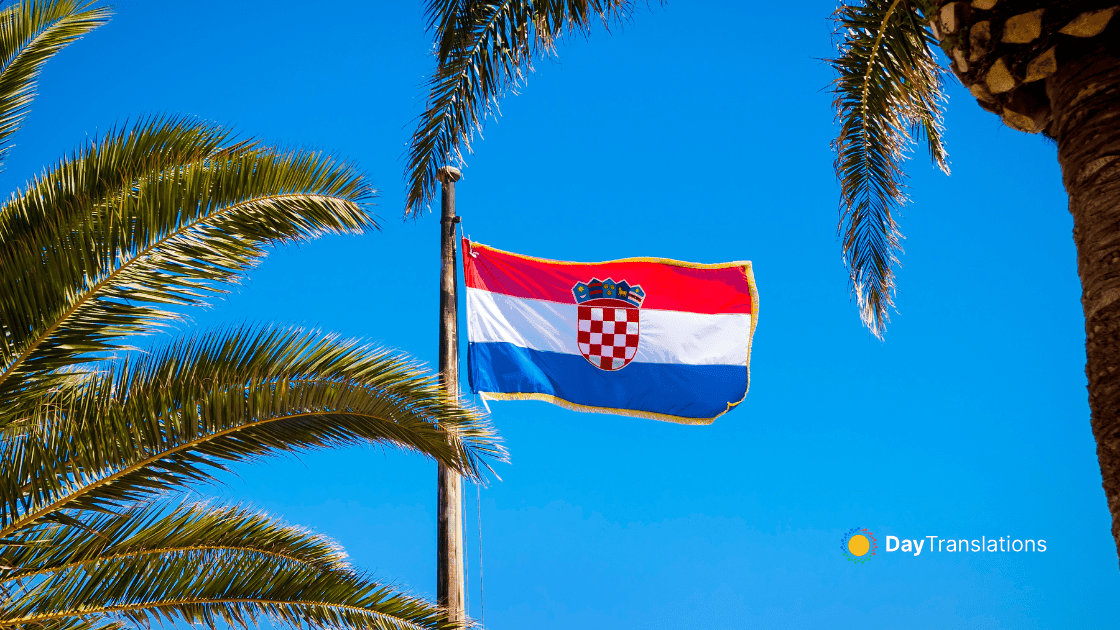
The national flag of Croatia contains three equal horizontal bands of red (top), white, and blue – the Pan-Slav colors – superimposed by the Croatian coat of arms; the coat of arms consists of one main shield (a checkerboard of 13 red and 12 silver (white) fields) surmounted by five smaller shields that form a crown over the main shield; the five small shields represent five historic regions, they are (from left to right): Croatia, Dubrovnik, Dalmatia, Istria, and Slavonia.
Note: The Pan-Slav colors were inspired by the 19th-century flag of Russia.
Extensive List of Languages of Croatia: Spoken and Extinct Languages
In this Country Profile
:: List of Languages ::
Bosnian [bos] 20,800 in Croatia (2001 census). Dialects: Ijekavían, Ikavian. Classification: Indo-European, Slavic, South, Western
Croatia Sign Language [csq] Classification: Deaf sign language
Croatian [hrv] 3,980,000 in Croatia (2001 census). Population total all countries: 5,546,590. Also in Austria, Bosnia and Herzegovina, Canada, Chile, Czech Republic, Germany, Hungary, Italy, Montenegro, Serbia, Slovakia, Slovenia, United States. Alternate names: Hrvatski. Dialects: Kaykavski, Chakavski, Shtokavski (Ijekavski). Shtokavski official dialect, but others recognized as valid dialects, with much literature. Chakavski in western and northern Croatia, Dalmatian coast, and Adriatic Islands; Kaykavski in northeastern Croatia and Zagreb; dialects in other countries, like Burgenland Croatian in Austria, less intelligible. Classification: Indo-European, Slavic, South, Western
Istriot [ist] 1,000 (2000 T. Salminen). Istrian Peninsula west coast, Rovinj (Rovigno) and Vodnjan (Dignano) towns. Dialects: Reportedly an archaic Romance language, often confused with Istro-Rumanian. Perhaps more similar to Friulian or Dalmatian than to Istro-Rumanian. Classification:Indo-European, Italic, Romance, Italo-Western, Italo-Dalmatian
Italian [ita] 19,600 in Croatia (2001 census). Ethnic population: 30,000 (1998). Istria, Iatarska County.Classification: Indo-European, Italic, Romance, Italo-Western, Italo-Dalmatian
Romanian, Istro [ruo] 560 (1994). Northeast Istrian Peninsula, Zejane village, some villages south. Alternate names: Istro-Romanian. Dialects: Structurally a separate language from Romanian [ron] (1984 F. Agard). Split from the other 3 Romanian languages between 500 and 1000 A.D. Different from Istriot [ist]. Classification: Indo-European, Italic, Romance, Eastern
Venetian [vec] 50,000 in Croatia (1994 T. Salminen). Istrian Peninsula and Dalmatia. Dialects: Istrian, Tretine, Venetian Proper. Classification: Indo-European, Italic, Romance, Italo-Western, Western, Gallo-Iberian, Gallo-Romance, Gallo-Italian
:: Reference ::
Gordon, Raymond G., Jr. (ed.), 2005. Ethnologue: Languages of the World, Fifteenth edition. Dallas, Tex.: SIL International. Online version: http://www.ethnologue.com/
Famous Croatian People: Croatian Artists, Scientists, Leaders, Musicians, Politicians and Athletes
In this Country Profile
Croatia is a melting pot of cultures and ethnicities with outstanding individuals who made a difference with their remarkable achievements.The following people made their mark on both the local and international scenes. They are just some of many famous Croatians who have lifted Croatia’s name worldwide and made a difference in our world. Their purpose and stories inspired awe if not greatness.
:: List of Famous People from Croatia ::
Savka Dabcevic-Kucar
Croatian socialist politician Savka Dabcevic-Kucar became Europe’s first female Prime Minister. She was one of the most influential Croatian female politicians during the communist period, especially during the Croatian Spring when she was deposed. She returned to politics during the early days of Croatian independence as the leader of the Coalition of People’s Accord and the Croatian People’s Party.
Rudolph Steiner
Philospher and social thinker Rudolf Joseph Lorenz Steiner was born in Donji Kraljevec, Croatia, then Kingdom of Hungary, Austrian Empire. He gained initial recognition as a literary critic and cultural philosopher. At the beginning of the 20th century, he founded a spiritual movement, Anthroposophy, as an esoteric philosophy growing out of European transcendentalism and with links to Theosophy. Steiner advocated a form of ethical individualism, to which he later brought a more explicitly spiritual component. He based his epistemology on Johann Wolfgang Goethe’s world view, in which “Thinking … is no more and no less an organ of perception than the eye or ear. Just as the eye perceives colors and the ear sounds, so thinking perceives ideas.” A consistent thread that runs from his earliest philosophical phase through his later spiritual orientation is the goal of demonstrating that there are no essential limits to human knowledge.
Bela Cikoš Sesija
Bela Cikoš Sesija was a Croatian painter of historical and allegorical scenes at the turn of the 20th century. He was one of the founders of the Academy of Fine Arts in Zagreb, as well as one of the first representatives of symbolism (Secession/Art Nouveau) in Croatia.
Mia Corak Slavenska
Mia Corak Slavenska was a Croatian-born American prima ballerina. She formed the Slavenska Ballette Variante and, later, the Theatre Ballette. In 1954, she became the prima ballerina of the Metropolitan Opera Ballet.
Mira Furlan
Mira Furlan is a Croatian actress and singer currently residing in the United States. She is well known for her roles as the Minbari Ambassador Delenn on all five seasons of the science fiction television series Babylon 5 (aired 1993 – 1998), and Danielle Rousseau on Lost.
Krsto Papic
Krsto Papic is a Croatian screenwriter and film director whose career spans several decades. Papic’s early feature films and documentaries were part of Croatian and Yugoslav New Cinema, and often regarded as Croatian echo of the Serbian Black Wave, while Papic himself was connected to the Croatian Spring. Papic’s subsequent feature films were more classical in its narration, but again politically controversial in the last decade of Yugoslavia. Particularly My Uncle’s Legacy, critical picture of Yugoslavia’s political situation under Titoism during Informbiro period, which won nomination for Golden Globe in 1989, has been surrounded by controversy and political attacks from traditional Party circles and especially Partisan Veterans’ organizations. Papic was awarded with Croatia’s highest Vladimir Nazor Award for live achievement in cinema in 2006, and with Grand Prix Special des Amériques at the Montreal Film Festival in 2004.
Zvonimir Rogoz
A native of Zagreb, Croatian actor Zvonimir Rogoz became famous in Czechoslovakia between the two world wars. He appeared in many Czechoslovakian films of the 1930s, but the best known of them all was the 1933 erotic drama Ecstasy, featuring Hedy Lamarr, who shocked the public by appearing nude. From 1950s onwards, Rogoz appeared in Croatian films, but the younger generations of Croatia remember him best for his private life: he fathered a child at the age of 96. This and other events became the subject of his autobiographical book Mojih prvih 100 godina (My First 100 Years).
He died in Zagreb a few months after his 100th birthday.
Branko Lustig
Branko Lustig is a prominent Croatian film producer. He is the only Croatian person to have won two Academy Awards. Lustig received his first Oscar in 1993 for the production of Schindler’s List, a film based on the novel of Thomas Keneally (which is, in turn, based on the true-life story of a German manufacturer who saved hundreds of Jews during World War II). He received his second Oscar for the epic movie Gladiator about a struggle for power in Imperial Rome, in 2001. Other major Hollywood films that Lustig has worked on as a producer or executive producer include The Peacemaker (1997), Hannibal (2001), and Black Hawk Down (2001).
Nikola Tesla
Nikola Tesla was an inventor, mechanical engineer, and electrical engineer. He was an important contributor to the birth of commercial electricity, and is best known for his many revolutionary developments in the field of electromagnetism in the late 19th and early 20th centuries. Tesla’s patents and theoretical work formed the basis of modern alternating current (AC) electric power systems, including the polyphase system of electrical distribution and the AC motor. This work helped usher in the Second Industrial Revolution.
Juan Vucetich
Juan Vucetich was a Croatian-born Argentine anthropologist and police official who pioneered the use of fingerprinting. Vucetich was born as Ivan Vucetic at Hvar in Dalmatia – then Habsburg Monarchy, now Croatia – and immigrated to Argentina in 1882. In 1891 Vucetich began the first filing of fingerprints based on ideas of Francis Galton which he expanded significantly. He became the director of the Center for Dactyloscopy in Buenos Aires. At the time, he included the Bertillon system alongside the fingerprint files. In 1892 Vucetich made the first positive identification of a criminal in a case where Francisca Rojas had killed her two sons and then cut her throat, trying to put the blame on the outside attacker. A bloody print identified her as the killer. Argentine police adopted Vucetich’s method of fingerprinting classification and it spread to police forces all over the world. Vucetich improved his method with new material and in 1904 published Dactiloscopía Comparada (“Comparative Dactyloscopy”)
Famous People from Croatia: Famous Croatian Footballers/Soccer Players
In this Country Profile
The following Croatian athletes dedicated themselves in promoting and inspiring people about football, one of the most well-loved sports in the world.
Davor Šuker
Retired Croatian footballer Davor Šuker is best known for his goal scoring ability, which has earned him a spot in FIFA top 100 greatest players. He played as a striker for a number of European clubs as well as the Croatian national team, where he is the all-time top goal scorer with 45 goals. The crowning moment of Šuker’s career was the 1998 World Cup in France, where he became the top goal scorer and won the Golden Boot by scoring 6 goals in 7 matches and also won Silver Ball 1998 at France as second best player of tournament (behind Ronaldo). His goal-scoring prowess proved instrumental as the Croatians surprisingly took third place, upsetting a strong Netherlands side, in their debut World Cup as an independent country. Croatia did not lose a single match in which Šuker scored prior to the semifinal loss to eventual champions France. Named as Croatia’s Golden Player for the UEFA 2003 Jubilee anniversary, he is also on the FIFA 100 list of the top 125 greatest footballers being the only Croatian on the list. He was the first Croatian to be named in the Team of the Tournament of an international tournament.
Robert Prosinecki
Former Croatian football midfielder Robert Prosinecki is regarded by many as the player with best technique that ever played in and for Croatia. Former national squad teammate Zvonimir Boban, humbly, also agreed with this. His dribbling is considered excellent, and his ability to keep possession of the ball is very highly regarded. He is one of the few footballers to have played for both the Spanish rival clubs FC Barcelona and Real Madrid. After retiring from active football he worked as assistant manager of the Croatia national football team between 2006 and 2010, before being appointed manager of the Red Star Belgrade football club in December 2010.
Zvonimir Boban
Zvonimir Boban is a Croatian former football midfielder who played most of his professional career for Serie A club Milan and was a member of the Croatia national team, which he captained to third place at the 1998 FIFA World Cup. He was a playmaker well known for his passing range and vision. Croatia never lost a match when he scored.
Dario Šimic
Dario Šimic was a versatile defender who played as full-back, sweeper or centre back. A product of Dinamo Zagreb’s academy, he later played for Serie A sides Internazionale and AC Milan as well as Ligue 1 side Monaco, before returning to Dinamo Zagreb in 2010, where he retired from the game during the same year. He is currently the Croatian national football team’s most capped player, having won a total of 100 international caps between 1996 and 2008. He was member of Croatia’s squad in all six major tournaments they qualified for during the 1990s and 2000s, which includes three FIFA World Cups (11 appearances in 1998, 2002 and 2006) and three UEFA European Championships (5 appearances in 1996, 2004 and 2008).
Igor Tudor
Igor Tudor is a Croatian former football defender. He was considered one of Croatia’s best defenders in the period between the late 1990s and mid-2000s. Tudor announced his retirement on 22 July 2008, at the mere age of 30, after the problems with his right ankle reappeared. He spent his last season playing for his youth club, Hajduk Split.