
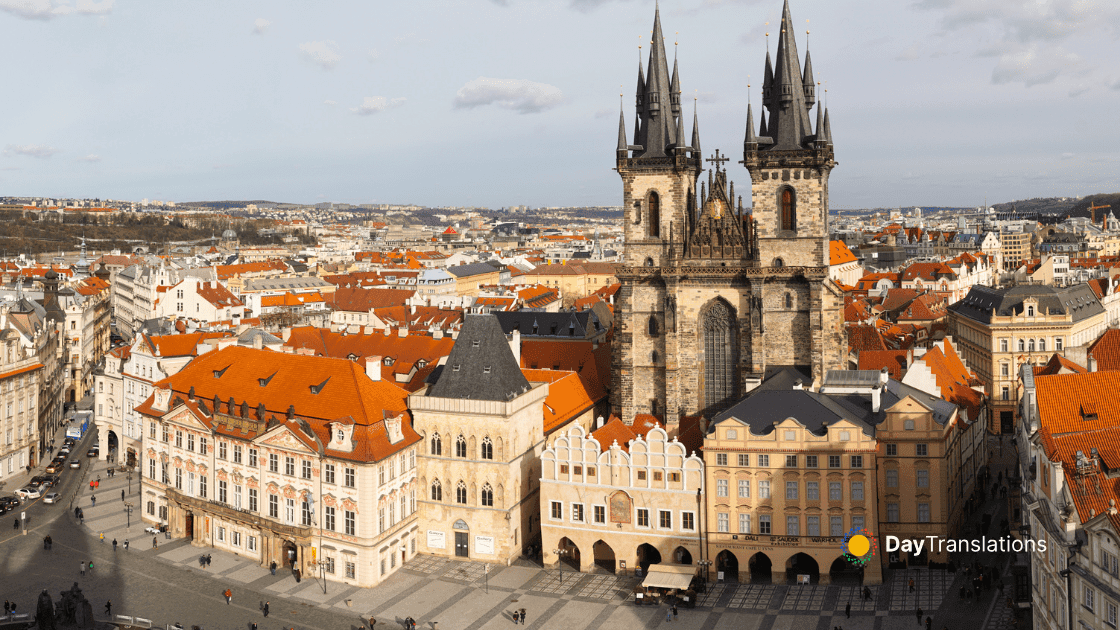
The Czech Republic is a landlocked country in Central Europe. The country borders Poland to the northeast, Germany to the west and northwest, Austria to the south and Slovakia to the east.
The Czech Republic has been a member of NATO since 1999 and of the European Union since 2004. The Czech Republic is also a member of the Organization for Security and Cooperation in Europe (OSCE). As an OSCE participating State, the Czech Republic’s international commitments are subject to monitoring under the mandate of the U.S. Helsinki Commission.
The Czech state, or Lands of the Bohemian Crown as it was known until 1918, was formed in the late 9th century. The country reached its greatest territorial extent during the 13th and 14th century, under the rule of the Premyslid and Luxembourg dynasties. Following the Battle of Mohács in 1526, the Kingdom of Bohemia was integrated into the Habsburg monarchy as one of its three principal parts alongside Austria and Hungary. The independent Republic of Czechoslovakia was formed in 1918, following the collapse of the Austro-Hungarian Empire after World War I. After the Munich Agreement (signed by Nazi Germany, France, Britain and Italy), Polish annexation of Zaolzie and German occupation of Czechoslovakia and the consequent disillusion with the Western response and gratitude for the liberation of the major portion of Czechoslovakia by the Red Army, the Communist party won plurality (38%) in the 1946 elections.
In a 1948 coup d’état, Czechoslovakia became a communist-ruled state. In 1968, the increasing dissatisfaction culminated in attempts to reform the communist regime. The events, known as the Prague Spring of 1968, ended with an invasion by the armies of the Warsaw Pact countries (with the exception of Romania); the troops remained in the country until the 1989 Velvet Revolution, when the communist regime collapsed. On 1 January 1993, Czechoslovakia peacefully dissolved into its constituent states, the Czech Republic and Slovakia.
In this Country Profile
The Czech Republic is a member of the Organization for Economic Co-operation and Development (OECD), the Council of Europe and the Visegrád Group.
The Czech Republic made economic reforms such as fast privatizations. Annual gross domestic product (GDP) growth stood at around 6% until the outbreak of the recent global economic crisis. The country is the first former member of the Comecon to achieve the status of a developed country according to the World Bank (2006) and the Human Development Index (2009), which ranks it as a “Very High Human Development” nation.
Professional Czech translation and interpreting services are crucial to any foreign companies and individuals with business interests in Czech Republic. We can gladly provide you with the finest and most accurate Czech language translations to help you in your job or your business. We aim to have you absolutely satisfied!
:: Background of Czech Republic ::
At the close of World War I, the Czechs and Slovaks of the former Austro-Hungarian Empire merged to form Czechoslovakia. During the interwar years, having rejected a federal system, the new country’s leaders were frequently preoccupied with meeting the demands of other ethnic minorities within the republic, most notably the Sudeten Germans and the Ruthenians (Ukrainians). On the eve of World War II, the Czech part of the country was forcibly annexed to the Third Reich, and the Slovaks declared independence as a fascist ally of Nazi Germany. After the war, a reunited but truncated Czechoslovakia (less Ruthenia) fell within the Soviet sphere of influence. In 1968, an invasion by Warsaw Pact troops ended the efforts of the country’s leaders to liberalize Communist Party rule and create “socialism with a human face.” Anti-Soviet demonstrations the following year ushered in a period of harsh repression known as “normalization.” With the collapse of Soviet-backed authority in 1989, Czechoslovakia regained its freedom through a peaceful “Velvet Revolution.” On 1 January 1993, the country underwent a “velvet divorce” into its two national components, the Czech Republic and Slovakia. The Czech Republic joined NATO in 1999 and the European Union in 2004.
:: Geography of Czech Republic ::
Location: Central Europe, between Germany, Poland, Slovakia, and Austria
Geographic coordinates: 49 45 N, 15 30 E
Area:
total: 78,867 sq km
land: 77,247 sq km
water: 1,620 sq km
Area – comparative: slightly smaller than South Carolina
Land boundaries: 1,989 km
Border countries: Austria 362 km, Germany 815 km, Poland 615 km, Slovakia 197 km
Coastline: 0 km (landlocked)
Maritime claims: none (landlocked)
Climate: temperate; cool summers; cold, cloudy, humid winters
Terrain: Bohemia in the west consists of rolling plains, hills, and plateaus surrounded by low mountains; Moravia in the east consists of very hilly country
Elevation extremes:
lowest point: Elbe River 115 m
highest point: Snezka 1,602 m
Natural resources: hard coal, soft coal, kaolin, clay, graphite, timber
Land use:
arable land: 38.82%
permanent crops: 3%
other: 58.18% (2005)
Irrigated land: 240 sq km (2003)
Total renewable water resources: 16 cu km (2005)
Freshwater withdrawal (domestic/industrial/agricultural):
total: 1.91 cu km/yr (41%/57%/2%)
per capita: 187 cu m/yr (2002)
Natural hazards: flooding
Environment – current issues: air and water pollution in areas of northwest Bohemia and in northern Moravia around Ostrava present health risks; acid rain damaging forests; efforts to bring industry up to EU code should improve domestic pollution
Environment – international agreements: party to: Air Pollution, Air Pollution-Nitrogen Oxides, Air Pollution-Persistent Organic Pollutants, Air Pollution-Sulfur 85, Air Pollution-Sulfur 94, Air Pollution-Volatile Organic Compounds, Antarctic-Environmental Protocol, Antarctic Treaty, Biodiversity, Climate Change, Climate Change-Kyoto Protocol, Desertification, Endangered Species, Environmental Modification, Hazardous Wastes, Law of the Sea, Ozone Layer Protection, Ship Pollution, Wetlands, Whaling; signed, but not ratified: none of the selected agreements
Geography – note: landlocked; strategically located astride some of oldest and most significant land routes in Europe; Moravian Gate is a traditional military corridor between the North European Plain and the Danube in central Europe.
:: People of Czech Republic ::
Population: 10,190,213 (July 2011 est.)
Age structure:
0-14 years: 13.5% (male 704,495/female 666,191)
15-64 years: 70.2% (male 3,599,774/female 3,554,158)
65 years and over: 16.3% (male 663,982/female 1,001,613) (2011 est.)
Median age:
total: 40.8 years
male: 39.2 years
female: 42.5 years (2011 est.)
Population growth rate: -0.12% (2011 est.)
Birth rate: 8.7 births/1,000 population (2011 est.)
Death rate: 10.86 deaths/1,000 population (July 2011 est.)
Net migration rate: 0.97 migrant(s)/1,000 population (2011 est.)
Urbanization:
urban population: 74% of total population (2010)
rate of urbanization: 0.3% annual rate of change (2010-15 est.)
Sex ratio:
at birth: 1.059 male(s)/female
under 15 years: 1.06 male(s)/female
15-64 years: 1.01 male(s)/female
65 years and over: 0.66 male(s)/female
total population: 0.95 male(s)/female (2011 est.)
Infant mortality rate:
total: 3.73 deaths/1,000 live births
male: 4.06 deaths/1,000 live births
female: 3.38 deaths/1,000 live births (2011 est.)
Life expectancy at birth:
total population: 77.19 years
male: 73.93 years
female: 80.66 years (2011 est.)
Total fertility rate: 1.26 children born/woman (2011 est.)
HIV/AIDS – adult prevalence rate: less than 0.1% (2009 est.)
HIV/AIDS – people living with HIV/AIDS: 2,000 (2009 est.)
HIV/AIDS – deaths: fewer than 100 (2009 est.)
Nationality: noun: Czech(s) adjective: Czech
Ethnic groups: Czech 90.4%, Moravian 3.7%, Slovak 1.9%, other 4% (2001 census)
Religions: Roman Catholic 26.8%, Protestant 2.1%, other 3.3%, unspecified 8.8%, unaffiliated 59% (2001 census)
Languages: Czech 94.9%, Slovak 2%, other 2.3%, unidentified 0.8% (2001 census)
Literacy:
definition: age NA
total population: 99%
male: 99%
female: 99% (2003 census)
School life expectancy (primary to tertiary education):
total: 15 years
male: 15 years
female: 16 years (2008)
Education expenditures: 4.6% of GDP (2006)
Geography of Czech Republic: Important Geographical Information about Czech Republic
In this Country Profile
The Czech Republic lies mostly between latitudes 48° and 51° N (a small area lies north of 51°), and longitudes 12° and 19° E.
:: Czech Republic’s Geography and Regions ::
The Czech landscape is exceedingly varied. Bohemia, to the west, consists of a basin drained by the Elbe (Czech: Labe) and the Vltava (or Moldau) rivers, surrounded by mostly low mountains, such as the Krkonoše range of the Sudetes. The highest point in the country, Snežka at 1,602 m (5,256 ft), is located here. Moravia, the eastern part of the country, is also quite hilly. It is drained mainly by the Morava River, but it also contains the source of the Oder River (Czech: Odra).
Water from the landlocked Czech Republic flows to three different seas: the North Sea, Baltic Sea and Black Sea. The Czech Republic also leases the Moldauhafen, a 30,000-square-metre (7.4-acre) lot in the middle of the Hamburg Docks, which was awarded to Czechoslovakia by Article 363 of the Treaty of Versailles, to allow the landlocked country a place where goods transported down river could be transferred to seagoing ships. The territory reverts to Germany in 2028.
Phytogeographically, the Czech Republic belongs to the Central European province of the Circumboreal Region, within the Boreal Kingdom. According to the World Wide Fund for Nature, the territory of the Czech Republic can be subdivided into four ecoregions: the Central European mixed forests, Pannonian mixed forests, Western European broadleaf forests and Carpathian montane conifer forests.
There are four national parks in the Czech Republic. The oldest is Krkonoše National Park (Biosphere Reserve), Šumava National Park(Biosphere Reserve), National Park Podyjí, Ceské Švýcarsko National Park.
The Czech Republic has a temperate continental climate, with relatively hot summers and cold, cloudy and snowy winters. Most rain falls during the summer. The temperature difference between summer and winter is relatively high, due to the landlocked geographical position.
Within the Czech Republic, temperatures vary greatly, depending on the elevation. In general, at higher altitudes, the temperatures decrease and precipitation increases. The wettest area in the Czech Republic is found around Bílý Potok in Jizera Mountains and the driest region is the Louny District to the northwest of Prague. Another important factor is the distribution of the mountains; therefore, the climate is quite varied.
At the highest peak of Snežka (1,602 m/5,256 ft), the average temperature is only -0.4 °C (31.28 °F), whereas in the lowlands of the South Moravian Region, the average temperature is as high as 10 °C (50 °F). The country’s capital, Prague, has a similar average temperature, although this is influenced by urban factors.
The coldest month is usually January, followed by February and December. During these months, there is usually snow in the mountains and sometimes in the major cities and lowlands. During March, April and May, the temperature usually increases rapidly, especially during April, when the temperature and weather tends to vary widely during the day. Spring is also characterized by high water levels in the rivers, due to melting snow with occasional flooding.
The warmest month of the year is July, followed by August and June. On average, summer temperatures are about 20 degrees higher than during winter. Especially in the last decade, temperatures above 30 °C (86 °F) are not unusual. Summer is also characterized by rain and storms.
Autumn generally begins in September, which is still relatively warm and dry. During October, temperatures usually fall below 15 °C (59 °F) or 10 °C (50 °F) and deciduous trees begin to shed their leaves. By the end of November, temperatures usually range around the freezing point.
Professional Translation Organizations & Associations in Czech Republic
In this Country Profile
Below is a list of the major translation organizations and associations of Czech Republic.
:: List of Organizations ::
Jednota tlumocniku a prekladatelu (Union of Interpreters and Translators)
Association of Czech Translation Agencies
Obec prekladatelú (Translators Guild)
Information about the Czech Republicn Flag: Colors and Meaning of the Flag of Czech Republic
In this Country Profile
:: Meaning of the Czech Republic Flag ::
The national flag of the Czech Republic contains two equal horizontal bands of white (top) and red with a blue isosceles triangle based on the hoist side. It is identical to the former flag of Czechoslovakia. The flag contains red and white colors derived from the ancient Coat of arms of Bohemia; because the flag was almost identical with the Polish flag and had the same colors as the Austrian flag, a blue wedge was added in 1920 (The version without the wedge is identical to the flag of Bohemia).
Extensive List of Languages of Czech Republic: Spoken and Extinct Languages
In this Country Profile
:: Languages of Czech Republic (Europe) ::
Albanian, Gheg [aln] 690 in Czech Republic (2001 census). Classification: Indo-European, Albanian, Gheg
Bavarian [bar] 9,000 in Czech Republic (2005). Alternate names: Bavarian Austrian, Bayerisch. Dialects:Central Bavarian, North Bavarian, South Bavarian (Heanzian). Classification: Indo-European, Germanic, West, High German, German, Upper German, Bavarian-Austrian
Czech [ces] 9,250,000 in Czech Republic (2001 census). Population total all countries: 9,490,840. West: Bohemia, Moravia, Silesia. Also in Austria, Bulgaria, Canada, Croatia, Israel, Poland, Romania, Serbia, Slovakia, Ukraine, United States. Alternate names: Bohemian, Cestina. Dialects: Central Bohemian, Czecho-Moravian, Hanak, Lach (Yalach), Northeast Bohemian, Southwest Bohemian. All Czech and Slovak dialects are mutually inherently intelligible. Classification: Indo-European, Slavic, West, Czech-Slovak
Czech Sign Language [cse] Dialects: Partially intelligible with French Sign Language [fsl]. Classification: Deaf sign language
German, Standard [deu] 39,100 in Czech Republic (2001 census). Erzgebirge, a border mountain range.Classification: Indo-European, Germanic, West, High German, German, Middle German, East Middle German
Polish [pol] 52,000 in Czech Republic (2001 census). Alternate names: Polski. Classification: Indo-European, Slavic, West, Lechitic
Romani, Carpathian [rmc] 380,000 in Czech Republic (2001 census). Slovakia. Population total all countries: 472,470. Central, Bohemia, and Moravia. Also in Poland, Romania, Slovakia, Ukraine, United States. Alternate names: Bashaldo, Hungarian-Slovak Romani, Romungro. Dialects: Moravian Romani, East Slovakian Romani, West Slovakian Romani. Not intelligible with Vlax Romani [rmy] or Angloromani [rme]. Classification: Indo-European, Indo-Iranian, Indo-Aryan, Central zone, Romani, Northern
Romani, Sinte [rmo] 5,100 in Czech Republic (2004). Alternate names: Rommanes, Sinte, Sinti, Tsigane. Dialects: Lallere. Classification: Indo-European, Indo-Iranian, Indo-Aryan, Central zone, Romani, Northern
Silesian, Upper [sli] 10,900 in Czech Republic (2001 census). Alternate names: Upper Schlesisch. Classification:Indo-European, Germanic, West, High German, German, Middle German, East Middle German
Slovak [slk] 193,000 in Czech Republic (2001 census). Classification: Indo-European, Slavic, West, Czech-Slovak
:: Reference ::
Gordon, Raymond G., Jr. (ed.), 2005. Ethnologue: Languages of the World, Fifteenth edition. Dallas, Tex.: SIL International. Online version: http://www.ethnologue.com/
Famous Czech People: Czech Artists, Scientists, Leaders, Musicians, Politicians and Athletes
In this Country Profile
The Czech Republic is home to outstanding individuals who made a difference with their remarkable achievements. The following people made their mark on both the local and international scenes. They are just some of many famous Czechs who have lifted Czech’s Republic’s name worldwide and made a difference in our world. Their purpose and stories inspired awe if not greatness.
:: List of Famous People from Czech Republic ::
Franz Kafka
Franz Kafka was a culturally influential German-language novelist. Contemporary critics and academics regard Kafka as one of the best writers of the 20th century. The term “Kafkaesque” has become part of the English vernacular. Kafka was born to middle class German-speaking Jewish parents in Prague, Bohemia, then part of the Austro-Hungarian Empire. The house in which he was born, on the Old Town Square next to Prague’s Church of St Nicholas, now contains a permanent exhibition devoted to the author. Most of Kafka’s writing, much of it unfinished at the time of his death, was published posthumously
Jan Neruda
Jan Neruda was a Czech journalist, writer and poet, one of the most prominent representatives of Czech Realism and a member of “the May school”. In his work Neruda promoted the idea of rebirth of Czech patriotism. He participated in all the central cultural and political struggles of his generation, and gained a reputation as a sensitive critic. Neruda became, with Vítezslav Hálek, the most prominent representative of the new literary trends.
Vítezslav Hálek
Vítezslav Hálek was a Czech poet, writer, journalist, dramatist and theatre critic. He is considered one of the most important representatives of the May school, besides Jan Neruda and Karolína Svetlá. Since 1861 he worked as editor in Národní listy; later he helped to publish newspapers and journals (Lumír, Zlatá Praha, Kvety etc.). He worked as journalist until his death in Prague (1874).
Martina Navratilova
Martina Navratilova is a Czech American and former Czechoslovak tennis player and a former World No. 1. Navratilova won 18 Grand Slam singles titles, 31 Grand Slam women’s doubles titles (an all-time record), and 10 Grand Slam mixed doubles titles. She reached the Wimbledon singles final 12 times, including 9 consecutive years from 1982 through 1990, and won the women’s singles title at Wimbledon a record 9 times. She and King each won 20 Wimbledon titles, an all-time record. Navratilova is one of just three women to have accomplished a career Grand Slam in singles, women’s doubles, and mixed doubles (called the Grand Slam “boxed set”) a record she shares with Margaret Court and Doris Hart. She holds the open era record for most singles titles (167) and doubles titles (177). She recorded the longest winning streak in the open era (74 consecutive matches) and three of the six longest winning streaks in the women’s open era. Navratilova, Margaret Court, and Maureen Connolly share the record for the most consecutive Grand Slam singles titles (six). Navratilova reached 11 consecutive Grand Slam singles finals, second all-time to Steffi Graf’s 13. In women’s doubles, Navratilova and Pam Shriver won 109 consecutive matches and won all four Grand Slam titles in 1984. Also the pair set an all time record of 79 titles together and tied Louise Brough Clapp’s and Margaret Osborne duPont’s record of 20 Grand Slam women’s doubles titles as a team.
Navratilova is a member of the Laureus World Sports Academy. She also serves the Health and Fitness Ambassador for AARP in an alliance created to help AARP’s millions of members lead active, healthy lives.
Ivan Lendl
Ivan Lendl is a former World No. 1 professional tennis player. Originally from Czechoslovakia, Lendl became a United States citizen. He was one of the game’s most dominant players in the 1980s and remained a top competitor into the early 1990s. He is considered to be one of the greatest tennis players of all time.[2] Lendl captured eight Grand Slam singles titles. He competed in 19 Grand Slam singles finals, a record for a man since surpassed by Roger Federer in 2009. He reached at least one Grand Slam final for 11 consecutive years, a record for a man since equaled by Pete Sampras. Before the formation of the ATP Lendl reached 12 year end championships (a record shared with John McEnroe) with the record of 9 consecutive finals. Competing on the World Championship Tennis tour, winning 2 WCT Finals titles and the Grand Prix Tennis Circuit where he won a record 5 Masters Grand Prix titles, since tied with Pete Sampras and Roger Federer. Lendl first attained the World No. 1 ranking on February 28, 1983 and bolstered his claim to the top spot when he defeated John McEnroe in the 1984 French Open final. For much of the next five years, Lendl was the top ranked player until August 1990 (with a break from September 1988 to January 1989 when Mats Wilander was at the top). He finished four years ranked as the world’s top player (1985–1987 and 1989) and was ranked World No. 1 for a total of 270 weeks, breaking the record previously held by Jimmy Connors (this has since been surpassed by Pete Sampras and Roger Federer).
Karolína Kurkova
Karolína Kurkova is a Czech model, best known as a former Victoria’s Secret Angel, and an aspiring actress.
Famous People from Czech Republic: Famous Czech Footballers/Soccer Players
In this Country Profile
The following Czech athletes dedicated themselves in promoting and inspiring people about football, one of the most well-loved sports in the world.
Franz Kafka
Franz Kafka was a culturally influential German-language novelist. Contemporary critics and academics regard Kafka as one of the best writers of the 20th century. The term “Kafkaesque” has become part of the English vernacular. Kafka was born to middle class German-speaking Jewish parents in Prague, Bohemia, then part of the Austro-Hungarian Empire. The house in which he was born, on the Old Town Square next to Prague’s Church of St Nicholas, now contains a permanent exhibition devoted to the author. Most of Kafka’s writing, much of it unfinished at the time of his death, was published posthumously
Jan Neruda
Jan Neruda was a Czech journalist, writer and poet, one of the most prominent representatives of Czech Realism and a member of “the May school”. In his work Neruda promoted the idea of rebirth of Czech patriotism. He participated in all the central cultural and political struggles of his generation, and gained a reputation as a sensitive critic. Neruda became, with Vítezslav Hálek, the most prominent representative of the new literary trends.
Vítezslav Hálek
Vítezslav Hálek was a Czech poet, writer, journalist, dramatist and theatre critic. He is considered one of the most important representatives of the May school, besides Jan Neruda and Karolína Svetlá. Since 1861 he worked as editor in Národní listy; later he helped to publish newspapers and journals (Lumír, Zlatá Praha, Kvety etc.). He worked as journalist until his death in Prague (1874).
Martina Navratilova
Martina Navratilova is a Czech American and former Czechoslovak tennis player and a former World No. 1. Navratilova won 18 Grand Slam singles titles, 31 Grand Slam women’s doubles titles (an all-time record), and 10 Grand Slam mixed doubles titles. She reached the Wimbledon singles final 12 times, including 9 consecutive years from 1982 through 1990, and won the women’s singles title at Wimbledon a record 9 times. She and King each won 20 Wimbledon titles, an all-time record. Navratilova is one of just three women to have accomplished a career Grand Slam in singles, women’s doubles, and mixed doubles (called the Grand Slam “boxed set”) a record she shares with Margaret Court and Doris Hart. She holds the open era record for most singles titles (167) and doubles titles (177). She recorded the longest winning streak in the open era (74 consecutive matches) and three of the six longest winning streaks in the women’s open era. Navratilova, Margaret Court, and Maureen Connolly share the record for the most consecutive Grand Slam singles titles (six). Navratilova reached 11 consecutive Grand Slam singles finals, second all-time to Steffi Graf’s 13. In women’s doubles, Navratilova and Pam Shriver won 109 consecutive matches and won all four Grand Slam titles in 1984. Also the pair set an all time record of 79 titles together and tied Louise Brough Clapp’s and Margaret Osborne duPont’s record of 20 Grand Slam women’s doubles titles as a team.
Navratilova is a member of the Laureus World Sports Academy. She also serves the Health and Fitness Ambassador for AARP in an alliance created to help AARP’s millions of members lead active, healthy lives.
Ivan Lendl
Ivan Lendl is a former World No. 1 professional tennis player. Originally from Czechoslovakia, Lendl became a United States citizen. He was one of the game’s most dominant players in the 1980s and remained a top competitor into the early 1990s. He is considered to be one of the greatest tennis players of all time.[2] Lendl captured eight Grand Slam singles titles. He competed in 19 Grand Slam singles finals, a record for a man since surpassed by Roger Federer in 2009. He reached at least one Grand Slam final for 11 consecutive years, a record for a man since equaled by Pete Sampras. Before the formation of the ATP Lendl reached 12 year end championships (a record shared with John McEnroe) with the record of 9 consecutive finals. Competing on the World Championship Tennis tour, winning 2 WCT Finals titles and the Grand Prix Tennis Circuit where he won a record 5 Masters Grand Prix titles, since tied with Pete Sampras and Roger Federer. Lendl first attained the World No. 1 ranking on February 28, 1983 and bolstered his claim to the top spot when he defeated John McEnroe in the 1984 French Open final. For much of the next five years, Lendl was the top ranked player until August 1990 (with a break from September 1988 to January 1989 when Mats Wilander was at the top). He finished four years ranked as the world’s top player (1985–1987 and 1989) and was ranked World No. 1 for a total of 270 weeks, breaking the record previously held by Jimmy Connors (this has since been surpassed by Pete Sampras and Roger Federer).
Karolína Kurkova
Karolína Kurkova is a Czech model, best known as a former Victoria’s Secret Angel, and an aspiring actress.