
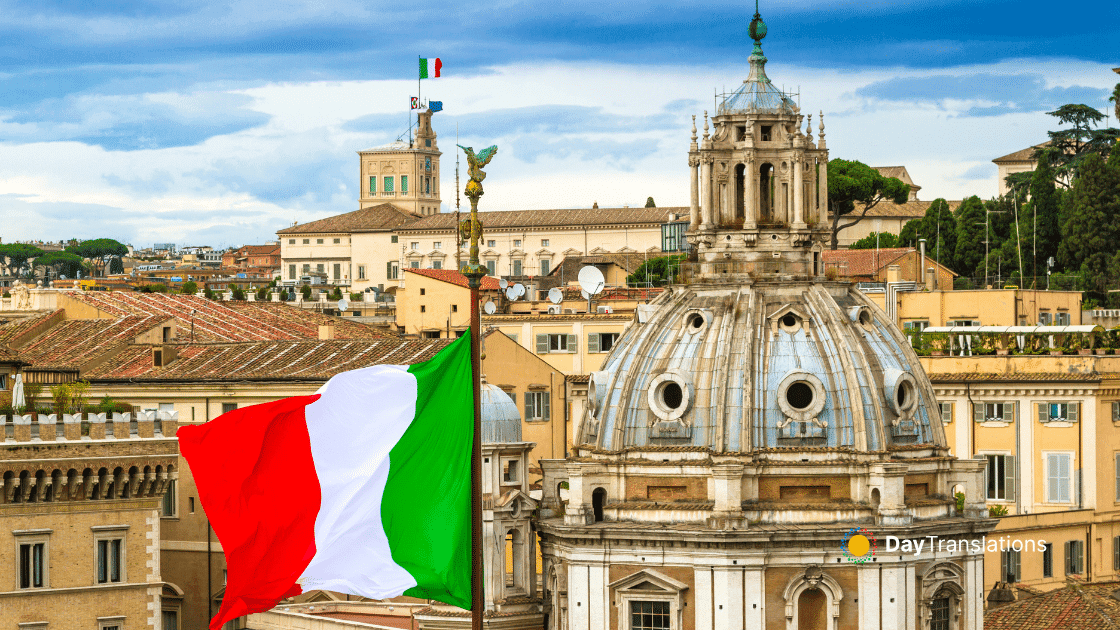
The Italian culture is one of great flamboyance, passion, energy, enthusiasm and color. With more than 55 million consumers, famous for their sophistication and high levels of brand awareness, the Italian market is replete with opportunities for an expanding business. Italy is one of the most advanced and dynamic countries in the world and the 7th world economic power in terms of GDP.
Italy is located on the Italian Peninsula in Southern Europe, and on the two largest islands in the Mediterranean Sea, Sicily and Sardinia, in the heart of the biggest and richest single market of the world: the European Union. Italy shares its northern Alpine boundary with France, Switzerland, Austria and Slovenia. Land boundaries are also the Holy See (Vatican City) and San Marino. The country is surrounded by four seas: the Adriatic Sea, the Ionian Sea, the Mediterranean Sea, and the Tyrrhenian Sea.
:: Background of Italy ::
As Italy became a nation-state in 1861 when the regional states of the peninsula, along with Sardinia and Sicily, were united under King Victor EMMANUEL II. An era of parliamentary government came to a close in the early 1920s when Benito MUSSOLINI established a Fascist dictatorship. His alliance with Nazi Germany led to Italy’s defeat in World War II. A democratic republic replaced the monarchy in 1946 and economic revival followed. Italy was a charter member of NATO and the European Economic Community (EEC). It has been at the forefront of European economic and political unification, joining the Economic and Monetary Union in 1999. Persistent problems include illegal immigration, organized crime, corruption, high unemployment, sluggish economic growth, and the low incomes and technical standards of southern Italy compared with the prosperous north.
In this Country Profile
:: Geography of Italy ::
Location: Southern Europe, a peninsula extending into the central Mediterranean Sea, northeast of Tunisia.
Geographic coordinates: 42 50 N, 12 50 E
Area: total: 301,230 sq km land: 294,020 sq km water: 7,210 sq km. Note: includes Sardinia and Sicily.
Area – comparative: slightly larger than Arizona
Land boundaries: total: 1,899.2 km; border countries: Austria 430 km, France 488 km, Holy See (Vatican) 3.2 km, San Marino 39 km, Slovenia 199 km, Switzerland 740 km
Coastline: 7,600 km
Maritime claims: territorial sea: 12 nm; continental shelf: 200 m depth or to the depth of exploitation
Climate: predominantly Mediterranean; Alpine in far north; hot, dry in south
Terrain: mostly rugged and mountainous; some plains, coastal lowlands
Elevation extremes:
lowest point: Mediterranean Sea 0 m;
highest point: Mont Blanc (Monte Bianco) de Courmayeur 4,748 m (a secondary peak of Mont Blanc)
Natural resources: coal, mercury, zinc, potash, marble, barite, asbestos, pumice, fluorspar, feldspar, pyrite (sulfur), natural gas and crude oil reserves, fish, arable land
Land use: arable land: 26.41% permanent crops: 9.09% other: 64.5% (2005)
Natural hazards: regional risks include landslides, mudflows, avalanches, earthquakes, volcanic eruptions, flooding; land subsidence in Venice
Environment – current issues: Air pollution from industrial emissions such as sulfur dioxide; coastal and inland rivers polluted from industrial and agricultural effluents; acid rain damaging lakes; inadequate industrial waste treatment and disposal facilities.
Environment – international agreements: party to: Air Pollution, Air Pollution-Nitrogen Oxides, Air Pollution-Persistent Organic Pollutants, Air Pollution-Sulfur 85, Air Pollution-Sulfur 94, Air Pollution-Volatile Organic Compounds, Antarctic-Environmental Protocol, Antarctic-Marine Living Resources, Antarctic Seals, Antarctic Treaty, Biodiversity, Climate Change, Climate Change-Kyoto Protocol, Desertification, Endangered Species, Environmental Modification, Hazardous Wastes, Law of the Sea, Marine Dumping, Ozone Layer Protection, Ship Pollution, Tropical Timber 83, Tropical Timber 94, Wetlands, Whaling signed, but not ratified: none of the selected agreement.
:: People of Italy ::
Population: 58,145,320 (July 2008 est.)
Age structure:
0-14 years: 13.6% (male 4,086,951/female 3,842,765)
15-64 years: 66.3% (male 19,534,247/female 19,024,776)
65 years and over: 20% (male 4,864,189/female 6,792,393) (2008 est.)
Median age:
total: 42.9 years
male: 41.4 years
female: 44.4 years (2008 est.)
Population growth rate: -0.019% (2008 est.)
Birth rate: 8.36 births/1,000 population (2008 est.)
Death rate: 10.61 deaths/1,000 population (2008 est.)
Net migration rate: 2.06 migrant(s)/1,000 population (2008 est.)
Sex ratio:
at birth: 1.07 male(s)/female
under 15 years: 1.06 male(s)/female
15-64 years: 1.03 male(s)/female
65 years and over: 0.72 male(s)/female
total population: 0.96 male(s)/female (2008 est.)
Infant mortality rate:
total: 5.61 deaths/1,000 live births
male: 6.19 deaths/1,000 live births
female: 5 deaths/1,000 live births (2008 est.)
Life expectancy at birth:
total population: 80.07 years
male: 77.13 years
female: 83.2 years (2008 est.)
Total fertility rate: 1.3 children born/woman (2008 est.)
HIV/AIDS – adult prevalence rate: 0.5% (2001 est.)
HIV/AIDS – people living with HIV/AIDS: 140,000 (2001 est.)
HIV/AIDS – deaths: fewer than 1,000 (2003 est.)
Nationality: noun: Italian(s) adjective: Italian
Ethnic groups: Italian (includes small clusters of German-, French-, and Slovene-Italians in the north and Albanian-Italians and Greek-Italians: south)
Religions: Roman Catholic 90% (approximately; about one-third practicing), other 10% (includes mature Protestant and Jewish communities and a growing Muslim immigrant community
Languages: Italian (official), German (parts of Trentino-Alto Adige region are predominantly German speaking), French (small French-speaking minority in Valle d’Aosta region), Slovene (Slovene-speaking minority in the Trieste-Gorizia area)
Literacy:
definition: age 15 and over can read and write
total population: 98.4%
male: 98.8%
female: 98% (2001 census)
Geography of Italy: Important Geographical Information about Italy
In this Country Profile
Italy has a strategic location dominating central Mediterranean as well as southern sea and air approaches to Western Europe. Most of the European capitals are within 3 hours flying time from Rome, not to mention many in the Balkans, North Africa and Middle East.
The country is surrounded by four seas: the Adriatic Sea, the Ionian Sea, the Mediterranean Sea, and the Tyrrhenian Sea. Located between continental Europe, Eastern Europe, the Balkans, Middle-East and North Africa, Italy is currently considered among the most advanced countries in several fields, like the biotech sector, industrial & engineering chemistry, research and development product testing, material science, health and vaccines, chemicals, aerospace, mechanics, renewable energies and many others.
Administrative Division: Italy is subdivided into 15 regions and 5* autonomous regions: Abruzzo, Basilicata, Calabria, Campania, Emilia-Romagna, Friuli-Venezia Giulia*, Lazio (Latium), Liguria, Lombardia, Marche, Molise, Piemonte (Piedmont), Puglia (Apulia), Sardegna* (Sardinia), Sicilia*, Toscana (Tuscany), Trentino-Alto Adige* (Trentino-South Tyrol), Umbria, Valle d’Aosta* (Aosta Valley), Veneto (Venetia).
Italy is for sure one of the most beautiful countries in the world, with an enormous variety of ancient cities, archeological and architectural wonders, mountains which offer outstanding views, splendid countryside, lakes and breathtaking coastlines. Italy is famous for its boot-shaped peninsula. Most of the country is covered by mountains: The Dolomite mountains which are located in northern Italy are part of the Alps range. The Apennine mountains, stretching from north to south, split the center of Italy into the east and west coast. Italy includes two large islands: Sicily, the largest island in the Mediterranean Sea and Sardinia, the second-largest island in the Mediterranean Sea. Sardinia is basically mountains rising out of the ocean. Moreover, Italy is a volcanically active country with the only active volcano in mainland Europe, Mount Vesuvius. Other famous volcanoes are: Etna and Stromboli.
There are over 1000 Rivers and Streams in Italy. The major rivers in Italy are: the Po River (which flows from the Alps near the French border, through Turin, and eastward into the Adriatic Sea), the Arno River (which flows from the north-central Apennines, through Florence, and into the Tyrrhenian Sea), and the Tiber River (which flows from the north-central Apennines, south through Rome, and into the Tyrrhenian Sea). In the north of the country are a number of subalpine lakes, the largest of which is Garda.
Information about the Italian Flag: Colors and Meaning of the Flag of Italy
In this Country Profile
The flag of Italy, Bandiera italiana, is a tricolor featuring three equally sized vertical pales displaying the national colors of Italy: the left pale is fern-green, the middle one is bright-white and the right pale is flame Scarlet-red. It was formally adopted on the 1st of January 1948. The first entity to use the Italian tricolor was the Cispadana Republic after Napoleon’s campaigns in 1796.
The Italian history serves as an example to the world of how a nation achieved freedom and independence. Italy was finally united in 1870. The tricolor contained at that time a shield and cross (sometimes even a royal crown) representing the ruling house of Savoy. After June 19, 1946, when Italy was established as Repubblica Italiana, those emblems were removed as a symbol of freedom and independence.
One of the most credible interpretation of the colors suggests that green and white come from the uniforms of the Milanese civic guard, furthermore, some red parts were added in 1796 when the Militia became the National Guard. White and red were also the colors of the Milanese flag. It was clearly inspired by the model of the French flag of 1790.
There were attributed also particular values to the colors of the Italian flag. According also to Ancient and Heraldic traditions white represents peace, honesty or the snow-capped Italian Alps, red illustrates bravery, strength, valor, the blood split in the Wars for Italian Independence and green reflects the hope.
:: Meaning of the Italian Coat and Arms ::
The Coat of Arms of the Italian Republic (Stemma della Repubblica Italiana), has been the symbol of the Italian Republic since 05 May 1948. The dominant element is a five-pointed star; an ancient secular symbol of Italy, known as Stellone d’Italia, aimed to protect the nation. The tips pointing downwards symbolize that Italy is a united state. The olive branch is a symbol of peace, also representing the southern part of the country, and the oak branch, a symbol of strength is also symbolizing the northern part of the country.
:: Italian Presidential Flag or Presidential Standard ::
A squared blue flag, containing in the middle the flag of the Napoleonic Republic of Italy, with the golden coat of arms of Italy on the green square, represents the Italian Presidential Standard.
Extensive List of Languages of Italy: Spoken Languages
In this Country Profile
Italian Republic, Repubblica Italiana. 58,057,477. National or official languages: Italian, regional languages: French, Standard German, Slovenian. Literacy rate: 97% to 98%. Also includes Assyrian Neo-Aramaic, English (29,000), Judeo-Tripolitanian Arabic (5,000), Judeo-Tunisian Arabic, Kabuverdianu (10,000), Maltese (28,000), Northern Kurdish (3,000), Somali (50,626), Sylheti, Chinese (40,000), people from Eritrea, the Philippines. Information mainly from R. A. Hall 1974; M. Stephens 1976; F. B. Agard 1984; B. Comrie 1987. The number of languages listed for Italy is 33. Of those, all are living languages.
:: List of Languages ::
Albanian, Arbëreshë
[aae] 80,000 (1963 L. Newmark). Ethnic population: 260,000 (1976 M. Stephens). Southern; Calabria, Apulia, Basilicata, Molise, Sicily. Alternate names: Arbëreshë. Dialects: Sicilian Albanian, Calabrian Albanian, Central Mountain Albanian, Campo Marino Albanian. Speakers say the four Italian dialects are not inherently intelligible with each other. Lexical similarity 45% with Tosk Albanian. Classification: Indo-European, Albanian, Tosk.
Bavarian
[bar] 258,885 in Italy (2000 WCD). South Bavarian is in the Bavarian Alps, Tyrol, Styria, including Heanzian dialect of Burgenland, Carinthia, northern Italy, and part of Gottschee; Central Bavarian is in the Alps and Lower Austria and Salzburg; North Bavarian in the north of Regensburg, to Nuremburg and Western Bohemia, Czech Republic. Alternate names: Bayerisch, Bavarian Austrian. Dialects: Central Bavarian, North Bavarian, South Bavarian. Classification: Indo-European, Germanic, West, High German, German, Upper German, Bavarian-Austrian.
Catalan-Valencian-Balear
[cat] 20,000 in Alghero (1996). Alghero, northwest coast on Sardinia. Dialects: Algherese. Classification: Indo-European, Italic, Romance, Italo-Western, Western, Gallo-Iberian, Ibero-Romance, East Iberian.
Cimbrian
[cim] 2,230. Population includes 500 in Lusernese Cimbrian in Trentino Alto Oolige 40 km southeast from Trento, plus 1,500 Sette Comuni Cimbrian (40% of Roana (Rowan), 70% of Messaselva di Roana Rotzo) in Veneto around 60 km north of Vicenza (1978 H. Kloss), and 230 or 65% of Giazza (Ijetzan) Veneto, 43 km northeast of Verona (1992 R. Zamponi). There were 22,700 speakers in Sieben Gemeinde and 12,400 in Dreizehn Gemeinde in 1854. Northeast Italy, Sette and Tredici Comuni (Sieben and Dreizehn Gemeinde) south of Trent, towns of Giazza (Glietzen, Ljetzen), Roana (Rabam), Lusern, some in Venetia Province. Alternate names: Tzimbro, Zimbrisch. Dialects: Lusernese Cimbrian, Tredici Communi Cimbrian (Tauch), Sette Comuni Cimbrian. Structural and intelligibility differences indicate that the 3 dialects listed could be considered separate languages. Lusernese Cimbrian is heavily influenced by Italian. Heavily influenced by Bajuwarisch dialects. It is sometimes considered to be a dialect of South Bavarian. Different from Bavarian, Walser, and Mocheno. No written influence from Standard German. Classification: Indo-European, Germanic, West, High German, German, Upper German, Bavarian-Austrian.
Corsican
[cos] 1,000 in Italy (1990). Maddalena Island, northeast coast of Sardinia. Alternate names: Corso, Corsu, Corse, Corsi. Classification: Indo-European, Italic, Romance, Southern, Corsican.
Croatian
[hrv] 3,500 in Italy (N. Vincent in B. Comrie 1987). Molise, southern, villages of Montemitro, San Felice del Molise, Acquaviva-Collecroce. Dialects: Croatian. Classification: Indo-European, Slavic, South, Western.
Emiliano-Romagnolo
[eml] 2,000,000 in Emilia-Romagna (2003). Population total all countries: 2,020,112. Northwest Italy, region of Piacenza to that of Ravenna, and between the Po and the Adriatic and the Apennines, in the territories of Emilia and Romagna, southern Pianura Padana (all provinces), southern Lombardia (Provinces Mantova and Pavia), northern Toscana (Lunigiana), northern Marche (Province Pesaro). Also spoken in San Marino. Alternate names: Emiliano, Emilian, Sammarinese. Dialects: Western Emiliano, Central Emiliano, Eastern Emiliano, Northern Romagnolo, Southern Romagnolo, Mantovano, Vogherese-Pavese, Lunigiano. A structurally separate language from Italian (F.B. Agard). Related to Lombard (R.A. Hall 1974:29, S. Fleischman 1992, OIEL 3:339). Classification: Indo-European, Italic, Romance, Italo-Western, Western, Gallo-Iberian, Gallo-Romance, Gallo-Italian.
Franco-Provençal
[frp] 70,000 in Italy (1971 census). Population includes 700 Faetar speakers (1995 Naomi Nagy). Northwest Italy, Aosta Valley. A small speech community also in Faeto and Celle S. Vito in the Province of Foggia in Apulia, and Guardia Piemontese in Calabria, Cosenza. Covers a huge area. Dialects: Valle D’aosta (Patoé Valdoten, Valdotain, Valdostano), Faeto (Faetar), Celle San Vito. Classification: Indo-European, Italic, Romance, Italo-Western, Western, Gallo-Iberian, Gallo-Romance, Gallo-Rhaetian, Oïl, Southeastern.
French
[fra] 100,000 in Italy (1987 Harris). Aosta Valley. Alternate names: Français. Classification: Indo-European, Italic, Romance, Italo-Western, Western, Gallo-Iberian, Gallo-Romance, Gallo-Rhaetian, Oïl, French.
Friulian
[fur] 794,000 (2000). Northeast and adjacent areas, northern Friuli-Venezia-Giulia on the borders of the Austrian Province of Corinthia and the Republic of Slovenia. Alternate names: Furlan, Frioulan, Frioulian, Priulian, Friulano. Dialects: East Central Friulian, Western Friulian, Carnico. Friulian, Ladin, and Romansch are separate languages (R. A. Hall, Jr. 1978, personal communication). F. B. Agard considers it to be structurally closer to Italian than to Romansch (personal communication 1981). Classification: Indo-European, Italic, Romance, Italo-Western, Western, Gallo-Iberian, Gallo-Romance, Gallo-Rhaetian, Rhaetian.
German, Standard
[deu] 225,000 in Italy (1987 Vincent in B. Comrie). Northern, Trentino-Alto Adige, South Tyrol, Province of Bolzano. Alternate names: Tedesco. Classification: Indo-European, Germanic, West, High German, German, Middle German, East Middle German.
Greek
[ell] 20,000 in Italy (1987 Vincent in B. Comrie). Southern, east of Reggio; Salento (Colimera, Sternatía, Zollino) and Aspromonte (Bova, Condofuri, Palizzi, Roccoforte, Roghudi). Alternate names: Greco. Dialects: Salento, Aspromonte. Classification: Indo-European, Greek, Attic.
Italian
[ita] 55,000,000 in Italy. Population includes some of whom are native bilinguals of Italian and regional varieties, and some of whom may use Italian as second language. Population total all countries: 61,489,984. Also spoken in Argentina, Australia, Belgium, Bosnia and Herzegovina, Brazil, Canada, Croatia, Egypt, Eritrea, France, Germany, Israel, Libya, Liechtenstein, Luxembourg, Paraguay, Philippines, Puerto Rico, Romania, San Marino, Saudi Arabia, Slovenia, Switzerland, Tunisia, United Arab Emirates, United Kingdom, Uruguay, USA, Vatican State. Alternate names: Italiano. Dialects: Tuscan, Abruzzese, Pugliese, Umbrian, Laziale, Central Marchigiano, Cicolano-Reatino-Aquilano, Molisano. Regional varieties coexist with the standard language; some are inherently unintelligible (Nida) to speakers of other varieties unless they have learned them. Aquilano, Molisano, and Pugliese are very different from the other Italian ‘dialects’. Piemontese and Sicilian are distinct enough to be separate languages (F. B. Agard 1981, personal communication). Venetian and Lombard are also very different (Philippe Cousson 1981, personal communication). Neapolitan is reported to be unintelligible to speakers of Standard Italian. Northern varieties are closer to French and Occitan than to standard or southern varieties (Agard, N. Vincent). Lexical similarity 89% with French, 87% with Catalan, 85% with Sardinian, 82% with Spanish, 78% with Rheto-Romance, 77% with Rumanian. Classification: Indo-European, Italic, Romance, Italo-Western, Italo-Dalmatian.
Italian Sign Language
[ise] Alternate names: Lingua Italiana Dei Segni, Lis. Dialects: Partially intelligible with French Sign Language. Not intelligible with American Sign Language. Regional differences, but signers from different regions seem to communicate fluently. Classification: Deaf sign language.
Judeo-Italian
[itk] 200. Alternate names: Italkian. Classification: Indo-European, Italic, Romance, Italo-Western, Italo-Dalmatian.
Ladin
[lld] 30,000 in Italy (2001 census). Ethnic population: 38,000. Autonomous province of Bolzano or Southern Tyrol (German Südtirol, Italian Alto Adige), in the Valleys of Gherdëina (Italian Val Gardena, German Grödnertal) and of Badia (Italian Val Badia, German Gadertal); autonomous province of Trento (Trient) or Trentino, in the Valley of Fascia (Italian Val di Fassa, German Fassatal) and in the province of Belluno in Fodom (Italian Livinallongo, German Buchenstein) and in Anpezo (Italian Ampezzo, around Cortina d’Ampezzo). Also spoken in USA. Alternate names: Dolomite, Rhaeto-Romance. Dialects: Atesino, Cadorino, Nones (Nones Blot, Nonesh, Parlata Trentina, Nonese), Gardenese (Grüdno, Grödnerisch), Fassano, Badiotto (Gadertalisch), Marebbano (Ennebergisch), Livinallese, Ampezzano. Friulian, Ladin (in Italy), and Romansch (in Switzerland) are separate languages (R. A. Hall, Jr. 1978, personal communication). Seven dialects. The dialect of Val di Fassa is taught in schools. Distinct from Ladino (Dzhudezmo, Judeo-Spanish). Classification: Indo-European, Italic, Romance, Italo-Western, Western, Gallo-Iberian, Gallo-Romance, Gallo-Rhaetian, Rhaetian.
Ligurian
[lij] 1,915,749 in Italy (2000 WCD). Population total all countries: 1,920,849. Liguria, northern Italy; east and west of Genoa along the Riviera and mountain hinterland, St. Pietro and St. Antioch, islands off southwest coast of Sardinia, cities of Carloforte and Calasetta in Sardinia. Also spoken in France, Monaco. Alternate names: Líguru, Ligure. Dialects: Genoese (Genoan, Genovese). Ligurian is closer to Piemontese, Lombard, and French than to Standard Italian. Classification: Indo-European, Italic, Romance, Italo-Western, Western, Gallo-Iberian, Gallo-Romance, Gallo-Italian.
Lombard
[lmo] 8,830,855 in Italy (2000 WCD). Population total all countries: 9,133,855. Milan, Lombardy, 3 valleys of Graubünden (Val Mesolcina, Val Bregaglia, Val Poschiavo), northern Italy. Western Lombard varieties also in Sicily. Ticino is in Switzerland. Also spoken in Switzerland, USA. Alternate names: Lombardo. Dialects: Milanese, Eastern Lombard, Western Lombard (Piazza Armerina, Novara, Nicosia, San Fratello), Alpine Lombard, Novarese Lombard, Trentino Western, Latin Fiamazzo, Latin Anaunico, Bergamasco, Ticinese (Ticino). A group of dialects, some of which may be separate languages. Western Lombard dialects (of Ticino and Graubnnden) are inherently intelligible to each other’s speakers. Speakers in more conservative valleys may have to use some kind of ‘standard’ dialect to communicate with speakers of other dialects of Lombard. Very different from Standard Italian. Classification: Indo-European, Italic, Romance, Italo-Western, Western, Gallo-Iberian, Gallo-Romance, Gallo-Italian.
Mócheno
[mhn] 1,900 (1992 Raoul Zamponi). Population includes 400 Fierozzo, 1,000 Palú, 460 Gereut. Valle del Fersina (Trentino). Dialects: Fierozzo (Florutz), Palú (Palai), Frassilongo (Gereut). Speakers can partially understand Bavarian, Cimbrian, or Standard German. Classification: Indo-European, Germanic, West, High German, German, Upper German, Bavarian-Austrian.
Napoletano-Calabrese
[nap] 7,047,399 (1976). Campania and Calabria provinces, southern Italy. Alternate names: Neapolitan-Calabrese. Dialects: Napoletano (Neapolitan, Tirrenic), Northern Calabrese-Lucano (Lucanian, Basilicatan). Limited inherent intelligibility of Standard Italian. Neapolitan and Calabrese are reported to be very different from each other. Southern Calabrian is reported to be a dialect of Sicilian. Classification: Indo-European, Italic, Romance, Italo-Western, Italo-Dalmatian.
Piemontese
[pms] 3,106,620 in Italy (2000 WCD). Northwest Italy, Piedmont, except for the Provençal- and Franco-Provençal-speaking Alpine valleys. Also spoken in Australia, USA. Alternate names: Piemontèis, Piedmontese. Dialects: High Piemontese (Alto Piemontese), Low Piemontese (Basso Piemontese). Distinct enough from Standard Italian to be considered a separate language. Considerable French influence. Classification: Indo-European, Italic, Romance, Italo-Western, Western, Gallo-Iberian, Gallo-Romance, Gallo-Italian.
Provençal
[prv] 100,000 in Italy (1990 P. Blanchet). Upper valleys of the Italian Piedmont (Val Mairo, Val Varacho, Val d’Esturo, Entraigas, Limoun, Vinai, Pignerol, Sestriero), Guardia Piemontese in Calabria. Alternate names: Provenzale. Dialects: Transalpin. Classification: Indo-European, Italic, Romance, Italo-Western, Western, Gallo-Iberian, Ibero-Romance, Oc.
Romani, Balkan
[rmn] 5,000 Arlija in Italy (1990). Dialects: Arlija (Erli). Classification: Indo-European, Indo-Iranian, Indo-Aryan, Central zone, Romani, Balkan.
Romani, Sinte
[rmo] 14,000 in Italy (1980). Population includes 10,000 Manouche, 4,000 Slovenian-Croatian. North Italy. Dialects: Piedmont Sintí, Slovenian-Croatian, Manouche. Classification: Indo-European, Indo-Iranian, Indo-Aryan, Central zone, Romani, Northern.
Romani, Vlax
[rmy] 4,000 in Italy. Population includes 1,000 to 3,000 Kalderash, 1,000 Lovari. Dialects: Kalderash, Lovari. Classification: Indo-European, Indo-Iranian, Indo-Aryan, Central zone, Romani, Vlax.
Sardinian, Campidanese
[sro] 345,180 (2000 WCD). Southern Sardinia. Alternate names: Sardu, Campidanese, Campidese, South Sardinian. Dialects: Cagliare (Cagliari, Cagliaritan), Arborense, Sub-Barbaricino, Western Campidenese, Central Campidanese, Ogliastrino, Sulcitano, Meridionale, Sarrabense. Cagliaritan is the dialect of Cagliari, the capital of Sardinia. Campidanese is quite distinct from the other Sardinian languages. Lexical similarity 62% between Cagliare and Standard Italian, 73% with Logudorese, 66% with Gallurese. Classification: Indo-European, Italic, Romance, Southern, Sardinian.
Sardinian, Gallurese
[sdn] Gallurese is in northeastern Sardinia. Alternate names: Northeastern Sardinian, Gallurese. Dialects: Lexical similarity 83% with Standard Italian, 81% with Sassarese, 70% with Logudorese, 66% with Cagliare. Classification: Indo-European, Italic, Romance, Southern, Sardinian.
Sardinian, Logudorese
[src] 1,500,000 (1977 M. Ibba, Rutgers University). Population includes all Sardinian languages. Central Sardinia. Alternate names: Sard, Sardarese, Logudorese, Central Sardinian. Dialects: Nuorese, Northern Logudorese, Barbaricino, Southwestern Logudorese. No one form of Sardinian is selected as standard for literary purposes. Logudorese is quite different from other Sardinian varieties. Lexical similarity 68% with Standard Italian, 73% with Sassarese and Cagliare, 70% with Gallurese. ‘Sardinian’ has 85% lexical similarity with Italian, 80% with French, 78% with Portuguese, 76% with Spanish, 74% with Rumanian and Rheto-Romance. Classification: Indo-European, Italic, Romance, Southern, Sardinian.
Sardinian, Sassarese
[sdc] Northwestern Sardinia. Alternate names: Northwestern Sardinian, Sassarese. Dialects: Lexical similarity 81% with Gallurese, 76% with Standard Italian. Classification: Indo-European, Italic, Romance, Southern, Sardinian.
Sicilian
[scn] 4,832,520 (2000 WCD). Sicily, an island off the southern mainland. Alternate names: Calabro-Sicilian, Sicilianu, Siculu. Dialects: Western Sicilian (Palermo, Trapani, Central-Western Agrigentino), Central Metafonetica, Southeast Metafonetica, Eastern Nonmetafonetica, Messinese, Isole Eolie, Pantesco, Southern Calabro. Distinct enough from Standard Italian to be considered a separate language. Pugliese (see Italian) and Southern Calabrese are reported to be dialects of Sicilian. Classification: Indo-European, Italic, Romance, Italo-Western, Italo-Dalmatian.
Slovenian
[slv] 100,000 in Italy (N. Vincent in B. Comrie 1987). The provinces of Trieste and Gorizia in northeast near Slovenia border. Alternate names: Slovene. Dialects: Primorski, Cividale, Resia. Classification: Indo-European, Slavic, South, Western.
Venetian
[vec] 2,180,387 in Italy (2000 WCD). Northern Italy, city of Venice, area of the Tre Venezie; Venezia Eugànea westward to Verona, southward to the Po, and eastward to the border of the Fruili; Venezia Tridentina, in the Adige valley and neighboring mountain regions to the north of Trent; and Venezia Giulia, east of the Friuli, and including Trieste. Bisiacco is spoken in Gorizia Province. Also spoken in Croatia, Slovenia. Alternate names: Veneto, Venet. Dialects: Istrian, Triestino, Venetian Proper, Bisiacco. Distinct from Standard Italian. Classification: Indo-European, Italic, Romance, Italo-Western, Western, Gallo-Iberian, Gallo-Romance, Gallo-Italian.
Walser
[wae] 3,400 in Italy (1978 Fazzini). Valle d’Aosta: Val Lesa (Gressoney, Issime, Gaby); Piemonte: Valsesie (Alagna, Rima S. Siuseppe, Rimelle), Novara: Valle Anzacxa (Macugnage); Val Formazza (Formazza, Pomatt). 9 communities in Italy, and 4 former ones. Alternate names: Walscher. Classification: Indo-European, Germanic, West, High German, German, Upper German, Alemannic.
:: Reference ::
Gordon, Raymond G., Jr. (ed.), 2005. Ethnologue: Languages of the World, Fifteenth edition. Dallas, Tex.: SIL International. Online version: http://www.ethnologue.com/
Famous Italian People: Italian Artists, Scientists, Leaders, Musicians, Politicians and Athletes
In this Country Profile
There is a category of people who changed the past, shaped the modern world and build the future! They are the greatest achievers and the most influential people worldwide. There are many Italian celebrities, writers and philosophers, singers and actors, world famous composers, politicians, who made a great contribution to the development of our civilization. We are happy to present to you some aspects of a culture rich in diversity.
:: List of Famous People from Italy ::
Enzo Ferrari
The sacred monster of the motoring world! Enzo Ferrar, also called “The Commendatore” was a famous Italian car driver and entrepreneur, the founder of the Scuderia Ferrari Grand Prix motor racing team and of the Ferrari car manufacturer.
Under the leadership of “The Commendatore” (1947-88) Ferrari won over 5000 races all over the world and earned 25 world titles. Moreover, the most important achievements have been 9 Formula 1 Drivers’ World titles, 8 Formula 1 Constructors’ World Championships, 14 Manufactures’ World titles, 9 wins at Le Mans 24 Hours race, 8 at the Mille Miglia, 7 at the Targa Florio.
Of all the sport cars in the world, no one is more famous than Ferrari. “The Commendatore” was a man who had exceptional intuitive capacities, he created not only a precious object, a niche item, but a status symbol, social phenomena and a culture with mythical values. This passionate genius devoted his life to engineering excellence for the sake of winning races and creating the ultimate performance cars. It seems that the Ferrari quality standard will remain unsurpassed.
Enrico Fermi
Nobel laureate (1938) and scientific luminary Enrico Fermi (September, 1901- November,1954) was an Italian pioneering nuclear physicist whose works on the development of the first nuclear reactor, and for his contributions to the development of quantum theory, nuclear and particle physics, and statistical mechanics were numerous, profound, and lasting. He is being considered one of the greatest scientists of the 20th century. There was created in 1952 also a synthetic element which was named after him: Fermium. Enrico Fermi, a modern Renaissance man!
Leonardo Da Vinci
“Simplicity is the ultimate sophistication”
Leonardo Da Vinci is the archetypal Renaissance Man representing the humanistic values of that period in his art, science and writing. He is celebrated as the most diversely talented person ever to have lived! He was more than an artist, he was an Italian polymath, a scientist, mathematician, engineer, inventor, anatomist, painter, sculptor, architect, botanist, musician, astronomer and writer. His insatiable curiosity and intuitive sense were beyond any limits! Works like Mona Lisa and The Supper occupy unique positions being considered the most famous and the most reproduced. Leonardo’s drawings, which reveal his brilliant draftsmanship and his mastery of the anatomy of humans, animals, and plant life, may be found in the principal European collections.
Leonardo once said that “things of the mind left untested by the senses are useless.” And he left little untested. The first parachute had been imagined and sketched by Leonardo Da Vinci, he invented different kind of products, from armored tanks to helicopters, scissors and automated bobbin winder and many others. He towered above all his contemporaries. Da Vinci remains one of the most fascinating people history has ever known!
Cristopher Columbus
Also called the Admiral of the Ocean Sea, Columbus (1451 – 1506) remains a disputable figure who has been variously characterized as one of the greatest mariners in history, a visionary genius, a hero, colonizer, a naive entrepreneur, greedy imperialist whose voyages across the Atlantic Ocean led to general European awareness of the American continents. His initial goal was to find a westward sea passage towards the Orient. He initiated the process of Spanish colonization, process which was later followed by the European colonization.
Carla Bruni
Born in Turin, Carla is a famous former supermodel, songwriter, singer and her fame increased even more after becoming the First Lady of France. The actual wife of the French President Nicolas Sarkozy was among the 20 highest-paid fashion models. She collaborated with designers and fashion houses such as Dior, Givenchy, Paco Rabanne, Christian Lacroix, Karl Lagerfeld, John Galliano, Chanel and Versace. The charming model appeared on the covers of various international magazines, among them: Elle, Glamour, Vogue, Max and many others.
Alessandro Volta
Can you imagine your life without batteries or electricity? The Italian physicist (1745-1827) is worldwide known for the development of the first electric cell, back in the 1800’s. He discovered the first practical method for generate electricity. Constructed of alternating discs of zinc and copper, with pieces of cardboard soaked in brine between the metals, the voltic pile produced electrical current. The metallic conducting arc carried the electricity over a greater distance. Alessandro Volta’s voltaic pile was the first battery that produced a reliable, steady current of electricity and these facts make him a pioneer in the field of electricity. Named after Alessandro Volta:
1.Volt: The unit of electromotive force, or difference of potential, which will cause a current of one ampere to flow through a resistance of one ohm.
2. Photovoltaic: Photovoltaic are systems that convert light energy into electricity.
Andrea Bocelli
If God had a singing voice, he would sound like Andrea Bocelli! Andrea Bocelli, also called “the fourth tenor”, was a disciple of Luciano Pavarotti and Zucchero Fornaciari. The blind, Tuscany-born vocalist has emerged as one of the most magnificent voices in contemporary opera. With his enchanting diction and dramatic style, Andrea Bocelli offers an one of a kind experience to the listener. Words fail me to describe his unique voice and his talent. The list of his awards seems to be endless: five Grammy Awards, one American Music Award, four Classical Brit Awards, four World Music Awards and many others. He has recorded seven complete operas (La bohème, Tosca, Il trovatore, Werther, Pagliacci, Cavalleria rusticana and Carmen)
Giacomo Casanova
Italy certainly has a reputation for romance! And who can be called “the world’s greatest lover” if not an Italian? Giacomo Casanova de Seingalt (1725 – 1798) was a Venetian adventurer and writer. Famous as a veritable womanizer, his name remains synonymous with the art of seduction. His main book Histoire de ma vie (Story of My Life) is regarded as an intimate portrait of the manners and European social life in the 18th century.
Silvio Berlusconi
Berlusconi is an Italian politician, entrepreneur, real estate and insurance tycoon, bank and media proprietor, sports team owner and songwriter. He is the third longest-serving Prime Minister of the Italian Republic (1994-2008). He is also considered Italy’s wealthiest man and media proprietor. He is the main shareholder at Fininvest which controls the public television. He has been also the president of the famous football team AC Milan.
Dante Alighieri
“The hottest places in hell are reserved for those who in times of geat moral crises maintain their neutrality”
“Il sommo Poeta”, “The Supreme poet” or “The father of the Italian language” are references to the one and only Durante degli Alighieri, (1265 – September 14, 1321), commonly known as Dante, the Florentine poet of Middle Ages. His magnum opus, the epic poem Divina Commedia is considered a masterpiece of world literature. More than a talented poet, he was also a politician, a statesman, a philosopher, a noble, an exile, and a theologian. The 14th century had four immortal writers: Dante, Chaucer, Petrarca, and Boccaccio. Alighieri is not only Italy’s preeminent poet, but one of the world’s greatest poets as well as a brilliantly argued, and along with Shakespeare he embodies one of the towering figures of Western literature.
Giorgio Armani
Italy with its unique sense of style and fashion has long led the development and revolution of haute couture. Well-known for defining trends and setting couture standards, the glamorous world of fashion is incomplete without mentioning the name of the Italian fashion icon Giorgio Armani. In 2006, Forbes once again named Giorgio Armani the most successful Italian designer an annual turnover of $1.691 billion, and a personal fortune of $5 billion. He is particularly known for his stylish suits worn by top Hollywood actors such as Mel Gibson or Richard Gere. His name is synonym with sophisticated and elegant fashion.
The legendary Armani is more than a fashion trendsetter, he is also an innovator. “Armani was the first designer to ban models with a body mass index (BMI) under 18. In January 2007 Armani became the first designer to broadcast a haute couture fashion show live on the Internet. Armani teamed up with Samsung to make the Giorgio Armani cell phone similar to the LG Prada” At 74, Armani is still one of the most active fashion designers the world has ever seen and his business empire includes lines of jewelry, cosmetics, fragrances, and eyewear will continue to be the same or even more spectacularly successful.