
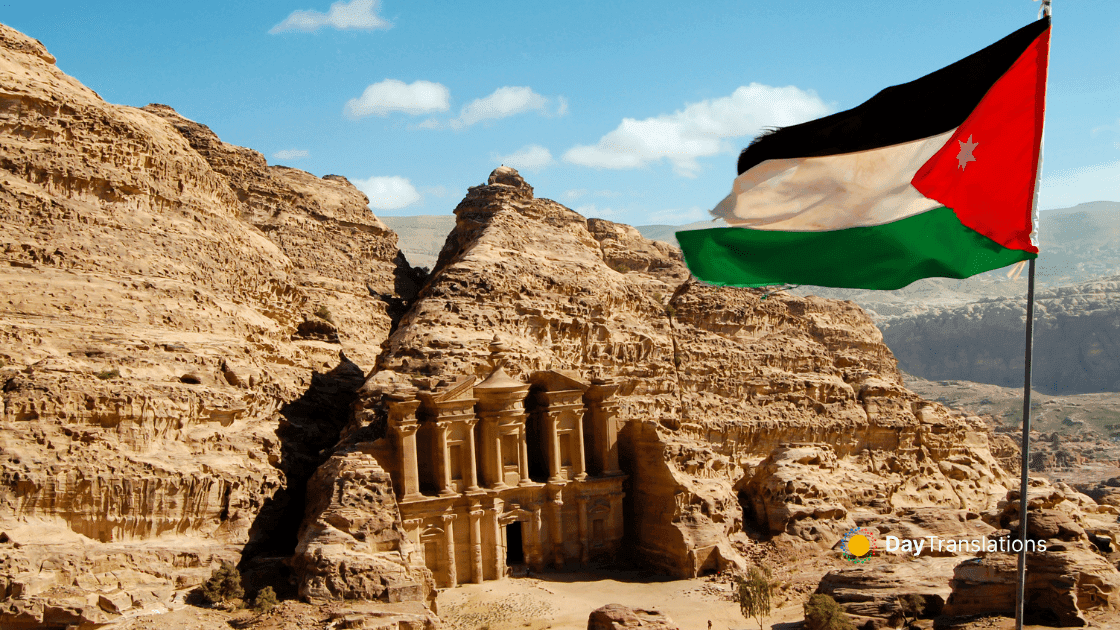
The Hashemite Kingdom of Jordan is located on the East Bank of the River Jordan in Western Asia. It borders Saudi Arabia to the east and south-east, Iraq to the east, Syria to the north and West Bank and Israel to the west, sharing control of the Dead Sea. Jordan’s only port is at its southern tip, at the Gulf of Aqaba, which is shared with Israel, Egypt, and Saudi Arabia. Much of Jordan is covered by the Arabian Desert. However, the north-western part of Jordan is part of the Fertile Crescent. The capital city is Amman.
During its history, Jordan has seen numerous civilizations, including those of the Ancient Near East with the Canaanite and later otherSemitic peoples such as the Edomites, and the Moabites. Other civilizations possessing political sovereignty and influence in Jordan were:Akkadian, Assyrian, Israelite/Judean, Babylonian, and Persian empires. The lands of Jordan were for a time under the rule of Pharaonic Egypt, composed part of the greater Kingdom of Israel (including the later Judaean Kingdom, Hasmonaen Kingdom of Israel and Herodian Dynasty), and notably, the region of Jordan also gave birth to the Nabataean civilization which left rich archaeological remains at Petra, one of the New Seven Wonders of the World located in the Ma’an Governorate. Cultures further west also left their mark, such as the Macedonian/Greek/Hellenistic, Roman, Byzantine, and Ottoman empires. Since the seventh century, the area has been under the primary rule of Muslim and Arab cultures, with the exceptions briefly for the area in Western Jordan during the Crusader Kingdom of Jerusalem, and for the entire region during the early-mid twentieth century under British rule which led to Jordan’s establishment as an autonomous state.
The Hashemite Kingdom of Jordan is a constitutional monarchy with representative government. The reigning monarch is the chief executive and the commander-in-chief of the armed forces. The king exercises his executive authority through the prime ministers and the Council of Ministers, or cabinet. The cabinet, meanwhile, is responsible before the democratically elected House of Deputies which, along with the House of Notables (Senate), constitutes the legislative branch of the government. The judicial branch is an independent branch of the government.
Modern Jordan is predominantly urbanized. Jordan is classified as a country of “high human development” by the 2010 Human Development Report. Furthermore, The Kingdom has been classified as an emerging market with a free market economy by the CIA World Fact Book. It has more Free Trade Agreements than any other country in the region. It has a “pro-Western” regime with very close relations with the United Kingdom and the United States. It also became a major non-NATO ally of the United States in 1996, and is one of only two nations in the region, the other being Egypt, that have diplomatic relations with Israel. Jordan is also currently undergoing close integration with the European Union and the Gulf Cooperation Council.
In this Country Profile
:: Background of Jordan ::
Following World War I and the dissolution of the Ottoman Empire, the UK received a mandate to govern much of the Middle East. Britain separated out a semi-autonomous region of Transjordan from Palestine in the early 1920s, and the area gained its independence in 1946; it adopted the name of Jordan in 1950. The country’s long-time ruler was King HUSSEIN (1953-99). A pragmatic leader, he successfully navigated competing pressures from the major powers (US, USSR, and UK), various Arab states, Israel, and a large internal Palestinian population. Jordan lost the West Bank to Israel in the 1967 war and barely managed to defeat Palestinian rebels who attempted to overthrow the monarchy in 1970. King HUSSEIN in 1988 permanently relinquished Jordanian claims to the West Bank. In 1989, he reinstituted parliamentary elections and initiated a gradual political liberalization; political parties were legalized in 1992. In 1994, he signed a peace treaty with Israel. King ABDALLAH II, the son of King HUSSEIN, assumed the throne following his father’s death in February 1999. Since then, he has consolidated his power and undertaken an aggressive economic reform program. Jordan acceded to the World Trade Organization in 2000, and began to participate in the European Free Trade Association in 2001. In 2003, Jordan staunchly supported the Coalition ouster of Saddam in Iraq and following the outbreak of insurgent violence in Iraq, absorbed thousands of displaced Iraqis. Municipal elections were held in July 2007 under a system in which 20% of seats in all municipal councils were reserved by quota for women. Parliamentary elections were held in November 2010 and saw independent pro-government candidates win the vast majority of seats.
:: Geography of Jordan ::
Location: Middle East, northwest of Saudi Arabia
Geographic coordinates: 31 00 N, 36 00 E
Area:
total: 89,342 sq km
land: 88,802 sq km
water: 540 sq km
Area – comparative: slightly smaller than Indiana
Land boundaries: 1,635 km
Border countries: Iraq 181 km, Israel 238 km, Saudi Arabia 744 km, Syria 375 km, West Bank 97 km
Coastline: 26 km
Maritime claims:
territorial sea: 3 nm
Climate: mostly arid desert; rainy season in west (November to April)
Terrain: mostly desert plateau in east, highland area in west; Great Rift Valley separates East and West Banks of the Jordan River
Elevation extremes:
lowest point: Dead Sea -408 m
highest point: Jabal Umm ad Dami 1,854 m
Natural resources: phosphates, potash, shale oill
Land use:
arable land: 3.32%
permanent crops: 1.18%
other: 95.5% (2005)
Irrigated land: 750 sq km (2003)
Total renewable water resources: 0.9 cu km (1999)
Freshwater withdrawal (domestic/industrial/agricultural):
total: 1.01 cu km/yr (21%/4%/75%)
per capita: 177 cu m/yr (2000)
Natural hazards: droughts; periodic earthquakes
Environment – current issues: limited natural fresh water resources; deforestation; overgrazing; soil erosion; desertification
Environment – international agreements: party to: Biodiversity, Climate Change, Climate Change-Kyoto Protocol, Desertification, Endangered Species, Hazardous Wastes, Law of the Sea, Marine Dumping, Ozone Layer Protection, Wetlands; signed, but not ratified: none of the selected agreements
Geography – note: strategic location at the head of the Gulf of Aqaba and as the Arab country that shares the longest border with Israel and the occupied West Bank
:: People of Jordan ::
Population: 6,407,085 (July 2010 est.)
Age structure:
0-14 years: 36% (male 1,161,484/female 1,096,441)
15-64 years: 59.4% (male 1,892,472/female 1,829,112)
65 years and over: 4.6% (male 143,058/female 146,718) (2010 est.)
Median age:
total: 21.8 years
male: 21.6 years
female: 22.1 years (2010 est.)
Population growth rate: 2.159% (2010 est.)
Birth rate: 27.06 births/1,000 population (2010 est.)
Death rate: 2.66 deaths/1,000 population (July 2010 est.)
Net migration rate: -2.81 migrant(s)/1,000 population (2010 est.)
Urbanization:
urban population: 79% of total population (2008)
rate of urbanization: 1.6% annual rate of change (2005-10 est.)
Sex ratio:
at birth: 1.06 male(s)/female
under 15 years: 1.06 male(s)/female
15-64 years: 1.03 male(s)/female
65 years and over: 0.97 male(s)/female
total population: 1.04 male(s)/female (2010 est.)
Infant mortality rate:
total: 17.03 deaths/1,000 live births
male: 17.55 deaths/1,000 live births
female: 16.48 deaths/1,000 live births (2010 est.)
Life expectancy at birth:
total population: 79.92 years
male: 78.64 years
female: 81.28 years (2010 est.)
Total fertility rate: 3.42 children born/woman (2010 est.)
HIV/AIDS – adult prevalence rate: less than 0.1% (2007 est.)
HIV/AIDS – people living with HIV/AIDS: 600 (2007 est.)
HIV/AIDS – deaths: fewer than 500 (2007 est.)
Nationality: noun: Jordanian(s) adjective: Jordanian
Ethnic groups: Arab 98%, Circassian 1%, Armenian 1%
Religions: Sunni Muslim 92%, Christian 6% (majority Greek Orthodox, but some Greek and Roman Catholics, Syrian Orthodox, Coptic Orthodox, Armenian Orthodox, and Protestant denominations), other 2% (several small Shia Muslim and Druze populations) (2001 est.)
Languages: Arabic (official), English widely understood among upper and middle classes
Literacy:
definition: age 15 and over can read and write
total population: 89.9%
male: 95.1%
female: 84.7% (2002 est.)
School life expectancy (primary to tertiary education):
total: 13 years
male: 13 years
female: 13 years (2008)
Education expenditures: 4.9% of GDP (1999)
Geography of Jordan: Important Geographical Information about Jordan
In this Country Profile
Jordan consists mainly of a plateau between 700 and 1,200 meters high, divided into ridges by valleys and gorges, and a few mountainous areas. Fractures of the Earth’s surface are evident in the great geological rift that extends southward from the Jordan Valley through the Gulf of Aqaba and the Red Sea, gradually disappearing south of the lake country of East Africa. Although an earthquake-prone region, as of early 1989 no severe shocks had been recorded for several centuries.
By far the greatest part of the East Bank is desert, displaying the land forms and other features associated with great aridity. Most of this land is part of the great Syrian (or North Arabian) Desert. There are broad expanses of sand and dunes, particularly in the south and southeast, together with salt flats. Occasional jumbles of sandstone hills or low mountains support only meager and stunted vegetation that thrives for a short period after the scanty winter rains. These areas support little life and are the least populated regions of Jordan.
The drainage network is coarse and incised. In many areas the relief provides no eventual outlet to the sea, so that sedimentary deposits accumulate in basins where moisture evaporates or is absorbed in the ground. Toward the depression in the western part of the East Bank, the desert rises gradually into the Jordanian Highlands – a steppe country of high, deeply cut limestone plateaus with an average elevation of about 900 meters. Occasional summits in this region reach 1,200 meters in the northern part and exceed 1,700 meters in the southern part; the highest peak is Jabal Ramm at 1,754 meters (though the highest peak in all of Jordan is Jabal Umm al Dami at 1854 meters. It is located in a remote part of southern Jordan). These highlands are an area of long-settled villages. Until about the 1940s, persons living in these villages depended upon rain-fed agriculture for their livelihood.
The western edge of this plateau country forms an escarpment along the eastern side of the Jordan River-Dead Sea depression and its continuation south of the Dead Sea. Most of the wadis that provide drainage from the plateau country into the depression carry water only during the short season of winter rains. Sharply incised with deep, canyonlike walls, whether wet or dry the wadis can be formidable obstacles to travel.
The Jordan River is short, but from its mountain headwaters (approximately 160 kilometers north of the river’s mouth at the Dead Sea) the riverbed drops from an elevation of about 3,000 meters above sea level to more than 400 meters below sea level. Before reaching Jordanian territory the river forms the Sea of Galilee, the surface of which is 212 meters below sea level. The Jordan River’s principal tributary is the Yarmouk River. Near the junction of the two rivers, the Yarmouk forms the boundary between Israel on the northwest, Syria on the northeast, and Jordan on the south. The Az Zarqa River, the second main tributary of the Jordan River, rises and empties entirely within the East Bank.
A 380-kilometer-long rift valley runs from the Yarmouk River in the north to Al Aqaba in the south. The northern part, from the Yarmouk River to the Dead Sea, is commonly known as the Jordan Valley. It is divided into eastern and western parts by the Jordan River. Bordered by a steep escarpment on both the eastern and the western side, the valley reaches a maximum width of twenty-two kilometers at some points. The valley is properly known as the Al Ghawr (the depression, or valley, also seen as Al Ghor).
The rift valley on the southern side of the Dead Sea is known as the Southern Ghawr and the Wadi al Jayb (popularly known as the Wadi al Arabah). The Southern Ghawr runs from Wadi al Hammah, on the south side of the Dead Sea, to Ghawr Faya, about twenty-five kilometers south of the Dead Sea. Wadi al Jayb is 180 kilometers long, from the southern shore of the Dead Sea to Al Aqaba in the south. The valley floor varies in level. In the south, it reaches its lowest level at the Dead Sea (more than 400 meters below sea level), rising in the north to just above sea level. Evaporation from the sea is extreme due to year-round high temperatures. The water contains about 250 grams of dissolved salts per liter at the surface and reaches the saturation point at 110 meters.
The Dead Sea occupies the deepest depression on the land surface of the earth. The depth of the depression is accentuated by the surrounding mountains and highlands that rise to elevations of 800 to 1,200 meters above sea level. The sea’s greatest depth is about 430 meters, and it thus reaches a point more than 825 meters below sea level. A drop in the level of the sea has caused the former Lisan Peninsula to become a land bridge dividing the sea into separate northern and southern basins.
Information about the Jordanian Flag: Colors and Meaning of the Flag of Jordan
In this Country Profile
The national flag of Jordan features three horizontal bands. The three colors used in the flag are black, white and green respectively. All these three bands in the flag of Jordan are connected to a red-colored symmetrical triangle. A white star with seven points is featured on the hoist side of the red triangle. The design is based on the Arab Revolt flag of World War I.
The color black stands for Abbasid Caliphate of Islam, white stands for the Umayyad Caliphate of Islam and the color green stands for Fatimid Caliphate of Islam. The red isosceles triangle on the hoist side represents the Great Arab Revolt of 1916, whereas the seven points symbolize the seven verses of Islamic belief, which is mentioned at the beginning of Qur’an. The seven points represent faith in one God, humanity, humility, national spirit, virtue, social justice and aspiration. The star also stands for the unity of the people of Arab.
Extensive List of Languages of Jordan: Spoken and Extinct Languages
In this Country Profile
Adyghe [ady] 44,300 in Jordan (1986). Alternate names: Adygey, West Circassian. Classification: North Caucasian, West Caucasian, Circassian
Arabic, Levantine Bedawi Spoken [avl] 700,000 in Jordan. Widespread but especially east. Alternate names: Bedawi. Dialects:South Levantine Bedawi Arabic, North Levantine Bedawi Arabic, Eastern Egyptian Bedawi Arabic. Classification: Afro-Asiatic, Semitic, Central, South, Arabic
Arabic, Najdi Spoken [ars] 50,000 in Jordan. Far eastern Jordan. Classification: Afro-Asiatic, Semitic, Central, South, Arabic
Arabic, South Levantine Spoken [ajp] 3,500,000 in Jordan (1996). Population total all countries: 6,200,000. Also in Argentina, Egypt, Israel, Kuwait, Libya, Palestinian West Bank and Gaza, Puerto Rico, Syria. Alternate names: Arabic, Levantine Arabic, Palestinian-Jordanian, South Levantine Arabic. Dialects:Madani, Fellahi. Village to village difference of which speakers are aware. Newly emerging urban standard dialect based on Amman. Classification: Afro-Asiatic, Semitic, Central, South, Arabic
Arabic, Standard [arb] Middle East, North Africa. Classification: Afro-Asiatic, Semitic, Central, South, Arabic
Armenian [hye] 8,000 in Jordan (1971). Dialects: Western Armenian. Classification: Indo-European, Armenian
Chechen [che] 3,000 in Jordan (Johnstone 1993). 2 or 3 villages mixed among Adygey [ady] and Arabic speakers. Classification: North Caucasian, East Caucasian, Nakh, Chechen-Ingush
Domari [rmt] 4,910 in Jordan (2000). Alternate names: Barake, Gypsy, Kurbat, Middle Eastern Romani, Nawar, Tsigene. Dialects: Nawar, Kurbat, Barake. Classification: Indo-European, Indo-Iranian, Indo-Aryan, Central zone, Dom
Jordanian Sign Language [jos] Alternate names: Lughat il-Ishaarah il-Urduniah, LIU. Classification: Deaf sign language
Kabardian [kbd] 56,000 in Jordan (2005 Circassian Association). Amman; Jerash; Sweileh; Russeifa; Zarqa.Classification: North Caucasian, West Caucasian, Circassian
:: Reference ::
Gordon, Raymond G., Jr. (ed.), 2005. Ethnologue: Languages of the World, Fifteenth edition. Dallas, Tex.: SIL International. Online version: http://www.ethnologue.com/
Famous Jordanian People: Jordanian Artists, Scientists, Leaders, Musicians, Politicians and Athletes
In this Country Profile
Jordan is home to outstanding individuals who made a difference with their remarkable achievements. The following people made their mark on both the local and international scenes. They are just some of many famous Jordanians who have lifted Jordan’s name worldwide and made a difference in our world.
:: List of Famous People from Jordan ::
Sayyid Hussein bin Ali
Sayyid Hussein bin Ali was the Sharif of Mecca, and Emir of Mecca from 1908 until 1917, when he proclaimed himself King of Hejaz, which received international recognition. He initiated the Arab Revolt in 1916 against the Ottoman Empire during the course of the First World War. In 1924, he further proclaimed himself Caliph of all Muslims. He ruled Hejaz until 1924, when, defeated by Abdul Aziz al Saud, he abdicated the kingdom and other secular titles to his eldest son Ali.
Abdullah I bin al-Hussein, King of Jordan
Abdullah I bin al-Hussein played a key role as architect and planner of the Great Arab Revolt against Ottoman rule, leading guerrilla raids on garrisons. He was the ruler of Transjordan and its successor state, Jordan, from 1921 to 1951 – first as Emir under a British Mandate from 1921 to 1946, then as King of an independent nation from 1946 until his assassination.
Hussein of Jordan
Hussein bin Talal was the King of Jordan from the abdication of his father, King Talal, in 1952, until his death. Hussein led Jordan through the Cold War and four decades of Arab-Israeli conflict. He recognized Israel in 1994, becoming the second Arab head of state to do so.
Abdullah II of Jordan
Abdullah II bin al-Hussein is the current King of the Hashemite Kingdom of Jordan. He ascended the throne on 7 February 1999 after the death of his father King Hussein.
Queen Noor of Jordan
Queen Noor of Jordan, born Elizabeth (Lisa) Najeeb Halaby, is the last wife and widow of King Hussein of Jordan. She was queen consort of Jordan between 1978 and 1999. Since her husband’s death in 1999, she has been queen dowager of Jordan. American by birth, she acquired Jordanian citizenship and renounced her American citizenship at the time of her marriage. She is the current president of the United World Colleges movement and an advocate of the anti-nuclear weapons proliferation campaign, Global Zero.
Queen Rania of Jordan
Rania al-Abdullah is the current Queen consort of Jordan as the wife of King Abdullah II of Jordan. Queen Rani has focused her energy, at home and abroad, on a variety of causes. In Jordan, her work concentrates on the caliber and quality of education for Jordanian children, while abroad she advocates for global education and for world leaders to fulfill their commitments towards the second Millennium Development Goal, Universal Primary Education.
Mustafa Wahbi Al-Tall, “Arar”
Mustafa Wahbi, better known as Arar, was a Jordanian poet, lawyer, teacher, judge, political agitator and philosopher. Arar was a pioneer of Jordanian patriotism and a spokesman for the nation’s ideals and aspirations. He was known for his nationalist and revolutionary oeuvre and his activism in accordance to it. Rebellious patriotism in Arar’s poetry is inextricably tied to his never-ending Don Juanism. As a lover, obsessed by the nostalgia for places that had once quenched his thirst for love, Arar created a quite new type of metaphors and terms of reference to the beloved and to her place in the poet’s dream-world. Place-related identity terms referring to the poet’s beloved or her close surroundings. And that helped establish a unique Jordanian literary tradition in the Arabic language.
Suleiman Mousa
Suleiman Mousa was a Jordanian author and historian. He wrote many books of which most prominent are “The Biography of Sharif Hussein Bin Ali “, “Jordan in the 1948 War”, “The Great Arab Revolt”, “History of Jordan in the 20th century”, and was the first and only Arab author to write about Lawrence of Arabia and show the Arab perspective. His book T.E. Lawrence: An Arab View was published in 1966 and translated into English, French and Japanese. It was written after a study that had convinced him that although there were many books written to praise Lawrence and others written to discredit him, all of them exaggerated his part in the Arab Revolt and failed to do justice to the Arabs themselves.
Haider Mahmoud
Haider Mahmoud is a prominent Jordanian poet. He was also Jordan’s Ambassador to Tunisia, and he later held the culture portfolio in the Jordanian government. Mahmoud’s works were published in several languages including Spanish, Japanese, Korean, French and Serbian, and his works are taught in the Jordanian curriculum in both the School and University levels. Mahmoud was granted several Arab and International awards and medals, including the King Abdullah II Award for Innovation in the Field of Literature (Jordan, 2004), The Independence Medal of First Order (Jordan, 1991), Medal of the Republic of the Supreme Order (Tunisia, 1999), Ibn-Khafaja Award for Poetry (Spain, 1986).
Abdul Rahman Munif
Abdul Rahman Munif is one of the most important Arabic novelists of the 20th century. He is most noted for closely reflecting the political surroundings of his day. His masterwork is the Cities of Salt quintet that followed the evolution of the Arabian Peninsula as its traditional Bedouin culture is transformed by the oil boom. The novels create an entire history of a broad region, evoking comparisons to William Faulkner’s Yoknapatawpha County. Munif chronicles the economic, social, and psychological effects of the promise of immeasurable wealth drawn from the deserts of nomad and oasis communities.