
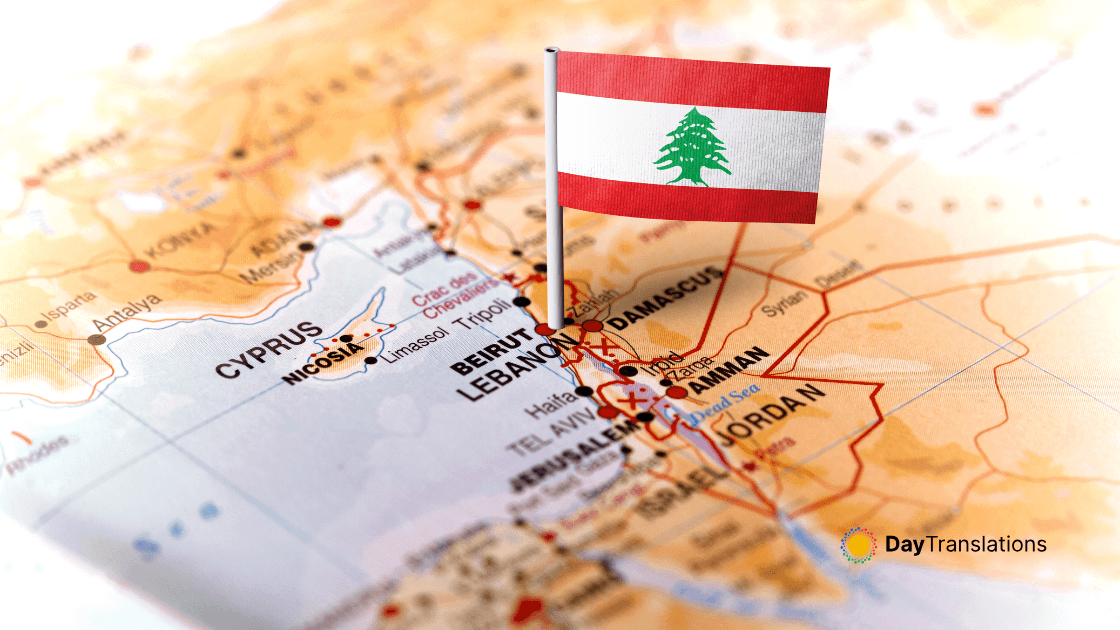
Lebanon is located in the Middle East, bordering the Mediterranean Sea, between Israel and Syria. Article 11 of Lebanon’s Constitution states that “Arabic is the official national language. A law determines the cases in which the French language may be used”. The majority of Lebanese people speak Lebanese Arabic, and sometimes French or English. Lebanese people of Armenian or Greek descent often speak Armenian or Greek fluently. If you are seeking professional translation services in Lebanon, Day Translations can assist you.
:: Background of Lebanon ::
Following the capture of Syria from the Ottoman Empire by Anglo-French forces in 1918, France received a mandate over this territory and separated out the region of Lebanon in 1920. France granted this area independence in 1943. A lengthy civil war (1975-1990) devastated the country, but Lebanon has since made progress toward rebuilding its political institutions. Under the Ta’if Accord – the blueprint for national reconciliation – the Lebanese established a more equitable political system, particularly by giving Muslims a greater voice in the political process while institutionalizing sectarian divisions in the government.
Since the end of the war, Lebanon has conducted several successful elections. Most militias have been disbanded, and the Lebanese Armed Forces (LAF) have extended authority over about two-thirds of the country. Hizballah, a radical Shia organization listed by the US State Department as a Foreign Terrorist Organization, retains its weapons. During Lebanon’s civil war, the Arab League legitimized in the Ta’if Accord Syria’s troop deployment, numbering about 16,000 based mainly east of Beirut and in the Bekaa Valley. Israel’s withdrawal from southern Lebanon in May 2000 and the passage in October 2004 of UNSCR 1559 – a resolution calling for Syria to withdraw from Lebanon and end its interference in Lebanese affairs – encouraged some Lebanese groups to demand that Syria withdraw its forces as well.
The assassination of former Prime Minister Rafiq HARIRI and 22 others in February 2005 led to massive demonstrations in Beirut against the Syrian presence (“the Cedar Revolution”), and Syria withdrew the remainder of its military forces in April 2005. In May-June 2005, Lebanon held its first legislative elections since the end of the civil war free of foreign interference, handing a majority to the bloc led by Saad HARIRI, the slain prime minister’s son. Lebanon continues to be plagued by violence – Hizballah kidnapped two Israeli soldiers in July 2006 leading to a 34-day conflict with Israel. The LAF in May-September 2007 battled Sunni extremist group Fatah al-Islam in the Nahr al-Barid Palestinian refugee camp; and the country has witnessed a string of politically motivated assassinations since the death of Rafiq HARIRI. Lebanese politicians in November 2007 were unable to agree on a successor to Emile LAHUD when he stepped down as president, creating a political vacuum until the election of Army Commander Michel SULAYMAN in May 2008 and the formation of a new unity government in July 2008.
In this Country Profile
:: Geography of Lebanon ::
Location: Middle East, bordering the Mediterranean Sea, between Israel and Syria.
Geographic coordinates: 33 50 N, 35 50 E
Area:
total: 10,400 sq km
land: 10,230 sq km
water: 170 sq km
Area – comparative: about 0.7 times the size of Connecticut
Land boundaries: total: 454 km, border countries: Israel 79 km, Syria 375 km
Maritime claims: territorial sea: 12 nm
Climate: Mediterranean; mild to cool, wet winters with hot, dry summers; Lebanon mountains experience heavy winter snows
Terrain: narrow coastal plain; El Beqaa (Bekaa Valley) separates Lebanon and Anti-Lebanon Mountains
Elevation extremes: lowest point: Mediterranean Sea 0 m, highest point: Qurnat as Sawda’ 3,088 m
Natural resources: limestone, iron ore, salt, water-surplus state in a water-deficit region, arable land
Land use:
arable land: 16.35%
permanent crops: 13.75%
other: 69.9% (2005)
Natural hazards: dust storms, sandstorms
Environment – current issues: deforestation; soil erosion; desertification; air pollution in Beirut from vehicular traffic and the burning of industrial wastes; pollution of coastal waters from raw sewage and oil spills
Environment – international agreements: party to: Biodiversity, Climate Change, Climate Change-Kyoto Protocol, Desertification, Hazardous Wastes, Law of the Sea, Ozone Layer Protection, Ship Pollution, Wetlands. Signed, but not ratified: Environmental Modification, Marine Life Conservation.
:: People of Lebanon ::
Population: 3,971,941 (July 2008 est.)
Age structure:
0-14 years: 26% (male 526,994/female 505,894)
15-64 years: 66.8% (male 1,275,021/female 1,380,131)
65 years and over: 7.1% (male 128,002/female 155,899) (2008 est.)
Median age:
total: 28.8 years
male: 27.6 years
female: 30 years (2008 est.)
Population growth rate: 1.154% (2008 est.)
Birth rate: 17.61 births/1,000 population (2008 est.)
Death rate: 6.06 deaths/1,000 population (2008 est.)
Net migration rate : NA (2008 est.)
Sex ratio:
at birth: 1.05 male(s)/female
under 15 years: 1.04 male(s)/female
15-64 years: 0.92 male(s)/female
65 years and over: 0.82 male(s)/female
total population: 0.94 male(s)/female (2008 est.)
Infant mortality rate:
total: 22.59 deaths/1,000 live births
male: 25.08 deaths/1,000 live births
female: 19.97 deaths/1,000 live births (2008 est.)
Life expectancy at birth:
total population: 73.41 years
male: 70.91 years
female: 76.04 years (2008 est.)
Total fertility rate: 1.87 children born/woman (2008 est.)
HIV/AIDS – adult prévalence rate: 0.1% (2001 est.)
HIV/AIDS – people living with HIV/AIDS: 2,800 (2003 est.)
HIV/AIDS – deaths: fewer than 200 (2003 est.)
Nationality:. noun: Lebanese (singular and plural) adjective: Lebanese
Ethnic groups: Arab 95%, Armenian 4%, other 1% note: many Christian Lebanese do not identify themselves as Arab but rather as descendents of the ancient Canaanites and prefer to be called Phoenicians
Religions: Muslim 59.7% (Shia, Sunni, Druze, Isma’ilite, Alawite or Nusayri), Christian 39% (Maronite Catholic, Greek Orthodox, Melkite Catholic, Armenian Orthodox, Syrian Catholic, Armenian Catholic, Syrian Orthodox, Roman Catholic, Chaldean, Assyrian, Copt, Protestant), other 1.3% note: 17 religious sects recognized
Languages: Arabic (official), French, English, Armenian.
Literacy:
definition: age 15 and over can read and write
total population: 87.4%
male: 93.1%
female: 82.2% (2003 est.)
Geography of Lebanon: Important Geographical Information about Lebanon
In this Country Profile
Lebanon is located in the Middle East, bordering the Mediterranean Sea, between Israel and Syria and occupies most of the area that made up ancient Phoenicia. Lebanon is one of the smallest countries of the Middle East, and the change in nature is connected to the altitudes. Furthermore, a major feature of Lebanese topography is the alternation of lowland and highland that runs generally parallel with a north-to-south orientation. Divided into five ribbon-like topographical areas stretching from North to South:
The Shoreline. At 210 km long, it is mostly consisted of rocks towards north, and sand south, adding some headlands, bays, and offshore islands
The Coastal plain. Surrounded by sea and mountains.
Mount Lebanon (the West Mountains).
Anti-Lebanon (the East Mountains).
Beqaa valley
Like any mountainous country, Lebanon’s physical geography is complex. Land forms, climate, soils, and vegetation differ markedly within short distances. The Lebanon Mountains run the length of the country, cresting at an elevation of more than 10,000 feet (3,000 m) above sea level. The Lebanon Mountains are the highest, most rugged, and most imposing of the whole maritime range of mountains and plateaus that start with the Amanus or Nur Mountains in northern Syria and end with the towering massif of Sinai. While some areas can be arid, the valleys between the mountains are green. The Biqa Valley. This central highland between the Lebanon Mountains and the Anti-Lebanon Mountains is about 177 kilometers in length and 9.6 to 16 kilometers wide and has an average elevation of 762 meters. Lebanon’s two major rivers are the Litani and the Orontes, both of which empty into the Mediterranean.
Professional Translation Organizations & Associations in Lebanon
In this Country Profile
Below is a list of the major translation organizations and associations of Lebanon.
:: List of Organizations ::
Arab Translators Network – Arab Professional Translators Society
Lebanese University
Université de Saint-Esprit
Université Saint-Joseph, École de Traducteurs et d’Interprètes de Beyrouth
Information about the Lebanese Flag: Colors and Meaning of the Flag of Lebanon
In this Country Profile
-
- Profile of Lebanon
- Geography of Lebanon
- Translation Organizations
- Flag of Lebanon
- Languages of Lebanon
The flag of Lebanon consists of two red stripes at the top and at the bottom. In the middle portion of the Lebanese flag there is a white band with a fully green cedar tree. The flag as adopted on 7th of December 1943. The flag ratio is 2:3.
Article 5 of the Lebanese Constitution “The Lebanese flag shall be composed of three horizontal stripes, a white stripe between two red ones. The width of the white stripe shall be equal to that of both red stripes. In the center of and occupying one-third of the white stripe is a green cedar tree with its top touching the upper red stripe and its base touching the lower red stripe.”
Article 5 of the Lebanese Constitution. “Two red-colored bands symbolizing martyrdom, surround horizontally a white-colored band, symbol of the Lebanese snow-capped mountain peaks; in the center of the flag, the cedar tree that characterized Lebanon since its birth, serving to build temples and ships, thus inspiring immortality and tolerance. Some people tend to use the color brown when drawing the trunk of the Cedar. This is a common mistake, the Cedar tree should be drawn in green.”
The present flag of Lebanon was adopted just prior to independence from France in 1943. It was designed to be a neutral flag, not allied to any one of Lebanon’s religious groups. The red and white colors are those associated, respectively, with the Kayssites and Yemenites, opposing clans that divided Lebanese society between 634 and 1711. The tree is the cedar traditionally connected with Lebanon: Psalms 92:12, “the righteous flourish like the palm tree, and grow like a cedar in Lebanon” The green cedar (Arz) (Species: Cedrus libani or Lebanon Cedar) symbolizes immortality and steadiness.
Extensive List of Languages of Lebanon: Spoken and Extinct Languages
In this Country Profile
Arabic, North Levantine Spoken
[apc] 3,900,000 in Lebanon (1991). Throughout Lebanon. Alternate names: Levantine Arabic, Lebanese-Syrian Arabic, Syro-Lebanese Arabic. Dialects: North Lebanese Arabic, South Lebanese Arabic (Shii, Metuali), North-Central Lebanese Arabic (Mount Lebanon Arabic), South-Central Lebanese Arabic (Druze Arabic), Standard Lebanese Arabic, Beqaa Arabic, Sunni Beiruti Arabic, Saida Sunni Arabic, Iqlim-Al-Kharrub Sunni Arabic, Jdaideh Arabic. Classification: Afro-Asiatic, Semitic, Central, South, Arabic.
Arabic, Standard
[arb] Middle East, North Africa. Classification: Afro-Asiatic, Semitic, Central, South, Arabic.
Armenian
[hye] 234,600 in Lebanon (1986). Alternate names: Ermenice, Armanski, Haieren, Somkhuri. Dialects: Western Armenian. Classification: Indo-European, Armenian.
English
[eng] 3,300 in Lebanon (2004). Classification: Indo-European, Germanic, West, English.
French
[fra] 16,600 in Lebanon (2004). Classification: Indo-European, Italic, Romance, Italo-Western, Western, Gallo-Iberian, Gallo-Romance, Gallo-Rhaetian, Oïl, French.
Kurdish, Northern
[kmr] 75,000 in Lebanon (2002 Meho). Ethnic population: 215,384 (2000 WCD). Beirut, also Sidon, Tripoli, and Biqa Valley. Dialects: Mhallami (Mardinli). Classification: Indo-European, Indo-Iranian, Iranian, Western, Northwestern, Kurdish.
:: Reference ::
Gordon, Raymond G., Jr. (ed.), 2005. Ethnologue: Languages of the World, Fifteenth edition. Dallas, Tex.: SIL International. Online version: http://www.ethnologue.com/
Famous Lebanese People: Lebanese Artists, Scientists, Leaders, Musicians, Politicians and Athletes
In this Country Profile
The following famous Lebanese people have made their mark on both the local and international scenes. They are just some of many famous Lebanese who have lifted Lebanon’s name worldwide.
:: List of Famous People from Lebanon ::
Joseph Roland Barbera
Joseph Roland Barbera is a notable Lebanese American animator, cartoon artist, storyboard artist, director- He produced together with William Hanna the most popular cartoons in the entire world: Tom and Jerry, The Huckleberry Hound Show, The Flintstones and many other world renowned cartoons. Hanna-Barbera Productions, Inc. was an animation studio that dominated North American television animation during the second half of the 20th century.
Elie Saab
Lebanese fashion designer Elie Saab has became synonymous with luxury and modernism. A serious couturier with a powerful and unique vision, Saab takes luxury to its zenith. The fact that Beyonce, appeared at Golden Globes awards ceremony in a brilliant metallic dress, has proved once again, that Elie Saab is one of the most highly rated names among Hollywood celebrities. In 1982, Saab launched his own Beirut-based fashion label when he was 18 years old. Nowadays, his creations can be found all over the world.
Zakaria Chihab
Is a retired Lebanese wrestler, the first Lebanese Olympic medal winner, a silver in the Men’s Greco-Roman bantamweight during Helsinki 1952 Olympics.
Khalil Gibran
Khalil Gibran was one of the most beloved Lebanese artists, authors, philosophers, theologians. He is chiefly known for his 1923 book. The Prophet, a series of 26 poetic philosophical essays written in English prose and is “widely regarded as a man of the East who brought a much needed element of spirituality to the West”. As a writer, Gibran relished controversy, and his writings reflected this spirit. The Prophet and his other books of poetry are illustrated with his mystical drawings. His poetry has been translated into more than twenty languages. The Lebanese poet Gibran Khalil Gibran is one of the Masters, just as the German Rilke. His drawings and paintings have been exhibited in the great capitals of the world.
Michael Ellis DeBakey
Michael Ellis DeBakey, a pioneering cardiovascular surgeon and researcher, was a world-renowned American, innovator, medical educator, and international medical statesman. According to the Baylor Collegr of Medicine, at age 23, while still in medical school at Tulane University, DeBakey invented the roller pump, the significance of which was not realized until 20 years later, when it became an essential component of the heart-lung machine.
Rony Seikaly
Rony Seikaly is former professional NBA basketball player. He was born in Beirut, Lebanon. Seikaly played for the US national basketball team at the 1986 World Championship, and with the US team he won the gold medal. Here are some of his records and accolades:
1989 Set Heat record for blocks in a game (8)
1990 Set Heat record for free throw attempts in a game (26) and blocks in a season (124)
1990 NBA’s Most Improved Player
1992 Set Heat record for rebounds in a season (934)
1993 NBA Player of the Week for March 7th
1993 Set Heat record for defensive (26) and total rebounds (34) in a game
1994 Set Heat record for free throws made in a game (16)
Fairuz
“Quite simply, Fairuz is one of the world’s nonpareil musicians and outstanding Artists, an international treasure of the order of Rostropovich, Sills, Ravi Shankar, Miles Davis, Sutherland, Pavarotti and Dylan.” (Harvard University scholar Barry Hoberman)
Fairuz is one of the most critically acclaimed Arabic singers. Legendary Fairuz possesses a large repertoire of around 1500 songs out of which nearly just 800 have been released. She has also been offered prestigious awards and titles over the years.
Fairuz has performed in many venues such as the Royal Albert Hall in London in 1962, the New York Carnegie Hall in 1971, the London Palladium in 1978, L’Olympia de Paris in 1979, London’s Royal Festival Hall in 1986, the Shrine Auditorium in Los Angeles (1971, 1981, and 2003), the John F. Kennedy Center for the Performing Arts in Washington D.C. (1981 and 1987) among many others. Moreover. Fairuz acted also in theatrical works. The Rahbani Brothers produced 25 popular musical plays (20 with Fairuz) over a period of more than 30 years.
“To her fans, the diminutive Lebanese diva known simply as Fayrouz has become a living icon without equal. For Arabs at home and especially for the diaspora, no other vocalist evokes both the bygone rhythms of village life and the halcyon, prosperous years before wars traumatized their region, sending many into exile.” New York Times.
Hayfa Wehbe
Gorgeous Hayfa Wehbe is a Lebanese model, actress, and singer who rose to fame in the Arab world as runner up for Miss Lebanon and later the release of her debut album Huwa az-Zaman. She is famous in the Middle East as a model since the age of 16.
Elias J. Corey
Elias James Corey is a notable chemist who received the Nobel Prize in Chemistry (1990) “for his development of the theory and methodology of organic synthesis”, specifically retrosynthetic analysis. He was born to Christian Lebanese immigrants in Methuen, Massachusetts. Professor Elias James Corey is regarded by many as the premier organic chemist of our time. Using theoretical principles, he has done pioneering work in stereochemistry and synthetic chemistry, particularly with prostaglandins, macrolide antibiotics, and insect hormones.
Peter Medawar
Worldwide famous Peter Medawar was born on 28 February 1915, in Rio de Janeiro, Brazil of a British mother and a Lebanese father. He was awarded the 1960 Nobel Prize in Physiology or Medicine 1960 for immune system. Medawar’s work on graft rejection and the discovery of acquired immune tolerance was fundamental to the practice of tissue and organ transplants.