
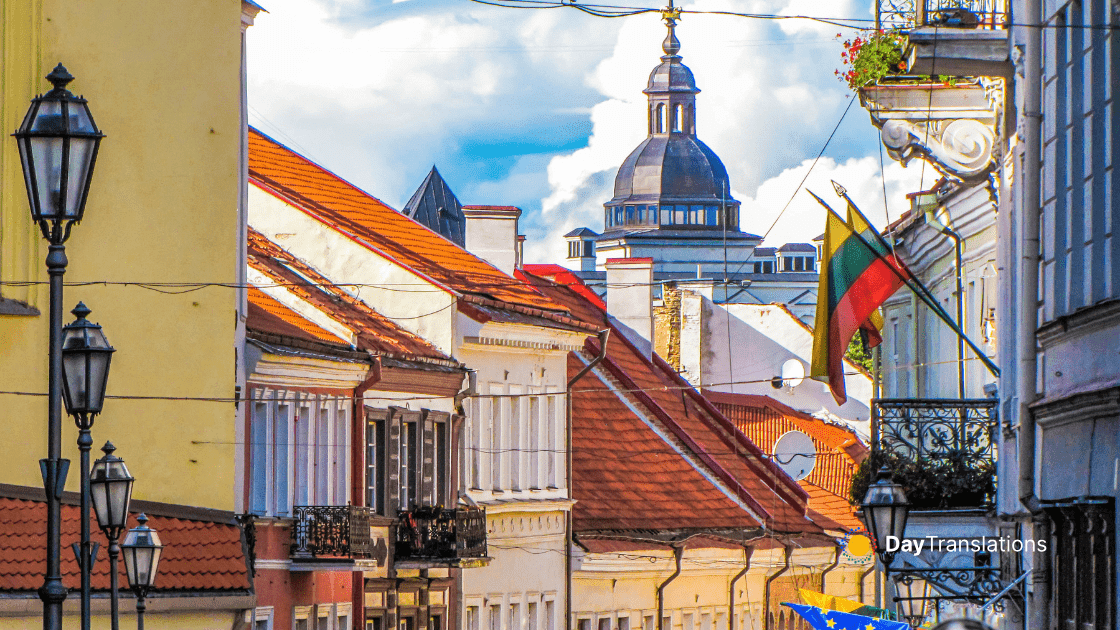
The Republic of Lithuania as it is officially called is part of Northern Europe and the largest of the three Baltic States. It was the largest country in Europe in the 14th century, called the Grand Duchy of Lithuania and comprise Ukraine, present-day Belarus, Lithuania and Latvia as well as parts of Russia, Poland, Moldova and Estonia. Poland and Lithuania became one state under the Lublin Union of 1569 and called it the Polish-Lithuanian Commonwealth, which lasted for two centuries. Wars with neighboring countries dismantled the union in clashes from 1772 to 1795 with Russia emerging as victor and annexing most parts of Lithuania. Lithuania gained independence from Russia on March 11, 1990.
Lithuania became a full member of NATO and the European Union in the early part of 2004. It is a member of the Council of Europe, which promotes cooperation and agreement on legal standards, democratic development, human rights, cultural cooperation and the rule of law. It is also a full member of the Schengen Agreement. Lithuania has its first woman president, Dalia Grybauskaite who won the elections on May 2009.
:: Background of Lithuania ::
Lithuania has a rich but turbulent history, peppered with internal strifes, border wars and periods of major territorial expansion. The earliest record about Lithuania was in 1009 A.D. There was expansion of the lands on the Baltic region during that time because of the Order of the Knights of the Sword and the Teutonic Order so Duke Mindaugas formed the Grand Duchy of Lithuania consisting of the lands occupied by Lithuanians – Samogitians, Couranians and Yotvingians. The Duchy lasted from 1230 to 1240. Duke Mindaugas converted to Catholicism in 1251 and on July 6, 1253, he was crowned as Lithuania’s King. He was assassinated ten years later causing civil war to erupt until another ruler by the name of Vytenis restored order by defeating the knights of the Teutonic Order.
In this Country Profile
The expansion of the Lithuanian empire continued from 1316 to 1341 under the leadership of Gediminas, the Grand Duke of Lithuania, the brother and successor of Vytenis. It extended up to Kiev, defeating the Russians and the Tatars (Tartars). But the Grand Duchy was isolated from the West and the Grand Duke tried to embrace Christianity to revert the situation and invited merchants, artisans and knights to relocate to Lithuania. He even sent appeals to Pope John XXII as well as to other European cities explaining that the aim of the Teutonic Order was conquering lands instead of spreading Christianity. By the time of Grand Duke Algirdas’ rule in1345 to 1377, the size of the Grand Duchy of Lithuania was almost doubled. Queen Jadwyga of Poland and Grand Duke Jogaila of Lithuania signed the Kreva Union of 1385 and oriented the economic as well as the cultural development of Lithuania westward.
Lithuania enjoyed independence with Poland, and by the time Grand Duke Vytautas ruled in 1392 up to 1430, the Grand Duchy of Lithuania has become among the largest countries in Europe and together with Jogaila commanded the Battle of Tannenberg and defeated the members and followers of the Teutonic Order. Russia was starting to become a power to be reckoned with and gaining ground on the lands under the Grand Duchy of Lithuania, prompting the country to align with Poland. Soon after the Poland-Lithuania Pact (Union of Lublin) was signed in 1569, turning Lithuania and Poland into one nation under a king. At that time, the Grand Duke of Lithuania was also the king that ruled the new nation. Land reform was introduced in the 16th century and agriculture boomed. New towns sprouted; there was book printing, humanism and reformation. Culture was developed not only in Lithuania but also in neighboring countries. The Vilnius University was formed in 1579. The Statutes of Lithuania was created during that time.
War with Sweden and Russia diminished the Polish-Lithuanian nation and by year 1795 a large part of Lithuania was already occupied by Russia. There were civil uprisings in an attempt to gain independence in 1794, 1830 to 1831 and again in 1863 but Russia prevailed. In 1832 the Vilnius University was closed and by 1864 a ban was put on using traditional Latin characters when printing Lithuanian books.
The growing number of intellectuals from the provinces brought about the emergence of a national movement that worked for the liberation of Lithuania from Russia. In Lithuania Minor or the German-ruled East Prussia, publications for Lithuania were being printed and smuggled to parts of Lithuania still under Russian rule. Finally the ban on book publication was lifted in 1904. Some of the most prominent leaders of this liberation movement include V. Kudirka and J. Basanavicius.
Lithuania was under the German rule in 1915 during WWI. In 1917 they were allowed to formally hold a meeting in Vilnius. That meeting resulted in the election of a ruling body with Antanas Smetona as chairman. The council declared Lithuanian independence on February 16, 1918 and fought the War of Independence from 1919 to 1920 against the Polish and Russian armies as well as the combined German and Russian soldiers led by General Bermondt. The Treaty of Moscow in 1920 caused Russia to renounce all claims to Lithuania and recognized its independence. The parliament assumed a constitution in 1922, declared the county as a republic with a parliamentary system of government. It added the region of Klaipeda in 1923. Towards the end of 1926, Antanas Smetona, leader of the Nationalist Party staged a coup led by the military and became the president.
Still, peace did not reign in Lithuania. Poland occupied the country in 1920 and annexed Vilnius in 1922. Germany pressured Lithuania to cede the region of Klaipeda in March 1939 although the period also brought about the development of small to medium-sized farms that improved production of agricultural products and exportation of livestock. Agriculture and light industries flourished and conformed with the new consumers.
There were other positives brought about by the inter-war. An extensive educational system was born and Lithuanian was the medium of instruction. Literature, music, theater, arts and the press were also developed. Russia and Germany took turns in trying to control Lithuania until an agreement signed by Lithuania and the USSR in 1939 saw the return of Vilnius to Lithuania in exchange for 20,000 Russian soldiers to be deployed in the country. However, Russia did not stop there. It demanded that Lithuania form a new government and requested an increase of Russian army troops. Powerless, Lithuania had no choice but to grant the request, with 10,000 additional Russian soldiers brought to the country and Lithuania proclaimed as a Soviet Socialist Republic. Lithuanians working for the state and prominent personalities were arrested then expatriated to Russia; almost 7,500 families were sent to Siberia; more than a thousand people were massacred and almost 4,000 people were imprisoned.
Rebels revolted against the oppression of USSR but another force threatened them in 1941 – Germany. For a brief period, much of Lithuania went under the control of the Germans and the people were again oppressed and were forced to work in German labor camps. Their rights as Lithuanians were removed and as many as 200,000 were massacred. Soviet partisans collaborated with independence supporters to prevent the men from getting recruited by the Germans. They were driven out of Lithuania by the Russian army in 1944. Lithuania continued to be under Russian rule until around the middle of 1988. The Communist Party of Lithuania was still in power until the economic and political crisis in the USSR also had a great impact on Lithuania. The Sajudis, a reform movement in Lithuania was formed, led by intellectuals who were anti-communists. Their program for national and democratic rights became popular across the nation and a multiple party system was instituted. The annexation of Lithuania to the USSR was annulled and Algirdas Brazaukas was elected as Lithuanian Communist Party’s First Secretary of the Central Committee in 1988 before splitting from the Central Committee. The Democratic Labor Party of Lithuania was formed by Algirdas Brazaukas in 1990.
The candidates backed by the Sajudis won the elections in the Lithuanian Supreme Soviet in 1990 and Vytautas Landsbergis, it chairman, adopted the Provisional Fundamental Law of the State. He proclaimed the restoration of the independence of Lithuania, prompting the USSR to retaliate by trying to overturn the government. There were many casualties during that round of hostilities. When the coup on Gorbachev in 1991 failed, the Communist Party was banned by Lithuania and their properties seized. While a sizeable number of troops remained in Lithuania, the tireless supporters of independence finally won and an agreement was signed by Russia and Lithuania on September 8, 1992 for the complete withdrawal of Russian troops by end of August 1993.
Ruling parties changed hands between the Conservatives led by Vytautas Landbergis and the Algirdas Brazaukas-led Labor Party from 1991 to mid-2000. New political parties New Union and Liberal Union broke the deadlock. Arthur Paulauskus of the center-left New Union became Chairman of the Seimas while the Liberal Party collapsed after 7 months. New Union Party and the left-wing Social Democratic Party formed a new cabinet under Algirdas Brazaukas with financial discipline as their main focus. Currently, Lithuania is a semi-presidential republic with Dalia Grybauskaite as President and Andrius Kubilius as Prime Minister. Irena Degutiene is the Seimas Speaker.
:: Geography of Lithuania ::
Location
Lithuania is one of the three states located in the Baltic Sea. Located in the southernmost part, it is the state with the largest population and also the largest in size. It is bounded on the north by Latvia, on the southeast by Belarus and the southwest by Poland. Its western part shares border with Kaliningrad Oblast, a territory of Russia.
Lithuania is the southernmost of the three Baltic States – and the largest and most populous of them. Lithuania was the first occupied Soviet republic to break free from the Soviet Union and restore its sovereignty via the declaration of independence on 11 March 1990. Its capital city is Vilnius.
Geographic Coordinates
Situated in Northern Europe, Lithuania lies between 53° and 57° North latitudes and 21° and 27° East longitudes. In some calculations and the only one recognized by the Guinness Book of World Records, the village of Purnuškes, 26 kilometer north of the capital city, Vilnius is the location of the geographical center of Europe. A marker, a white granite column on top of a crown of stars was erected at the exact point.
Area
Lithuania has a total landmass of 65,300 square kilometers, of which 62,680 square kilometers is land and 2,620 square kilometers is water. In comparative area size it is just slightly larger than West Virginia. It has a short sandy coastline that extends for 99 kilometers with only 38 kilometers facing the open Baltic Sea. The Curonian sand peninsula shelters the rest of the shoreline. The sand peninsula called the Curonian Spit is a thin and slightly curved sand dune spit, separating the Curonian Lagoon from the Baltic Sea, with the majority or 52 kilometers belonging to Lithuania and 46 kilometers can be found in Kaliningrad Oblast. The territorial sea belonging to Lithuania extends to 12 nautical miles.
Climate
Lithuania enjoys a transitional climate that varies between maritime and continental climates. The country has cool summers and warm winters, with precipitation equally distributed throughout the year, so there may be times when the county experiences wet and moderate summers and winters, with fixed periods for snow fall. Average temperature along the coast is around 1.6° C or 35° F in January. In July the temperature can be around 64°F (17.8°C). Inland, in Vilnius, the average temperature is 36°F (2.1°C) in January and about 18.1°C or 65° F in summer.
Terrain
Lithuania is predominantly a flat country, with undulating plains and lowlands. The highest point is Aukštojas, a hill that is almost 294 meters high. About 4% of Lithuania is covered by inland water, with 2,833 lakes and 1,600 ponds in the southern and northern parts of the country. There are also 758 rivers traversing the country. The shortest river is 10 kilometers long while the largest is the Nemunas River, which originates from Belarus, The World Bank data states that 34% of the total land area of Lithuania is still covered by forests and woodlands with pine, spruce and birch, although oak and ash forests are already scarce.
Elevation Extremes
The lowest point in Lithuania is the Baltic Sea. Aukštojas is the highest point. It is a hill that was officially measured in 2004 to be 293.54 meters high. It was higher than the previously designated highest point, Juozapine Hill which was only 292.7 meters. Aukštojas is approximately 24 kilometers southeast of the capital city. It was named after an ancient deity believed to be the creator of the world according to Lithuanian mythology.
Natural Resources
Lithuania is abundant in dolomite, clay, quartz sand, gypsum sand and limestone that are applicable for manufacturing glass, ceramics and high-quality cement. The country is also rich in mineral water but lacks sources of industrial materials and energy. There are oil deposits in Lithuania but these are not enough for commercial exploration as it will only satisfy about 20% of what Lithuania needs. Thermal energy along the Baltic Sea coast is abundant. There are also iron ore deposits although this is not explored since it will require strip mining, which is harmful to the environment. It will need huge foreign investments for mining and thermal energy utilization. Amber or gintaras, the national gem of Lithuania is found on the shores of the Baltic Sea and the Curonian Lagoon and some can be collected on the shores, particularly after a storm. Amber found in Lithuania vary in color tones from yellow to dark brown. There are also some that are bluish, greenish and reddish amber although these are becoming rarer.
Land Use
According to the World Bank figures, the total arable land in Lithuania has been drastically lowered to 29.3% (2007) from the high 40s in 2001. Only 0.5% of the land is planted with permanent crops. Poor land management contributes to the problem, with the number of derelict land parcels increasing. Meadowland and pastures are being turned into scrubland and former land areas used for farming are now being used for the construction of residential and recreation areas.
Natural Hazards
Lithuania is very lucky as there are no natural hazards threatening the country.
Environment
Current environmental issues affecting Lithuania are the contamination of its groundwater and soil with the chemicals and petroleum products coming from the military bases around the region.
International Agreements
In terms of international environmental agreements Lithuania is involved in:
• Air Pollution
• Air Pollution-Sulphur 85
• Air Pollution-Volatile Organic Compounds
• Air Pollution-Nitrogen Oxides
• Air Pollution-Persistent Organic Pollutants
• Climate Change-Kyoto Protocol
• Air Pollution-Sulphur 94
• Climate Change
• Endangered Species
• Law of the Sea
• Environmental Modification
• Biodiversity
• Wetlands
• Desertification
• Ozone Layer Protection
• Hazardous Wastes
• Ship Pollution
The country has already signed, but has not formally sanctioned any of the selected agreements.
:: People of Lithuania ::
Population
According to July 2011 estimates, the current population of Lithuania is 3,535,547, broken down into 13.8% aged 0-14 years, equivalent to 350,146 males and 236,984 females. Those aged 15-64 comprise 69.7% of the population, broken down into 1.211,707 males and 1,254,195 females. The older generation 65 years and over comprise 16.5%, with 381,157 females and 201.358 males.
Median Age
The median age is 40.1 years, with the males averaging 37.5 years and females averaging 42.7 years, according to 2011 estimates. Lithuania has a low population growth, with the 2011 estimate placed at -0.276%. It is also estimated that the birth rate for 2011 is only 9.29 births for every 1,000 population and a death rate of 11.33 per 1,000 population. The net migration is also very low, placed at -0.72 migrants per 1,000 population.
Sex Ratio
The sex ratio slightly favors the males with 0.89 males for every female for the total population. At birth, there is 1.057 male for every female born. In the under 15 years of age the data is almost the same, with 1.06 male; 0.96 males for the 15-64 year old bracket and 0.53 males for every female in the 65 years and over bracket.
Infant Mortality Rate
The 2011 estimates for infant mortality rate show that there are about 6.27 deaths for every 1,000 live births. The infant mortality rate is higher with the males, with 7.49 deaths for every 1,000 live births compared to only 4.99 deaths for every 1,000 females born.
Life Expectancy at Birth
Of the total population, the 2011 estimate for life expectancy at birth is placed at 75.34 years, broken down into 70.48 for the males and 80.48 for females. The fertility rate is estimated at 1.25 children born for every woman of child-bearing age for 2011.
HIV/AIDS
HIV/AIDS is not that prevalent in Lithuania. According to a survey done in 2009, there is only 0.1% prevalence of HIV/AIDS in adults, with 1,200 people living with HIV/AIDS and less than 100 deaths caused by HIV/AIDS.
Ethnicity
The people of Lithuania are called Lithuanians, which is used both as a noun and as an adjective. In terms of ethnicity, 84% of the population is Lithuanian and the rest broken down into 6.1% Polish, 4.9% Russian, 1.1% Belarusian and 3.9% of unspecified ethnicity, based on 2009 data.
Religion
Seventy-nine percent of the Lithuanian population is Catholic. This is followed by Russian Orthodox with 4.1%. Protestants, including the Evangelical Christian Baptists and the Lutherans comprise 1.9%, while 5.5% follow another or an unspecified religion and the rest or 9.5% do not follow any religion, according to the census done in 2001.
Languages
Lithuanian, the official language in the country is spoken by 82% of the population. Russian is next and is spoken by about 8% while Polish is spoken by 5.6% of the population. The rest of the population or 4.4% did not specify what language they speak, according to the 2001 census.
Literacy
Literacy is very high in Lithuania, with 99.6% of the population, male and female aged 15 and over able to read and write, according to the 2001 census. In the 2008 data, students spend an average of 16 years in school, with the females spending more time getting an education at 17 years compared to males who only spend an average of 15 years.
:: References ::
https://www.cia.gov/library/publications/the-world-factbook/geos/lh.html
http://europa.eu/about-eu/countries/member-countries/lithuania/index_en.htm
http://en.wikipedia.org/wiki/Lithuania
http://www.state.gov/r/pa/ei/bgn/5379.htm
http://countrystudies.us/lithuania/8.htm
http://www.tradingeconomics.com/lithuania/arable-land-percent-of-land-area-wb-data.html
http://www3.lrs.lt/pls/inter/w5_show?p_r=3803&p_k=2
Geography of Lithuania: Important Geographical Information about Lithuania
In this Country Profile
From being the largest kingdom in Europe during ancient times, consisting of Lithuania, Belarus, Ukraine and large parts of Russia and Poland, present-day Lithuania is still the largest in terms of size and population among the Baltic States. Lithuania shares a border with Latvia on the north that is 453 kilometers long. Belarus is located on the southeastern border and extends for 502 kilometers. The southwestern part is bordered by Poland for just 91 kilometers. Although this is the shortest border, this is still the busiest one since international traffic occurs here. Kaliningrad Oblast, an enclave of Russia is also part of the western border of Lithuania. The rest faces the open Baltic Sea for 108 kilometers. This is where the ice-free harbor of Klaipeda is located, sitting at the mouth of the Nemunas River. Lithuania is divided into 10 counties and 60 municipalities.
Topography
Lithuania is basically a glacially flat country situated on the eastern shores of the Baltic Sea. Lithuania has fertile soil dotted with several water systems. Highlands of moderate elevation are located on the eastern and southern sections of the country. Hilly regions are primarily found in the western part of Lithuania. Lithuania’s highest point, as of 2004 is the hill of Aukštojas, with a height of 293.54 meters. This is the officially-recognized highest point in Lithuania by the Guinness Book of World Records. It is higher than the previously designated highest point, the Juozapine Hill which, according to new measurements is only 292.7 meters high. The country is larger than Denmark, Netherlands, Switzerland and Belgium and about the size of West Virginia.
Rivers and Lakes
Numerous rivers, lagoons, lakes and swamps can be found in Lithuania, and most of the rivers are used for internal shipping for the transport of goods. The Curonian Lagoon, which is shared by Kaliningrad and Lithuania, is located on the western part of the country, separated by a narrow and long strip of sand dune called the Curonian Spit, which separates the Curonian Lagoon from the Baltic Sea.
Out of the 758 rivers in Lithuania, 21 are longer than 100 kilometers, with the Nemunas River as the longest. Other important rivers are Neris, Venta, Šušupe, Šventoji, Nevežis and Minija. Six thousand lakes punctuate the landscape of Lithuania, with 2,833 lakes larger than 10,000 square meters and 1,600 small ponds. Two thousand one hundred lakes are supported by groundwater while the rest are interconnected and supported by rivulets and inlets.
Some of the larger and interesting lakes are Drukšiai, the largest lake that supports the Ignalina nuclear power plant; Dysnai, Dusia, Luodis and Vištytis with the highest elevation at 170 meters above sea level. Lake Sartai has the longest shoreline and where horse racing on ice is held. The lake with the most islands, numbering 31 is Lake Avilys. Lake Asveja has the longest coastline, about 30 kilometers when all its inlets are combined. It is also the third deepest lake in Lithuania with Lake Tauragnas as the deepest. Lake Baluošas has an island that also has a lake within. Lake Žuvintas is the shallowest lake, with the deepest part only measuring 3 meters. The castle of Trakai is located on an island in Lake Galve. Despite the numerous river systems in Lithuania, only 600 kilometers are passable.
Forests
Lithuania was once heavily forested. Right now only third of the county is covered by forests. Oak and ash forests are already scarce. Most forests ar now covered with birch, spruce and pine. However, mushrooms and wild berries and several varieties of plants are still very abundant in the Lithuanian forests.
Climate
The climate in Lithuania is generally mild, ranging between continental and maritime climate. Along the coast the average temperature for January can be only as low as 27.5° Fahrenheit and about 60.8° Fahrenheit in July. Inland, around the capital city Vilnius, average temperature for January is about 21°F while July temperatures can be about 60.8°F. But Lithuania also suffers from temperature extremes, when summer temperatures can be as high as 95°F while the winters can be very cold, dropping down to -45°F inland and -29°F along the coast.
Lithuania receives about 800 millimeters of rain along the coast and around 900 millimeters on the highlands of Samogitia and lesser around the eastern part of the country, just about 600 millimeters. Severe storms are more common on areas near the Baltic Sea. Snow regularly falls every year and can last for seven months. The growing season on the eastern part of the country is only 169 days; longer on the western side, which can last of 202 days.
Natural Resources
Agricultural land and peat are two of the most valuable natural resources of Lithuania. At present one third of the country’s total land area is arable; another third is covered by forests and the rest planted with permanent crops, used for residential, business and recreation areas as well as permanent pastures. It is abundant in minerals that are suitable for the manufacture of high-quality cement, ceramics and glass, including dolomite, quartz sand, gypsum sand, clay and limestone. Mineral water is also abundant in the country.
Peat lands in Lithuania are still widespread, even if they were diminished in size. Larger accumulations can still be found in the southeast and western parts of the country. In the 1960s, the consumption of peat for fuel was about 1.5 million tons; reduced to 1 million tons in 1975 and further reduced to about 0.1 million tons by 1985. Households, briquette plants and heat plants are the principal consumers of peat.
Lithuania has a short supply of sources for industrial materials and energy. The shelf of the Baltic Sea and the western region of Lithuania are estimated to have commercial amounts of oil but studies indicate that this will only be able to supply 20% of what the whole of Lithuania will need in the next 20 years. There are a few oil wells operating in the western part of Lithuania, when oil was discovered in the area around the 1950s.
The abundance of rivers and lakes in near the coast of the Baltic Sea provides Lithuania with a vast quantity of thermal energy that can be used to provide heating for thousands of residences, as well as iron ore deposits on the southern parts. While the iron ore can be a viable commercial product, the Lithuanian government is reluctant to pursue this as it will require strip mining, which can harm the environment. It will also need large foreign funding for the exploration to commence.
Lithuania is still a good source of amber, the national gem of Lithuania. Amber is washed ashore from the Baltic Sea and some are gathered from the Courish Lagoon and also along the banks of large rivers like Nemunas, Sirvinta and Streva. Amber can also be found in Lake Plateliai and Lake Luktas. Amber from the Baltic Sea is considered as the best variety, with colors ranging from light golden yellow like honey to pale yellow and dark brown tones. There were other colors of amber before –white and those that have reddish, greenish and bluish tints, but these colors are already very rare. Amber washed up on the shores are irregular in shape. Some look like drops, rounded nodules and some are like grains.
:: References ::
http://www.mongabay.com/reference/country_studies/lithuania/GEOGRAPHY.html
http://en.wikipedia.org/wiki/Geography_of_Lithuania
http://www.vaitasassociates.com/geograph.htm
http://www.peatsociety.org/index.php?id=101
http://www.lithaz.org/lith/amber.html
Information about the Lithuanian Flag: Colors and Meaning of the Flag of Lithuania
In this Country Profile
The flag of Lithuania has a long history. In ancient times there were no national flags, just state flag. During that time the Great Duchy of Lithuania had a state flag that was red in color. On it was a white Vytis, a knight wearing an armor and riding a white leaping stallion. The knight held a sword high above his head. Lithuania underwent an era of national rebirth between the end of the 19th century and the beginning of the 20th century by fighting for their freedom from Russia. While fighting in the 1905 revolution and during World War I, the desire to become an independent state and the idea of creation of a new flag rose again.
There was a huge debate over the issue during the Conference of Vilnius in 1917, and the task of resolving the issue fell into the hands of the Council of Lithuania. Several ideas surfaced and a flag commission was created with Dr. Jonas Basanavicius, Tadas Daugirdas and artist Antanas Zmuidzinavicius. They submitted a proposal for a new flag design on April 19, 1918 that was adopted by the Council of Lithuania.
Colors
The adopted Lithuanian flag has three equal horizontal stripes with golden yellow on top, green in the middle and red at the bottom. The colors were selected, according to Dr. Basanavicius because these were colors that are found in folk weaving and other folk art often.
Meaning
The yellow symbolizes the fertile fields around Lithuania that turn golden when the grains planted on the fields, such as rye, flax and wheat ripen. The green represents nature and the vitality of Lithuania and the red represents the blood shed by those who fought for their nation’s freedom. Collectively the colors represent freedom from oppression, undaunted courage of the people and their hope for the future.
The adopted flag was first raised at the Council of State building on November 11, 1918 at the nation’s capital, Vilnius and was used until June 1940 before Lithuania was occupied by the Bolsheviks. It was raised again 48 years later, on October 7, 1988 at the Gediminas Castle when Lithuania gained its independence once again. It was readopted on March 20, 1989 following the end of the Soviet Union and Lithuania had become fully independent. The aspect ratio of the flag was changed from 1:2 to 3:5 in 2004. It should be noted that the Lithuanian flag looked the same as the flag of the Danish island of Ærø, which is located in the Baltic Sea.
:: References ::
http://www.omnitel.net/ramunas/Lietuva/lt_emblem_flag.shtml
http://www.mapsofworld.com/flags/lithuania-flag.html
http://en.wikipedia.org/wiki/Flag_of_Lithuania
Extensive List of Languages of Lithuania: Spoken and Extinct Languages
In this Country Profile
Karaim
[kdr] 120 in Lithuania. Ethnic population: 273 in Lithuania. Alternate names: Turkic Karaite. Dialects: Trakay (Trakai). Classification: Altaic, Turkic, Western, Ponto-Caspian
Lithuanian
[lit] 2,960,000 in Lithuania (1998). Population total all countries: 3,154,180. Widespread. Also in Argentina, Australia, Belarus, Brazil, Canada, Estonia, Kazakhstan, Kyrgyzstan, Latvia, Poland, Russian Federation (Europe), Sweden, Tajikistan, Turkmenistan, United Kingdom, United States, Uruguay, Uzbekistan. Alternate names: Lietuvi, Lietuviskai, Litauische, Litewski, Litovskiy. Dialects: Aukshtaitish (Aukshtaichiai, Aukstaitiskai, Highland Lithuanian), Dzukish (Dzukiskai), Shamaitish (Samogitian, Zhemaitish, Zemaitis, Zemaitiskai, Zemachiai, Lowland Lithuanian), Suvalkietiskai. Aukstaitiskai easily understand Suvalkai, Dzukai with some difficulty, and vice versa; Zemaitiskai difficult for others to understand. Classification: Indo-European, Baltic, Eastern
Lithuanian Sign Language
[lls] Classification: Deaf sign language
Romani, Baltic
[rml] Dialects: Lithuanian Romani. Classification: Indo-European, Indo-Iranian, Indo-Aryan, Central zone, Romani, Northern
:: Reference ::
Gordon, Raymond G., Jr. (ed.), 2005. Ethnologue: Languages of the World, Fifteenth edition. Dallas, Tex.: SIL International. Online version: http://www.ethnologue.com/
Famous Lithuanian People: Lithuanian Artists, Scientists, Leaders, Musicians, Politicians and Athletes
In this Country Profile
From its turbulent history and exposure to different cultures, Lithuania has a crop of illustrious personalities who helped shape the nation. Their accomplishments brought glory to a nation whose perseverance and courage to become independent and rise above the oppression are fully embodied in the colors of their flag. They shared their honor and made the population proud of their heritage.
:: List of Famous People from Lithuania ::
Arvydas Romas Sabonis
He was born on December 19, 1964 in Kaunas. He placed Lithuania in the sports map by becoming the best and most famous Lithuanian basketball player. He was named the European Player of the Year eight times and won the Mr. Europa Award twice. He was also a six-time Euroscar awardee. Sabonis spent seven seasons with the National Basketball League in the United States and was considered as one of the best passers and best overall centers in NBA history and was likened to NBA-great Larry Bird. He played for the Soviet Union basketball team which won the gold medal in the 1988 Summer Olympics in South Korea and helped Lithuania win bronze in the 1992 and 1996 Olympics. Sabonis retired in 2003 and became a business man. He was inducted to the FIBA Hall of Fame on August 20, 2010 and was names to the Naismith Memorial Basketball Hall of Fame (NMBHF) on April 4, 2011 and will be inducted on August 2011. Sabonis, who stands 7 feet and 3 inches will be the tallest basketball player to be inducted in the NMBHF.
Raimondas Šarunas Marciulionis
He is another basketball great from Lithuania, born on June 13, 1964 and a teammate of Arvydas Romas Sabonis when they won the Olympic gold medal in basketball for Russia during the 1988 Summer Olympics in South Korea. Like his compatriot, Marciulionis was also an NBA player, one of the first Europeans to join the North American basketball league. He was drafted by the Golden State Warriors in 1989 then played for the Seattle Supersonics in 1994 to 1995 then moved to Sacramento Kings and then to the Denver Nuggets. Before his retirement Marciulionis opened the Šarunas Hotel located in Vilnius in 1993. The following year he founded and became president of the Lithuanian Basketball League. In 1999 he was the founder and commissioner of the North European Basketball League that was absorbed by the current Baltic Basketball League. Today he juggles between being the president of Šarunas Marciulionis Basketball Academy and being a successful businessman.
Šarunas Jasikevicius
He was born on March 5, 1976 in Karunas but spent his teenage years in Pennsylvania, United States and attended the University of Maryland, where he played college basketball. Jasikevicius has an extensive club career, playing in Lithuanian basketball clubs Lietuvos Rytas in 1998 for his pro debut then moved to Olimpija Ljubljana. He also joined FC Barcelona for three seasons, from 2000 to 2003 and the Maccabi Tel Aviv in 2003. Jasikevicius also played for the Indiana Pacers from 2005 to 2007 then traded to the Golden State Warriors in 2007. He later signed up with Panathinaikos BC for three seasons from 2007 to 2010, Lietuvos Rytas of Lithuania in 2010 and is now (2011) signed up for one year with Fenerbahçe Ülker basketball club in Turkey. In his club basketball career, Jasikevicius won several awards but he holds the distinction of being the only player in the history of basketball to win the Euroleague award three times with three different teams – with FC Barcelona in 2003, with the Maccabi Tel Aviv also in 2003 and with the Panathinaikos BC in 2009.
Jonas Mekas
Jonas Mekas was born on December 23, 1922 in Semeniškiai, Biržai, Lithuania. He left Lithuania in 1944 because of the war but was caught by the Germans and imprisoned for eight months in a labor camp with his brother. They were able to escape and stayed for two months on a farm near the Danish border. He studied philosophy at the University of Mainz in Germany from 1946 to 1948 before emigrating to the US and settling in Brooklyn, New York with his brother Adolfas. He discovered avant-garde films and started creating his own. Mekas is a writer, curator and filmmaker and considered the godfather of American avant-garde cinema, with his works being exhibited in festivals and museums in America and Europe. He had closely collaborated and interacted with personalities like Yoko Ono, John Lennon and Salvador Dali. He has been teaching film courses at the New York University and the New School for Social Research in Greenwich, New York; at the MIT and at Cooper Union, a private college in Manhattan. Mekas has opened the Jonas Mekas Visual Arts Center in Vilnius on November 10, 2007.
Eimuntas Nekrošius
Multi-awarded Eimuntas Nekrošius, a world-renowned Lithuanian theater director was born on November 21, 1952 in Pažobris, a village in the municipality of Raseiniai in Lithuania. He graduated from the Lunacharsky Institute of Theater Arts in Moscow and returned to Lithuania to work at the Vilnius State Youth Theater and the Kaunas State Drama Theater. He had directed numerous plays including Little Tragedies by Aleksandr Pushkin, Hamlet by William Shakespeare, Macbeth and the Children of Rosenthal for the Bolshoi Theater in Moscow, and Faust by Johann Wolfgang Geothe.
Most of his plays exceed viewing time because he likes directing complex and challenging pieces. The plays usually use natural props like ice, stone, wind, fire and water, and all of them are set to soothing and repetitive background music.
Oskaras Koršunovas
Oskaras Koršunovas has directed more than 30 stage plays since 1990. Born in 1969 in Vilnius, he received his Bachelor’s (1988) and Masters (1994) degrees in theater directing from the Music Academy of Lithuania. At the Academic Drama Theater of Lithuania, Oskaras staged more than 20 performances. He moved on to establish his own Oskaras Koršunovas Theater in 1998. He distinguishes himself by focusing on present-day reality, creating plays about absurdity, fragmentation, chaos and paradox. As still quite young theater director, he has participated in more than 100 festivals and is already the recipient of many local and international awards.
Maironis
He was born as Jonas Maciulis in 1862. He was a poet and priest in Lithuania whose works became the standard for modern poetry in Lithuania. His name should not be confused with Jonas Maciulis, a Lithuanian professional basketball player born on February 10, 1985 who is under contract with Armani Jeans Milano. Maironis was from a poor peasant family from the Pasandravis estate. After attending the Kiev University for sometime he transferred to the Kaunas Seminary where he graduated in 1888, He also enrolled at the St. Petersburg Catholic Theological Academy where he graduated in 1892. He became a professor at the Academy, a rector of the Kaunas Seminary and a literature lecturer at Kaunas University. Some of his most notable works, translated into English are Lithuania, Trakai Castle, From Birute Hill, I’ll Vanish Like Smoke, The Earth is Sleeping, Spring, News Has Come, Summer Nights, Evening on the Lake of the Four Forest Cantons, and Jurate and Kastytis.
Martynas Mažvydas
Martynas Mažvydas was born on May 21, 1510 near Žemaiciu Naumiestis. He was a Lithuanian author who was persecuted by many in the predominantly Catholic Lithuania for his Protestant leanings and in 1546 accepted the invitation of Duke Albrecht of Prussia to study at Albertina University in Konigsberg, now known as Kaliningrad. He was still at the university when he wrote the first printed book in the Lithuanian language, the Catechismusa Prasty Szadei or The Simple Words of Cathechism, printed in Konigsberg in 1547.
Jurga Ivanauskaite
Jurga Ivanauskaite was born on November 14, 1961 in Vilnius. She was considered one of the most talented Lithuanian women. She wrote numerous essays, prose and dramas. She was also a painter. Her first book, publish in 1985 was entitled The Year of Lilies in the Valley or Pakalnuciu Metai. She was also the author of Ragan Ir Lietus or The Withc and the Rain, Placebas or Placebo and Citadel of Sleeping Butterflies (Mieganciu Drugeliu Tvirtove which were translated into many languages. She was an active supporter of the Tibetan liberation movement after visiting the Far East several times. Jurga died of soft tissue sarcoma at the age of 45 on February 17, 2007 in her hometown of Vilnius.
Mikalojus Konstantinas Ciurlionis
He was a consummate artist – a musician and a painter who had created more than 500 paintings and 350 musical works in his short lifetime. Born on September 10, 1875, Mikalojus was an educated Lithuanian, the eldest in a brood of nine. He was a musical prodigy and was able to play by ear when he was three and was able to sight-read music by the time he was seven. He contributed greatly to symbolism and art nouveau in Lithuania. The majority of his works can be viewed at the M. K. Ciurlionis National Art Museum located in Kaunas. There were several posthumous exhibitions of his artworks as well as the establishment of the National M. K. Ciurlionis School of Art in Vilnius and the Ciurlionis Art Gallery in Chicago. Asteroid 2420 Ciurlionis, discovered on October 3, 1975 by Nikolai Stepanovich Chernykh was named in his honor.
Violeta Urmanaviciute-Urmana
Violeta is considered the most beautiful mezzo soprano in the world and the most famous Lithuanian opera prima donna. She has sung in some of the most prestigious opera stages in the world, such as New York, Munich and Milan and had received a Royal Philharmonic Fellowship.
Vytautas Kernagis
Vytautas Kernagis was a Lithuanian artist who wore many hats. He was a singer-songwriter, an actor, a director, a television announcer and a bard. He also did many firsts for Lithuania. He was a pioneer of Lithuanian sung poetry and recorded his first album in 1978. He took part in the first rock opera of Lithuania entitled Velnio nuotaka; participated in the first musical done in Lithuania, the Ugnies medžiokle su varovais in 1976 and in Šokantis ir dainuojantis mergaites vieverselis, the first Lithuanian musical for a puppet theater. He was also a member of the pioneer big beat bands Aisciai and Rupus miltai of Lithuania. He died at age 57 from gastric ulcer.
Jonas Basanavicius
The many political upheavals that happened in Lithuania through the course of its history brought forth many outstanding personalities such as Jonas Basanavicius, who was considered as the patriarch of the Lithuanian nation. He founded the first newspaper in Lithuanian language, Aušra or The Dawn. He was also an activist that worked for the reestablishment of the independence of Lithuania. He was the chairman of the organizing committee of the Congress of Lithuanians in 1905 called the Great Seimas of Vilnius, the first modern national congress that dealt with national concerns rather than social issues. He was also a doctor and scientist and founded the Lithuanian Scientific Society where he also acted as chairman. The society conducted research on the language of Lithuania as well as its various dialects, and also conducted historical, archeological and anthropological researches. Jonas Basanavicius died on February 16, 1927, the same month and day that Lithuania was declared independent as a result of the Great Seimas.
Marija Gimbutiene
Marija Gimbutiene was born in Vilnius on January 23, 1921. She was a Lithuanian-American archeologist famous for her research cultures of Old Europe during the Neolithic and Bronze ages. Her published works on her research concluded that the Neolithic sites in Lithuania and Europe revealed that there were stable classless societies were the women were the center spiritually and materially. These works spurred the later researches on matriarchal and the Goddess movements.
Vytautas
Vytautas was one of the famous rulers of Lithuania during the glory days of the Grand Duchy of Lithuania. He was responsible for annexing several countries and increasing the size of the Grand Duchy. He was still revered as a national hero in modern Lithuania and played a great part in the National Lithuanian Revival during the 19th century.
Mindaugas
Mindaugas was the first known Grand Duke of Lithuania and also the country’s only king. He was born circa 1200. Although very little is known about his origins due to the absence of records, it was clear that he and his brother inherited the title because they were included in the list of elder dukes although they were younger when a treaty was signed in 1219 with Galicia-Volhynia. He was able to extend the size of his kingdom during his 10-year reign as the ruler of all the Lithuanians that number between 300,000 to 400,000. There was power struggle with his relatives and he was assassinated by his nephew and another political rival in 1263. The same fate was bestowed on the three immediate successors of Mindaugas.
Robert Lee Zemeckis
Robert Lee Zemeckis was born in Chicago to a Lithuanian American father and an Italian American mother on May 14, 1952. He is a famous Hollywood film director as well as a screenwriter and producer. He was the director who employed state-of-the-art special effects for the Back to the Future film series. He also directed the Academy Award-winning live-action/animation film Who Framed Roger Rabbit and Forrest Gump for which he earned an Academy Award for Best Director. He also pioneered the performance capture techniques for The Polar Express, Beowulf and A Christmas Carol. He revealed that he grew up without art in his family but he was inspired by television and started filming home movies with his parents’ 8 mm film camera.
Charles Bronson
He changed his last name to Bronson because he thought that Buchinsky is too Russian, although he is in fact Lithuanian, one of the 15 children born to Lithuanian immigrants. His father was of Lipka Tatar ancestry from Druskininkai. His maternal grandparents were from Lithuania who immigrated to the US and settled in the coal mining town of Tamaqua in Pennsylvania. Charles Bronson was christened Charles Dennis Buchinsky. He was the first Buchinsky family member to graduate from high school but his father died when he was 10 and he had to work in the coal mines until he enlisted in the US Army Air Force in 1943 as an aerial gunner and as a B-29 Superfortress crewman in 1945 Bronson was awarded the Purple Heart for his service. After working several odd jobs when the war ended, he joined a theatrical group in Philadelphia. From being a non-credited bit player, he went on to become a successful Hollywood actor, playing various roles, usually where brawn and muscles are needed. He first gained attention in the western film The Magnificent Seven and went on to star in great films such as Once Upon a Time in the West, The Dirty Dozen, The Great Escape, The Mechanic, Rider on the Rain and the very popular series, Death Wish.
Jascha Heifetz
He was born on January 20, 1901 in Vilnius to Jewish parents. He was considered as one of the best violinists in the world and his ability to play the violin with stunning precision was considered by critics to be unequalled. His father, Reuven Heifetz, his first mentor, was a violin teacher. Jascha was a child prodigy, and took up the violin at age 3. By the time he was five he was already taking lessons from Ilya D. Malkin, a pupil of Leopold Auer who became Jascha’s teacher in 1910 when he entered the Saint Petersburg Conservatory. At age 9 Jascha made his public debut in Kaunas, formerly Kovno, playing Felix Mendelssohn’s Violin Concerto in E minor. Jascha gained wide recognition and popularity at a very young age. He played in front of 25,000 spectators in an outdoor concert in 1911 and the police had to be called in to protect him due to the surge of adoring fans. He toured Europe while he was barely in his teens. His family moved to the United States in 1917 and he made his first appearance in front of an American audience on October 27, 1917 at Carnegie Hall in New York where he was an instant success. It was also on that same year that he became an honorary member of the national fraternity for men in music, the Phi Mu Alpha Sinfonia at the New England Conservatory of Music, making him the youngest member at age 16.
Juozas Petras Kazickas
Juozas Petras Kazickas, born on April 16, 1918 is of Lithuanian-American descent, He is a self-made multi-millionaire whose assets are worth more than 1 billion litas and in 2006 he was considered as the wealthiest Lithuanian. Juozas took up economics, first at Vytautas Magnus University and finished it at the Vilnius University. He received a scholarship to pursue his post graduate studies at Yale University and received his Ph.D. in 1951 when he successfully defended his thesis about the sovietization of Czechoslovakia. He was offered a professorship position at Georgetown University but turned it down to form Neris International with a fellow Lithuanian. Their company, based in Manhattan became a major coal exporter to Italy and Germany.
Kazickas is into venture capitalism and used to be actively involved with major industries. He became an adviser to the Lithuanian government. He was instrumental in encouraging American manufacturing giants like Coca-Cola, Motorola and Philip Morris to invest in his home country. He established his first private capital communication company Lithuania Litcom in 1991. This later became Omnitel.
He is also involved in philanthropy work. He sponsored the construction of a Catholic Church in Kathmandu, the Church of the Assumption, in memory of his son who was found dead in a hotel in Nepal in 1976. He established the Kazickas Family Foundation in 1998. It is a private foundation that donates to other foundations, gives scholarships and provides fund for Baltic Studies at Washington and Yale universities. It is also supporting the reconstruction of the Royal Palace of Lithuania and the Pažaislis Monastery, the largest monastery complex in Lithuania and the best example of Italian baroque style of architecture in Lithuania.
Nerijus Numavicius
Nerijus Numavicius is considered the richest businessman in Lithuania, with a net worth valued at 3.8 billion litas in 2011. He is the majority owner (73%) of the VP Group, a group of companies engaged in various retail trade businesses. He was born on May 12, 1968 in Šilale. He studied public health in Vilnius University and formed his company with fellow medical studies students. He is now a congress member of the Lithuanian Business Confederation and the chairman of the International Business School at Vilnius University.
Bronislovas Lubys
Bronislovas Lubys, born on October 8, 1938 in Plunge is one of the richest Lithuanians, owning 51% shares of stocks in Achema, the largest producer of fertilizer in the Baltic States, with facilities located in Jonava, with about 1,700 employees. He was the former Prime Minister of Lithuania and was a signatory to the Act of the Re-Establishment of the State of Lithuania or the Act of March 11 (1990).
Other notable people of Lithuanian descent:
Nathan Cummings
Nathan Cummings was the founder of Sara Lee. He was born in 1896 in Canada to Lithuanian immigrants. After acquiring and then selling McCormicks, he acquired several companies and formed them into the Consolidated Grocers Corporation which was changed into the Consolidated Foods Corporation in 1954 because he thought the name sounded old-fashioned. The company name was later changed into Sara Lee in 1985 after the name of one of the company’s best selling brands that Cummings acquired in 1956.
Victor David Brenner (June 12, 1871 – April 5, 1924).
He was born in Lithuania but grew up in the United States. He was an engraver, medalist and sculptor, known for being the designer of the Lincoln penny or the United States Lincoln Wheat Ears Cent.
Alexander Bruce Bialskis
He was the first director of the Federal Bureau of Investigation from 1912 to 1919.
Al Jolson (1886 to 1950) – singer and entertainer
Walter Matthau (1920 to 2000) – American actor
Birute Galdikus (1946) – world-leading authority on orangutans; anthropologist.
:: References ::
http://www.way2lithuania.com/en/travel-lithuania/famous-people
http://www.russiannewsnetwork.com/famlith.html
http://en.wikimedia.org/wiki/