
Malaysia is a very colorful country in Southeast Asia, very culturally diverse due to the different influences from its indigenous people, the Malays, the generations of Chinese traders that made Malaysia their home and the Indians and other ethnic groups whose cultural influences shaped the Malaysia that we know today.
Aside for the diverse traditions, Malaysia also imbibed colorful festivals, styles of clothing, architecture, religion, culinary secrets and various modes of life. Malaysians love to socialize and celebrate because they are warm, friendly and laid back.
As diverse as its culture, Malaysia is divided into 13 states and 3 Federal territories in total. Eleven states namely Johor, Kedah, Kelantan, Malacca, Negeri Sembilan, Pahang, Perak, Perlis, Penang, Selangor and Terengganu and two Federal territories, Kuala Lumpur and Putrajaya are in Peninsular Malaysia. Sabah and Serawak are the two states located in East Malaysia and one federal state, Labuan. Kuala Lumpur is the capital of Malaysia and the seat of the Federal government is located in Putrajaya.
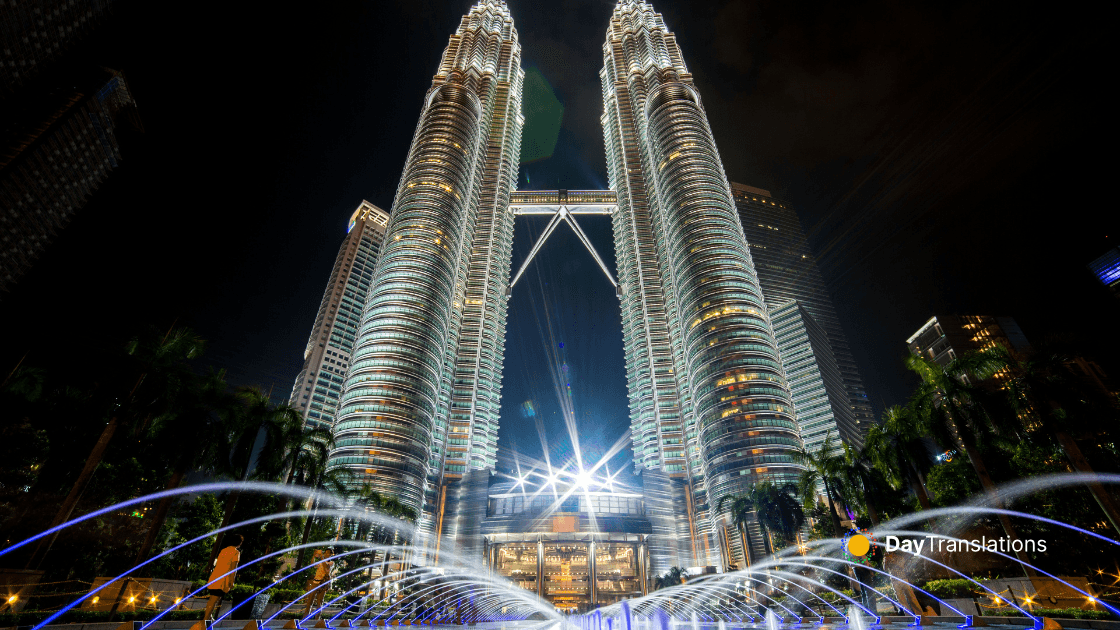
Attesting to its multiculturalism is Malaysia’s extreme contrasts. Here you will see wooden houses built on stilts several feet away from five-star hotels and towering skyscrapers like the Petronas Twin Towers in Kuala Lumpur, once the world’s tallest twin buildings in the world until 2004.
While English is the international language when conducting business, it is still important to have your important documents translated into the local language as part of business etiquette. Our professional translators are available to provide you with efficient, reliable accurate and fast online translation services while you are doing business in Malaysia.
In this Country Profile
:: Background of Malaysia ::
Malaysia is located in the spice route, and traders and settlers around the region, predominantly composed of Chinese and Indians begun arriving in the peninsula around the 1st century AD and by the 3rd century, trading ports and towns have already been firmly established.
Sanskrit inscriptions begun to appear around the 4thyor 5th century and Buddhism and Hinduism were the dominant religions. For six centuries (7th to 13th centuries), the Malay Peninsula was under the rule of the Srivijaya empire, an ancient maritime kingdom from Sumatra, now Indonesia. A prince of the ancient empire, Parameswara founded the Malacca Sultanate, believed to be the first independent state in the Malay Peninsula and became a Muslim, accelerating the conversion of Malays to Islam.
Several colonies ruled Malaysia since the 15th century. It was first conquered by Portugal in 1511 and then taken by the Dutch soon after. By 1786 the sultan of Kedah had leased the island of Penang to the British Empire through the British East Indian Company.
The Anglo-Dutch Treaty of 1824 caused Malacca to be under British control and by 1826 they were controlling Penang, Malacca, Labuan. Labuan was established as the crown colony based on the Straits Settlement and the Federated Malay States, consisting of Pahang, Selangor, Perak and Negeri Sembilan hade British residents as advisers to the Malay rulers who had to defer to them, also based on the treaty. The rest of the Malay states, which were still not under British rule, also had British advisers.
The Japanese army invaded and occupied Malaya, Sabah, Sarawak and Singapore during World War II and ruled the states for three years until Allied Forces reconquered Malaya. The British planned to unite the administration of Malaya after the war but were met with very strong opposition from the Malays, who strongly felt the weakening of the Malay rulers. They also opposed the granting of citizenship to the ethnic Chinese.
The Malayan Union, consisting of all those states under British rule in the Malay Peninsula, excluding Singapore was dissolved in 1948, giving back the autonomy of the Malay states to their rulers, although they were still under British protection. The Malayan Communist Party, the Malayan National Liberation Army (MNLA) started a campaign to oust the British from Malaya and the campaign lasted from 1948 to 1960, with frequent clashes between the anti-insurgency group led by Commonwealth troops and the MNLA.
By August 31, 1963 the British crown colonies of Sabah, Sarawak, including Singapore were proposed to be federated to form Malaysia. It was delayed until September 16, 1963 mainly due to the opposition of Serawak United People’s Party, consisting of working class Chinese and leftists, many of whom were involved in underground communist activities and Indonesia’s first president, Sukarno. Singapore became an independent state, separating from Malaysia on August 9, 1965.
Independence brought tension in the region, heightened by the conflict with Indonesia due to the formation of Malaysia. The racial tension between the Malays and the Chinese resulted in the May 13, 1969 race riots where many were killed. Officially the casualty tally was only 196 although the media reported that more than 2,000 people died between May 13 and July 31. The riot caused the declaration of national emergency as it resulted in the suspension of parliament, the establishment of a temporary National Operations Council, the resignation of Prime Minister Tunku Abdul Rahman and the implementation of the controversial New Economic Policy.
The goals of the New Economic Policy or NEP were to restructure the economy and eradicate poverty through the redistribution of wealth by changing the share of economic ownership, favoring the Bumiputras or the indigenous people of Malaysia. It was implemented in 1971 when Tun Abdul Razak was made Prime Minister. New business and large-scale manufacturing industries were created and expanded under the NEP. By the time Mahathir bin Mohamad became Prime Minister in 1981 there was already rapid economic growth and economic diversity due to the shift from being an agriculture-based economy to give more focus to services, tourism and manufacturing. The shift saw the emergence of very huge projects like the North-South Expressway, the Multimedia Super Corridor and the Petronas Tower as well as the transfer of the federal administrative capital to Putrajaya.
Malaysian government follows a bicameral legislative system. The country is headed by the King or Yang di-Pertuan Agong, which is changed every five years among the rulers of Malaysia. The current King is Sultan Mizan Zainal Abidin, the Sultan of Terengganu whose reign started on December 13, 2006. Adopting a democratic parliamentary, the Prime Minister heads the government, which is appointed by the King. Currently the position is occupied by Najib Razak who assumed office on April 3, 2009.
:: Geography of Malaysia ::
Location
Malaysia is located in Southeast Asia, amidst the South China Sea, which separates Malaysia into two regions with East Malaysia to the east and Peninsular Malaysia to the west. Peninsular Malaysia is bordered by Thailand on the north, Singapore on the south, Strait of Malacca on the west and Sumatra, Indonesia on the east. A large part of East Malaysia shares borders with Borneo and Kalimantan, Indonesia and the rest is bordered by the Celebes Sea and Brunei.
Geographic Coordinates
Malaysia’s latitude is 2° 30’ north of the equator while its longitude is 112° 30’ East of Greenwich.
Area
Total: 329,847 sq. km.
Land: 328, 657 sq. km.
Water: 1,190 sq. km.
Comparative Area Size
In terms of land area, Malaysia, with a total land area of 329,847 sq km is slightly larger than New Mexico in the United States, which has a total area of 315,194 sq km.
Land Boundaries
Total land boundary of Malaysia is 2,669 km, shared with Brunei for 381 km, with Indonesia for 1,782 km and with Thailand for 506 km.
Malaysia is composed of two regions separated by the South China Sea, Peninsular Malaysia and East Malaysia, which is also known as Malaysian Borneo. Its total coastline is 4,675 long. Peninsular Malaysia has a coastline of 2,068 km and East Malaysia has 2,607 km.
Maritime Claims
• Malaysia lays claim to 12 nautical miles of territorial waters from its baseline.
• Contiguous zone is 24 nautical miles from its coast.
• Exclusive economic zone covers 200 nautical miles from the coast.
• Continental shelf of Malaysia is 200 meters deep or to the extent of its continental margin; specified boundary in the South China Sea.
CLIMATE
Malaysia’s climate is basically tropical climate with the annual southwest monsoons prevailing from April to October and the northeast monsoons being active from the months of October to February. Temperatures are fairly high but uniform, between 73 degrees Fahrenheit to 88 degrees Fahrenheit, with very high humidity.
TERRAIN
The majority of Malaysia’s terrain is covered by swamps and rainforests. The terrain of Peninsular Malaysia is composed of coastal plains in the east and west regions and a range of steep mountains covered by forests. Sarawak has an alluvial swampy coastal plain, rolling country with intervals of mountain ranges with rainforest-covered mountainous interior. The Crocker Mountains, which extends inland for about 48 kilometers north and south, divides Sabah into two.
ELEVATION EXTREMES
Lowest Point – sea level along the Indian Ocean at 0 meters
Highest Point – In the mainland, the highest point is Mount Kinabalu, which rises to 13,451 feet.
NATURAL RESOURCES
Malaysia is considered as one of the top exporters of natural rubber and palm oil. It also exports timber. Petroleum, natural gas and tin contribute greatly to Malaysia’s economy. The country is also rich in copper, iron ore, bauxite and coal and has deposits of clay, silica, limestone, barite, kaolin, phosphates granite and marble.
LAND USE
Arable Land: Fifty-six percent of the total land area of Malaysia is arable, which are planted with crops such as wheat, rice and maize. Permanent crops or those not replanted after each harvest such as coffee, citrus, rubber, flowering shrubs, vines and fruit and nut trees cover 17.54% of the total land area. Other areas used for other purposes such as meadows, pastures, barren land, woodlands, forests, roads and built-on areas total 77% according to the 2005 data figures.
NATURAL HAZARDS
Flooding, forest fires and landslides are some of the natural hazards that occur in Malaysia regularly.
ENVIRONMENT
Current Issues: Economic development plays a major role in the environmental issues that plague developing nations. Malaysia like other countries is also suffering from air pollution due to industrial and vehicular emissions and also has to contend with water pollution due to the increasing amount of raw sewage. Smoke and haze from Indonesian forest fires affect the country. Deforestation is also getting to be an environmental problem as escalates the frequency of occurrence of natural hazards in the country.
International Agreements:
Environmental protection is a priority in the region and Malaysia participating in several international and regional efforts in support of the reduction, application, research and promotion of biodiversity, climate change, Climate Change-Kyoto Protocol, desertification, endangered species, hazardous wastes, law of the sea, marine life conservation, ship pollution, tropical timber 83, tropical timber 94, ozone layer protection and wetlands. Malaysia has signed the international agreements but has not yet ratified any of the agreements.
:: People of Malaysia ::
POPULATION
The current population of Malaysia (2010 figures) is 28,306,700. July 2011 population estimate puts it at 28,728,607.
Age Structure
• 0 – 14 years ——– 29.6% total, with 4,374,495 males and 4,132,009 females
• 15 – 64 years ——- 65.4% total, with 9,539,972 males and 9,253,574 females
• 65 years and over — 5% total, with 672,581 males and 755,976 females based on 2011 estimates
MEDIAN AGE
Total: 26.8 years
Male: 26.7 years
Female 27.0 years according to 2011 estimates
POPULATION GROWTH RATE
According to 2011 estimates, the annual birth rate in Malaysia is 1.576%. Birth rate is estimated (2011) at 21.08 births/1,000 population. Death rate, according to the July 2011 estimate is at 4.93 deaths/1,000 population while the net migration rate is -0.39 migrants/1,000 population. This 2011 estimated figure does not reflect the net flow of illegal immigrants from other countries around the region whose number is unknown.
SEX RATIO
• At Birth 1.069 male(s) / female
• Under 15 years 1.06 male(s) / female
• 15 – 64 years 1.01 male(s) / female
• 65 years and over 0.79 male(s) / female
• Total Population 1.01 male(s) / female (2011 estimate)
MORTALITY RATE
Infant mortality rate in Malaysia according to 2011 estimates place the total figures at 15.02/1,000 live births. The breakdown is 17.37/1,000 live births for males and 12.52/1,000 births for female.
LIFE EXPECTANCY AT BIRTH
Total Population: 73.79 years
The 2011 estimates for life expectancy at birth for males in Malaysia is around 71.9 years and 76.4 years for females.
TOTAL FERTILITY RATE
There are 3.67 children born for every woman In Malaysia, according to the 2011 estimates.
Based on estimates done in 2009, HIV / AIDS statistics show the following:
• HIV / AIDS – Adult Prevalence Rate
HIV/AIDS in Malaysia is prevalent in 0.5% of its adult population.
• HIV / AIDS – People living with HIV/AIDS
It was estimated in 209 that there are about 100,000 people In Malaysia who are living with HIV/AIDS.
• HIV / AIDS – Deaths
2009 estimate place deaths due to HIV/AIDS at 5,800.
NATIONALITY: Malaysian (s) (noun); Malaysian (adjective)
Ethnic Groups: (2004 estimates)
• Malay 50.4%
• Chinese 23.7%
• Indigenous 11.0%
• Indians 7.1%
• Others 7.8%
Religions
• Islam 60.4%
• Buddhism 19.2%
• Christianity 9.1%
• Hinduism 6.3%
• Confucianism/Taoism/
Other Traditional Chinese 2.6%
• Other/Unknown 1.5%
• None 0.8%
Languages
Bahasa Malaysia or simply Malay is the official language in Malaysia. Other predominant languages spoken are various Chinese dialects such as Cantonese, Foochow, Hainan, Hakka, Hokkien and Mandarin, English, Tamil, Thai, Panjabi and Malayalam. The indigenous people in East Malaysia speak many indigenous languages, with Iban and Kadazan more widely spoken.
LITERACY
Literacy rate in Malaysia is high, with 88.7% of the total population over 15 can read and write. Literacy rate for females is 85.4%, slightly lower than the males, which is around 92%. Although kindergarten is not compulsory, more Malaysian children are starting to attend kindergarten between the age of three and six. Primary education, lasting 6 years is compulsory but children are not compelled to attend secondary school.
Geography of Malaysia: Important Geographical Information about Malaysia
In this Country Profile
Malaysia is near the equator, which greatly affects its climate. It can be categorizes as equatorial or tropical, constantly being hot and humid all-year round. Being separated by the South China Sea, the two regions of Malaysia differ in weather patterns. Peninsular Malaysia in the west is affected by the wind coming from the mainland. On the other hand, East Malaysia being located in the east has more maritime weather. The South China Sea, which is part of the vast Pacific Ocean, exposes Malaysia to the effects of El Nino and La Nina weather phenomenon, increasing the occurrence of the country’s natural hazards.
Two monsoon winds seasons prevail in Malaysia. From November to March, the country is affected by the northeast monsoon bringing more rainfall coming from the northern part of the Pacific and China. During late May until September, the southwest monsoon, originating from the Australian desert blows into Malaysia, bringing rains although not as much as the northern monsoon. Fine weather prevails all over the country from March to October.
Malaysia is quite unique. It is the only country that has land in the Malay Archipelago as well as in Asian mainland. However the two distinct parts of Malaysia, Peninsular Malaysia and East Malaysia share almost the same landscape, both having coastal plains and gently rolling hills and mountains, with the highest peak, Mount Kinabalu located on the tip of Sabah in East Malaysia. There are two major cities in East Malaysia, Kota Kinabalu and Kuching.
East Malaysia has a mountainous interior, hilly plains and fertile valleys and beautiful coasts. Sedimentary rocks found in the mountains of East Malaysia are mostly sedimentary with limestone, formed about 540 million years ago during the Paleozoic age being the most common. When these rocks were eroded during the Tertiary Period the remnants of the sedimentary rocks were found to be rich in natural gas and oil.
Peninsular Malaysia is more mountainous, with almost half of it covered by granite, older rocks and igneous rocks. Alluvium (clay) covers the rest of Peninsular Malaysia. The fertile regions are those near the coast and the area that borders the straits of Malacca is where the majority of Peninsular Malaysia’s population congregates. This is also where Kuala Lumpur, the capital of Malaysia is located.
In East Malaysia, the highest mountain range is the Crocker Range located in Sabah. The mountain range divides the state into two. This is where Mount Kinabalu, a UNESCO World Heritage Site and the tallest mountain in Malaysia is found. The second highest peak in the country is Mount Trus Madi. The only active volcano in Sabah is Bombalai Hill. Mount Trus Madi, lying between the districts of Tambunan to the north and Keningau to the south is not as popular as Mount Kinabalu. It is reputed that its summit has the best view of Mount Kinabalu at dawn. This is also the only place where the Nepenthes x trusmadiensis, a unique pitcher plant that is a natural hybrid between Nepenthes Iowii and Nepenthes edwardsiana is found.
On the Peninsular Malaysian side the mountain range of Titiwangsa Mountains divide the peninsula into the west and east coasts. This is where Mount Korbu, the second highest peak in the peninsula is located. The highest peak, Mount Tahan is found in the Tahan Range.
Tropical rainforests cover nearly half of Malaysia. The rainforests are made up mainly of dipterocarp, mangroves and swamps. Sabah and Sarawak, both in East Malaysia are two of the world’s richest sources of dipterocarp species of trees.
Erosion of limestone around Malaysia created numerous caves on both states and Mulu Caves located in East Malaysia are the largest in the world and a major tourist attraction. Deer Cave and Lang’s Cave are the other famous caves while the Sarawak Chamber is known as the largest cave chamber in the world, measuring 2,297 feet long and 230 feet high. The Sarawak Chamber was only discovered in 1981 and its size is thrice the size of the Big Room in the Carlsbad Caverns National Park of New Mexico in the United States.
Major parts of both Peninsular Malaysia and East Malaysia are bordered by water. There is the South China Sea that divides the country into two states. The western coast of Peninsular Malaysia faces the Strait of Malacca towards the southern portion and the northern portion faces the Andaman Sea. The Strait of Malacca is a very important shipping lane, making Malaysia one of the major ports in the world. The Straits of Johor is the maritime border between Singapore and Malaysia and where the Johor-Singapore Causeway linking Malaysia and Singapore is built.
Malaysia has the largest artificial lake in Southeast Asia, the Kenyir Lake which was built near the Malaysian-Thai border. Only two natural lakes can be found in Malaysia, the Bera Lake and the Tasik Chini. These freshwater lakes are rich in bio-diversity and provide livelihood to the Semelai branch and the Jakun branch of the Orang Asli, respectively. According to the Orang Asli legend, a dragon called Naga Seri Gumum, Malaysia’s version of the Loch Ness Monster inhabits Tasik Chini. It is also believed that an ancient sunken Khmer city lies at the bottom of Tasik Chini.
Information about the Malaysian Flag: Colors and Meaning of the Flag of Malaysia
In this Country Profile
:: Meaning of the Malaysia Flag ::
The current flag of Malaysia was officially adopted in September 16, 1963 and used the flag of the United States as its model. There are 14 red and whites stripes of equal width on the flying side of the flag and a dark blue canton on the hoisting side. The colors and design symbolize unity, the symbols of Islam and royalty.
The official colors of the flag of Malaysia are red, white, yellow and dark blue, combining the stars and stripes and traditional Islamic symbols. It has 14 alternating stripes of red and white, starting with red. All the stripes are of even size. A dark blue canton is on the upper left corner of the flag with a crescent moon and a 14-point star in the middle of the canton.
The dark blue canton stands for unity of the people of Malaysia. The crescent moon is the symbol of Islam and the 14-point star symbolizes the unity of the 13 states and the federal government. The red and white stripes of even size stand for the equal status of the federal government and the member states in the federation. Yellow is the color of royal Rulers of the Malay States.
Extensive List of Languages of Malaysia: Spoken and Extinct Languages
In this Country Profile
:: List of Languages ::
Languages of Malaysia – PENINSULAR
Malaysia (Peninsular). 26,640,000 (2004). 12,123,300 speakers of Austronesian languages, 3,399,000 speakers of Chinese languages, 44,610 speakers of Austro-Asiatic languages (Matisoff 1991), 1,090,000 speakers of Dravidian languages. Immigrant languages: Burmese, Chinese Sign Language, Eastern Panjabi (56,400), Malayalam (35,800), Sylheti, Telugu (39,000), Western Cham. Information mainly from A. Baxter 1988; B. Comrie 1987; R. Dentan 1968; I. Hancock 1969; J. Holm 1989; F. Lebar, G. Hickey, J. Musgrave 1964; S. Lim 1981; W. G. Shellabear 1913. Blind population: 22,300. The number of individual languages listed for Malaysia (Peninsular) is 41. Of those, all are living languages.
Batek
[btq] 1,000 (2006), decreasing. North Pahang, Kelantan, Trengganu. Alternate names: Bateg, Bateq, Batok, Kleb, Nong, Tomo. Dialects: Batek Teq (Teq), Batek De’ (Deq), Batek Iga, Batek Nong (Nong). Deq and Nong dialects may be separate languages. Classification: Austro-Asiatic, Mon-Khmer, Aslian, North Aslian, Eastern
Cheq Wong
[cwg] 660 (2003 COAC), increasing. Just south of Semai, Pahang. Alternate names: Beri, Che Wong, Chewong, Che’wong, Chuba, Siwang. Classification: Austro-Asiatic, Mon-Khmer, Aslian, North Aslian, Chewong
Chinese, Hakka
[hak] 1,090,000 in Malaysia (2000). Classification: Sino-Tibetan, Chinese
Chinese, Mandarin
[cmn] Peninsular Malaysia, Sabah, and Sarawak. Classification: Sino-Tibetan, Chinese
Chinese, Min Dong
[cdo] 252,000 in Malaysia (2004). Dialects: Foochow (Fuzhou). Classification: Sino-Tibetan, Chinese
Chinese, Min Nan
[nan] 2,660,000 in Malaysia (2000). 497,280 Teochew, 141,045 Hainanese, 2,020,868 Hokkien (2000). Alternate names: Min Nan, Minnan. Dialects: Fukienese (Amoy, Fujianese, Hokkien), Hainanese, Chaochow (Teochow, Teochew). Classification: Sino-Tibetan, Chinese
Chinese, Pu-Xian
[cpx] 24,700 in Malaysia (2000). Peninsular Malaysia and Sarawak. Dialects: Xinghua (Hsinghua, Hinghua
Chinese, Yue
[yue] 1,070,000 in Malaysia (2000 census). Alternate names: Cantonese, Yue, Yueh. Dialects: Cantonese, Toishanese. Classification: Sino-Tibetan, Chinese
Duano
[dup] 500 in Malaysia (2007 SIL), decreasing. Ethnic population: 4,067. South coast, Pontian Kecil area, northwest; west coast of Johor, Muar, Batu Pahat, and Pontian districts, Lenga, Semerah, Minyak Beku, Senggarang, Rengit, Kuala Benut, Pontian Besar, and Sungai Layau settlements. Alternate names: Desin Dolak, Desin Duano, Orang Kuala, Orang Laut. Classification: Austronesian, Malayo-Polynesian, Malayo-Sumbawan, North and East, Malayic, Malay
English
[eng] 380,000 in Malaysia (Crystal 2005), increasing. Classification: Indo-European, Germanic, West, English
Jah Hut
[jah] 5,100 (2003 COAC), increasing. Ethnic population: 2,442 (2000 D. Bradley). Just south of main body of Semai [sea], Kuala Krau, Pahang [zlm]. Alternate names: Jah Het. Dialects: Kerdau, Krau, Ketiar Krau (Tengganu), Kuala Tembeling, Pulau Guai, Ulu Ceres (Cheres), Ulu Tembeling. Classification: Austro-Asiatic, Mon-Khmer, Aslian, Jah Hut
Jakun
[jak] Ethnic population: 27,448. East coast and inland, Pairang River, Pekan to Sri Gading, east to Benut, northwest to middle Muat River area. Alternate names: Djakun, Jakoon, Jaku’d, Jakud’n, Orang Hulu. Classification: Austronesian, Malayo-Polynesian, Malayo-Sumbawan, North and East, Malayic, Malay
Jehai
[jhi] 1,000 (2006), increasing. Ethnic population: 1,843 (2003). Northeast Perak and west Kelantan. Alternate names: Jahai, Pangan. Dialects: Jehai, Batek Teh. Classification: Austro-Asiatic, Mon-Khmer, Aslian, North Aslian, Eastern
Kensiu
[kns] Population total all countries: 300. Ethnic population: 232 (2003). Northeast Kedah, near Thai border. Overlaps into south Yala Province, Thailand. Also in Thailand. Alternate names: Kenseu, Kensieu, Kensiw, Mendi, Monik, Moniq, Ngok Pa, Orang Bukit, Orang Liar. Dialects: Ijoh (Ijok), Jarum, Jeher (Sakai Tanjong of Temongoh), Kedah (Quedah), Plus, Ulu Selama, Kensiu Batu, Kensiu Siong, Kentaq Nakil. Classification: Austro-Asiatic, Mon-Khmer, Aslian, North Aslian, Western
Kintaq
[knq] 160 in Malaysia (2003 COAC), decreasing. Kedah-Perak border area, Thai border. Overlaps into South Yala Province, Thailand. Also in Thailand. Alternate names: Bong, Kenta, Kintak, Kintaq Bong. Classification: Austro-Asiatic, Mon-Khmer, Aslian, North Aslian, Western
Lanoh
[lnh] 220 (2000 D. Bradley). Ethnic population: 224 (2000 D. Bradley). North central Perak. Alternate names: Jengjeng. Classification: Austro-Asiatic, Mon-Khmer, Aslian, Senoic
Mah Meri
[mhe] 2,990 (2003 COAC), increasing. Selangor coast, Malacca. Alternate names: Besisi, Cellate. Dialects: Kuala Langot Besisi, Malakka Besisi, Ulu Langat Orang Bukit, Selangor Sakai, Betise’ (Betisek), Sisi. Classification: Austro-Asiatic, Mon-Khmer, Aslian, South Aslian
Malaccan Creole Malay
[ccm] Ethnic population: 300. Malacca Straits. Alternate names: Chitties Creole Malay. Dialects: May be historically related to Sri Lankan Creole Malay [sci]. Classification: Creole, Malay based
Malaccan Creole Portuguese
[mcm] 1,000. Ethnic population: 12,640. Trankera and Hilir, Melaka, Straits of Malacca. Related varieties in parts of Kuala Lumpur and Singapore. Alternate names: Bahasa Geragau, Bahasa Serani, Luso-Malay, Malaccan, Malaqueiro, Malaquenho, Malaquense, Malaquês, Malayo-Portuguese, Malaysian Creole Portuguese, Papia Kristang, Português de Malaca, Portuguese Patois, Serani. Classification: Creole, Portuguese based
Malay
[msa] A macrolanguage. Population total all countries: 39,144,949.
Malay
[zlm] 8,880,000 in Malaysia. 10 million in Peninsular Malaysia, 505,800 in Sarawak, and 30,000 in Labuan. Population total all countries: 10,296,000. Widespread in Peninsular Malaysia, parts of Sarawak. Also in Canada, Indonesia (Sumatra), Myanmar, Singapore, United Arab Emirates, United States. Alternate names: Colloquial Malay, Local Malay, Malayu. Dialects: Coastal Terengganu, Inland Terengganu, Kelantan, Pahang, Southeast Island, Orang Hulu, Orang Kuala, Jugra-Muar-Melaka-Johor, Sarawak (Sarawak Malay), Tamiang, Deli, Riau Mainland, Lubu, Akit, Sakai, Riau islands, coastal Jambi, Belitung, Northwestern Kalimantan, Upstream Western Kalimantan, Southwestern Coastal Kalimantan. Kedah
Malay [meo], Negeri Sembilan Malay [zmi], Jakun [jak], Duano [dup], Orang Kanaq [orn], Orang Seletar [ors], Temuan [tmw], Sabah Malay [msi], and Burnei [kxd], are so closely related that they may one day be included as dialects of Malay [zlm]. Classification: Austronesian, Malayo-Polynesian, Malayo-Sumbawan, North and East, Malayic, Malay
Malay, Baba
[mbf] Ethnic population: 5,000. Peninsular Malaysia, Melaka Tengah, Malacca Straits. Alternate names: Chinese Malay, Straits Malay. Classification: Creole, Malay based
Malay, Kedah
[meo] 2,600,000 in Malaysia (2004). Kedah, Penang, Perlis, and (north) Perak states. Also in Thailand. Alternate names: Satun Malay. Dialects: Distinct from Pattani Malay [mfa], Standard Malay [zsm]. Classification: Austronesian, Malayo-Polynesian, Malayo-Sumbawan, North and East, Malayic, Malay
Malay, Standard
[zsm] Some L1 speakers, but pervasive diglossia with local Malay varieties makes it difficult to estimate L1 population. Widespread Peninsular Malaysia, Sabah, and Sarawak. Also in Brunei, Singapore. Alternate names: Formal Malay, Malay, Malayu, Melayu, Melayu Baku. Dialects: Over 80% cognate with Indonesian. Classification: Austronesian, Malayo-Polynesian, Malayo-Sumbawan, North and East, Malayic, Malay
Malaysian Sign Language
[xml] 24,000. Alternate names: Bahasa Isyarat Malaysia. Dialects: Variations are found in every state, but are mutually intelligible with the possible exception of some places in Terengganu state. The status of the sign language in Terengganu is not yet clear. Classification: Deaf sign language
Minriq
[mnq] 160 (2003 COAC). Southeast Kelantan. Alternate names: Mendriq, Menraq, Menrik, Menriq. Classification: Austro-Asiatic, Mon-Khmer, Aslian, North Aslian, Eastern
Mintil
[mzt] 40 (1975 SIL). Tamun River, Pahang. Alternate names: Mitil. Classification: Austro-Asiatic, Mon-Khmer, Aslian, North Aslian, Eastern Nearly extinct.
Negeri Sembilan Malay
[zmi] Ethnic population: 507,500 (2004). Southeast of Kuala Lumpur, Ulu Muar District. Alternate names: Malaysian Minangkabau, Ulu Muar Malay. Dialects: Related to Minangkabau [min] in Sumatra, Indonesia. Classification: Austronesian, Malayo-Polynesian, Malayo-Sumbawan, North and East, Malayic, Malay
Orang Kanaq
[orn] Ethnic population: 83 (2003 census). Southeast and northeast of Mawai. Classification: Austronesian, Malayo-Polynesian, Malayo-Sumbawan, North and East, Malayic, Malay
Orang Seletar
[ors] Population total all countries: 880. Ethnic population: 1,407 (2003 census). Southeast coast around Kukuo, Jahore Bahru, east and north, and the north coast of Singapore. Also in Singapore. Classification: Austronesian, Malayo-Polynesian, Malayo-Sumbawan, North and East, Malayic, Malay
Penang Sign Language
[psg] 1,000, decreasing. 150 monolinguals. Ethnic population: 2,000. Penang. Classification: Deaf sign language
Sabüm
[sbo] North central Perak. Dialects: Most similar to Lanoh [lnh], Semnam [ssm]. Classification: Austro-Asiatic, Mon-Khmer, Aslian, Senoic
Selangor Sign Language
[kgi] 500, decreasing. Peninsular Malaysia, Selangor, elsewhere. Alternate names: KLSL, Kuala Lumpur Sign Language. Classification: Deaf sign language
Semai
[sea] 43,900 (2003). 2,000 monolinguals. Ethnic population: 40,000 (2000). Northwest Pahang and south Perak, Selangor, Negri Sembilan, central mountain area. Alternate names: “Central Sakai” , Seng’oi, Sengoi, Senoi. Dialects: Jelai, Perak I, Perak II, Cameron, Telom, Bidor, Betau, Lipis, Bil, Ulu Kampar (Kampar), Gopeng, Tanjung Malim, Parit, Tapah (Jalan Pahang). Classification: Austro-Asiatic, Mon-Khmer, Aslian, Senoic
Semaq Beri
[szc] Ethnic population: 3,545 (2003 COAC). Pahang, Trengganu, Kelantan. Alternate names: Semaq Bri, Semoq Beri. Dialects: 2 dialects. Classification: Austro-Asiatic, Mon-Khmer, Aslian, South Aslian
Semelai
[sza] Ethnic population: 6,418 (2003 COAC). Between Segamat (Johore) and Pahang rivers. Classification: Austro-Asiatic, Mon-Khmer, Aslian, South Aslian
Semnam
[ssm] 670 (2000). North central Perak. Dialects: Similar to Lanoh [lnh], Sabüm [sbo]. Classification: Austro-Asiatic, Mon-Khmer, Aslian, Senoic
Tamil
[tam] Ethnic population: 1,396,480 (2000). Classification: Dravidian, Southern, Tamil-Kannada, Tamil-Kodagu, Tamil-Malayalam, Tamil
Temiar
[tea] Ethnic population: 25,725 (2003 COAC). Perak and Kelantan; Pahang. Alternate names: Northern Sakai, Pie, Seroq, Temer. Dialects: Grik, Kenderong, Kenering, Po-Klo (Sakai Bukit of Temongoh), Sakai of Plus Korbu, Sungai Piah, Tanjong Rambutan, Tembe’ (Tembi), Ulu Kinta (Kinta Sakai), Lanoh Kobak. Classification: Austro-Asiatic, Mon-Khmer, Aslian, Senoic
Temoq
[tmo] Southeast Pahang, Jeram River. Classification: Austro-Asiatic, Mon-Khmer, Aslian, South Aslian
Temuan
[tmw] Ethnic population: 22,162 (2003 COAC). Southern extension of the main range, south half of the peninsula, Selangor, Pahang, Johore, Negri Sembilan, Kuala Langat, scattered settlements. Alternate names: Benua, Niap. Dialects: Beduanda (Biduanda), Belanda (Belana, Blanda, Landa, Belanas, Belandas), Berembun (Birmun), Mantra (Mentera, Mintra), Temuan, Udai. Classification: Austronesian, Malayo-Polynesian, Malayo-Sumbawan, North and East, Malayic, Malay
Tonga
[tnz] Northwest tip north of Kaki. Alternate names: Mos Tean-ean. Dialects: Satun. Classification: Austro-Asiatic, Mon-Khmer, Aslian, North Aslian, Tonga
LANGUAGES OF MALAYSIA (SABAH)
Malaysia (Sabah). 2,862,300 (2006 Encyclopedia of Malaysia). 704,800 non-Malaysians. Literacy rate: 80%. Information mainly from M. Boutin 1986; M. and A. Boutin 1985; J. King and J. King 1984; P. Kroeger 1985, 1986; C. Miller 1981–1982, 1987; A. Pallesen 1985; C. Sather 1997; J. Walton and D. Moody 1984. The number of individual languages listed for Malaysia (Sabah) is 52. Of those, all are living languages.
Abai Sungai
[abf] 500 (2000). Ethnic population: 1,000. Lower reaches of Kinabatangan River. Classification: Austronesian, Malayo-Polynesian, North Borneo, Sabahan, Paitanic
Bajau, West Coast
[bdr] 55,000 (2000). West coast of Sabah, Kuala Penyu to Kudat, north, some east areas. Alternate names: Land Bajaw, West Coast Bajao. Dialects: Kota Belud, Kawang, Putatan, Papar, Banggi, Sandakan Bajau, Pitas Bajau. Diversified in structure more than other Borneo languages. Related to but distinct from East Coast Bajau languages of Malaysia and the Philippines, and Indonesian Bajau [bdl] (1977 K. Pallesen). Less than 65% intelligibility with Southern Sama [ssb]. Papar dialect used in national broadcasting. May be more than 1 language. Classification: Austronesian, Malayo-Polynesian, Greater Barito, Sama-Bajaw, Sulu-Borneo, Borneo Coast Bajaw
Balangingi
[sse] 4,000 in Malaysia (2000). East coast of Sabah. Alternate names: Baangingi’, Balagnini, Balangingi Bajau, Balanian, Balanini, Balignini, Banadan, Binadan, Northern Sinama, Sama. Classification: Austronesian, Malayo-Polynesian, Greater Barito, Sama-Bajaw, Sulu-Borneo, Inner Sulu Sama
Banjar
[bjn] 2,300 in Malaysia (2000 SIL). Tawau. Alternate names: Bandjarese, Banjar Malay, Banjarese. Classification: Austronesian, Malayo-Polynesian, Malayo-Sumbawan, North and East, Malayic, Malay
Bisaya, Sabah
[bsy] 15,800 (2000). North Brunei Bay coast area, mainly west Beaufort along Padas River, south of Weston; south Kuala Penyu District to coast. Alternate names: Basaya, Besaya, Bisaia, Bisayah, Jilama Bawang, Jilama Sungai. Dialects: 90% intelligibility of Tatana [txx]. Lexical similarity: with dialects of Brunei Bisaya [bsb]: 58% with Sarawak dialect and 57%–59% with Brunei dialect. Classification: Austronesian, Malayo-Polynesian, North Borneo, Sabahan, Dusunic, Bisaya
Bonggi
[bdg] 1,400 (1990 UBS). Kudat District, Banggi Island. 15 villages. Alternate names: Banggi, Bangay, Banggi Dusun. Dialects: Most similar to Molbog of the Philippines. Lexical similarity: with dialects of Brunei Bisaya [bsb]: 58% with Sarawak dialect and 57%–59% with Brunei dialect. Classification: Austronesian, Malayo-Polynesian, North Borneo, Sabahan, Dusunic, Bisaya
Bookan
[bnb] 2,760 (2000). 300 or more Tengara. Keningau and Kinabatangan districts, Sook and Kinabatangan rivers headwaters area. Alternate names: Baukan, Baukan Murut. Dialects: Baukan (Baokan, Bokan, Bookan, Boken, Bokun, Bukun, Bokon, Ulun-No-Bokon, Ulun-No-Bokan, Pingas), Kokoroton Murut, Tengara (Tungara, Tingara, Tenggaraq, Tangara’, Tanggaraq, Kinabatangan Murut). Close to Keningau Murut [kxi], Timugon [tih], Tagal [mvv]. Classification: Austronesian, Malayo-Polynesian, North Borneo, North Sarawakan, Dayic, Murutic, Northern
Brunei
[kxd] 51,000 in Malaysia (2000). Sarawak, 4th, 5th divisions, Upper Balait and Tutau rivers, north coast; Sabah in Beaufort, Kuala Penyu, Labuan, Labuk-Sugut, Papar, Sipitang, Sandakan, Tenom districts. Alternate names: Brunei-Kadaian, Orang Bukit. Dialects: Brunei, Kadaian (Kadayan, Kadian, Kadien, Kadyan, Karayan, Kedyan, Kedayan, Kedien, Kerayan). Classification: Austronesian, Malayo-Polynesian, Malayo-Sumbawan, North and East, Malayic, Malay
Bugis
[bug] Alternate names: Buginese. Classification: Austronesian, Malayo-Polynesian, South Sulawesi, Bugis
Dumpas
[dmv] 1,080 (2000). Labuk-Sugut District, Perancangan village. Alternate names: Doompas. Dialects: May be Paitanic. Comprehension of Tombonuo [txa] 87%, Labuk-Kinabatangan Kadazan [dtb] 57%, Coastal Kadazan [kzj] 44%. Classification: Austronesian, Malayo-Polynesian, North Borneo, Sabahan, Dusunic, Unclassified
Dusun, Central
[dtp] 141,000 (1991 SIL). 50,000 Ranau (1989 UBS), 70,000 Bundu (1990 UBS), 500 (?) Kuala Monsok Dusun (Wurm and Hattori 1981). Labuk-Sugut District, Perancangan village. Alternate names: Central Kadazan, Dusan, Dusum, Dusun, Dusur, Kadasan, Kadayan, Kedayan. Dialects: Dusun Sinulihan (Sinulihan), Kadazan-Tagaro (Tagaro), Kiundu, Pahu’, Sokid, Tindal, Menggatal (Kiulu, Telipok), Ranau, Bundu (Taginambur), Beaufort, Luba, Kuala Monsok Dusun. Classification: Austronesian, Malayo-Polynesian, North Borneo, Sabahan, Dusunic, Dusun, Central
Dusun, Sugut
[kzs] 12,200 (2000). Labuk-Sugut District, Sugut River headwaters. Alternate names: Dusun, Kadayan, Sugut, Sugut Kadazan, Tanggal, Tilau-Ilau. Dialects: Tinagas, Talantang. Classification: Austronesian, Malayo-Polynesian, North Borneo, Sabahan, Dusunic, Dusun, Central
Dusun, Tambunan
[kzt] 15,600 (2000), decreasing. Tambunan District, parts of Keningau. Alternate names: Tambunan. Classification: Austronesian, Malayo-Polynesian, North Borneo, Sabahan, Dusunic, Dusun, Central
Dusun, Tempasuk
[tdu] 6,000 (Wurm and Hattori 1981). Tempasuk village area, Kota Belud. Alternate names: Kedamaian Dusun, Tampasok, Tampassuk, Tampasuk, Tempasok, Tindal. Classification: Austronesian, Malayo-Polynesian, North Borneo, Sabahan, Dusunic, Dusun, Central
Gana
[gnq] 1,000 (2000). Minusut and Kuangoh, Keningau District along Baiaya River, a tributary of Pegalan River, north of Keningau town. Alternate names: Gana’, Ganaq, Keningau Dusun, Minansut. Classification: Austronesian, Malayo-Polynesian, North Borneo, Sabahan, Dusunic, Dusun
Ida’an
[dbj] 5,000 (2000). Population includes 1,500 Begak. East coast of Sabah, Lahad Datu, Kinabatangan, and Sandakan districts. Alternate names: Bulud Upi, Eraans, Idaan, Idahan, Idan, Idayan. Dialects: Begak (Begahak, Bagahak), Subpan (Supan, Sungai), Ida’an. Not closely related to other languages. Classification: Austronesian, Malayo-Polynesian, North Borneo, Sabahan, Ida’an
Iranun
[ill] Lahad Datu and Kota Belud districts, 17 villages; also reportedly in Kudat and Marudu. Alternate names: “Ilanun” , Illanun, Illanoan, Illanoon, Iranon Maranao, Iranum, Lanoon, Ylanos, Lanun, Illanos. Classification: Austronesian, Malayo-Polynesian, Philippine, Greater Central Philippine, Danao, Maranao-Iranon
Javanese
[jav] 300,000 in Malaysia (Wurm and Hattori 1981). Alternate names: Jawa. Classification: Austronesian, Malayo-Polynesian, Javanese
Kadazan, Coastal
[kzj] 60,000 (1986 SIL). West coast of Sabah, Penampang, and Papar districts. Alternate names: Kadazan Tangaa’, Membakut Kadazan, Papar Kadazan, Penampang Kadazan. Classification: Austronesian, Malayo-Polynesian, North Borneo, Sabahan, Dusunic, Dusun
Kadazan, Klias River
[kqt] 1,000 (1984 SIL). Klias River area, Beaufort District. Dialects: Low intelligibility with Coastal Kadazan [kzj]. Lexical similarity: 77% with Tatana [txx]. Classification: Austronesian, Malayo-Polynesian, North Borneo, Sabahan, Dusunic, Dusun
Kadazan, Labuk-Kinabatangan
[dtb] 20,600 (2000 SIL). 14,000 to 16,000 Labuk (1987 SIL), 7,000 to 8,000 Sungai (1982 SIL). Northeast Sabah, Sandakan, Labuk-Sugut, and Kinabatangan districts. Alternate names: Eastern Kadazan, Labuk Kadazan, Sogilitan, Tindakon, Tompulung. Dialects: Mangkaak (Mangkahak, Mangkok, Mangkak), Sukang, Labuk, Lamag Sungai (Sungei). Classification: Austronesian, Malayo-Polynesian, North Borneo, Sabahan, Dusunic, Dusun, Eastern
Kalabakan
[kve] 2,230 (2000 WCD). Tawau District along Kalabakan River. Alternate names: Kalabakan Murut, Tawau Murut, Tidung. Classification: Austronesian, Malayo-Polynesian, North Borneo, North Sarawakan, Dayic, Murutic, Tidong
Keningau Murut
[kxi] 7,000 (2000), decreasing. 1,000 to 1,200 Dusun Murut (1985 SIL). Keningau District, area north of Keningau town Pegalan River. Alternate names: Central Murut. Dialects: Nabay (Nabai, Nebee, Dabay, Dabai, Rabay, Rabai), Ambual, Dusun Murut. Similar to Bookan [bnb], Timugon tih]. Classification: Austronesian, Malayo-Polynesian, North Borneo, North Sarawakan, Dayic, Murutic, Murut
Kimaragang
[kqr] 25,000 (2007), decreasing. Kota Marudu and Pitas districts. Alternate names: Kimaragan, Kimaragangan, Maragang, Marigang. Dialects: Tandek (Garo), Pitas Kimaragang, Sandayo, Sonsogon. Classification: Austronesian, Malayo-Polynesian, North Borneo, Sabahan, Dusunic, Dusun
Kinabatangan, Upper
[dmg] 5,000 (2000). 500 Dusun Segama and 800 to 900 Sinabu’ (1985 SIL). Primarily upper reaches of Kinabatangan River; also Lahad Datu and Sandakan districts, Maligatan, Minusu, and Tongud. Alternate names: Sungai Milian. Dialects: Kalabuan (Kolobuan), Makiang, Dusun Segama (Saga-i, Soghai, Segai), Sinabu’ (Sinabu). Dialects have approximately 87% mutual intelligibility. Lexical similarity: over 90% among all dialects, except Makiang and Sinabu’ with 80%. Classification: Austronesian, Malayo-Polynesian, North Borneo, Sabahan, Paitanic, Upper Kinabatangan
Kota Marudu Talantang
[grm] 1,800 (2000). Kota Marudu District, Talantang 1 and Talantang 2. Classification: Austronesian, Malayo-Polynesian, North Borneo, Sabahan, Dusunic, Dusun
Kota Marudu Tinagas
[ktr] 1,250 (1985 SIL). South Kota Marudu and Parong, a migrant village in north Kota Marudu. Classification: Austronesian, Malayo-Polynesian, North Borneo, Sabahan, Dusunic, Dusun, Central
Kuijau
[dkr] 7,910 (2000). Keningau District, area west and north of Keningau town. Alternate names: Hill Dusun, Kijau, Koijoe, Kuiyow, Kujau, Kuliow, Kuriyo, Kwijau, Menindal, Menindaq, Minansut, Tidung, Tindal. Classification: Austronesian, Malayo-Polynesian, North Borneo, Sabahan, Dusunic, Dusun
Lobu, Lanas
[ruu] 2,800 (1986 SIL). 2,000 in Lobu, 800 in Rumanau. Lobu in Keningau District near Lanas, Rumanau in Masaum, Mangkawagu, Minusu, Kinabatangan District. Dialects: Lobu, Rumanau (Rumanau Alab, Romanau, Roomarrows). May be a dialect of Upper Kinabatangan [dmg]. Classification: Austronesian, Malayo-Polynesian, North Borneo, Sabahan, Paitanic, Upper Kinabatangan
Lobu, Tampias
[low] 1,800 (1985 SIL). Tampias area, Ranau. 3 villages. Dialects: High intelligibility of Upper Kinabatangan [dmg]. Lexical similarity: 73% with Lanas Lobu [ruu]. Classification: Austronesian, Malayo-Polynesian, North Borneo, Sabahan, Paitanic, Upper Kinabatangan
Lotud
[dtr] 5,000 (1985 SIL), decreasing. Tuaran District, just north of Kota Kinabalu, Tuaran town area. Alternate names: Dusun Lotud, Suang Lotud. Classification: Austronesian, Malayo-Polynesian, North Borneo, Sabahan, Dusunic, Dusun
Malay
[msa] A macrolanguage. Population total all countries: 39,144,949.
Malay, Cocos Islands
[coa] 4,000 in Malaysia (2000), decreasing. Population total all countries: 5,000. Tawau and Lahad Datu; 1 village northwest of Beluran. Also in Australia. Alternate names: Suang Lotud, Dusun Lotud AGE All ages DOM Home, market, village meetings. Classification: Austronesian, Malayo-Polynesian, Malayo-Sumbawan, North and East, Malayic, Malay, Trade
Malay, Sabah
[msi] Alternate names: Bazaar Malay, Pasar Malay. Classification: Austronesian, Malayo-Polynesian, Malayo-Sumbawan, North and East, Malayic, Malay
Mapun
[sjm] 1,870 in Malaysia (1999). East coast of Sabah, Sandakan; west coast of Sabah, Banggi, Marudu, Kudat, Kota Kinabalu. Alternate names: Bajau Kagayan, Cagayan de Sulu, Cagayanon, Jama Mapun, Kagayan, Orang Cagayan, Sama Mapun. Classification: Austronesian, Malayo-Polynesian, Greater Barito, Sama-Bajaw, Sulu-Borneo, Borneo Coast Bajaw
Minokok
[mqq] 1,200 (2007). Kinabatangan River headwaters. Dialects: Most similar to Labuk-Kinabatangan Kadazan [dtb] and Kimaragang [kqr]. Classification: Austronesian, Malayo-Polynesian, North Borneo, Sabahan, Dusunic, Dusun, Central
Molbog
[pwm] 6,680 in Malaysia (1990 Census). Banggi Island. Classification: Austronesian, Malayo-Polynesian, Philippine, Greater Central Philippine, Palawanic
Paluan
[plz] 5,500 (2000). 3,000 Paluan, 1,000 to 2,000 Pandewan. Tenom, Keningau, and Pensiangan districts, Padas River tributaries; Dalit, Keramatoi, Nabawan, Pamentarian, Mesopo rivers; lower Sook River valley; Talankai and Sapulut rivers’ headwaters. Dialects: Paluan (Peluan), Dalit Murut, Sook Murut, Takapan, Makaheeliga (Makialiga), Pandewan (Pandewan Murut). Most similar to Tagal Murut [mvv]. Classification: Austronesian, Malayo-Polynesian, North Borneo, North Sarawakan, Dayic, Murutic, Murut
Papar
[dpp] 1,000 (2000). Kuala Penyu District. Alternate names: Bajau Bukit. Classification: Austronesian, Malayo-Polynesian, North Borneo, Sabahan, Dusunic, Dusun
Rungus
[drg] 15,000 (1991 UBS). Kudat, Pitas, Labuk-Sugut districts. Alternate names: Dusun Dayak, Melobong Rungus, Memagun, Memogun, Momogun, Roongas, Rungus Dusun. Dialects: Gandahon, Gonsomon, Nuluw, Pilapazan (Rungus Tanga, Central Rungus). Gonsomon and Nuluw most distinctive dialects. Gandahon is less distinct. Lexical similarity within 86%–96% range. Classification: Austronesian, Malayo-Polynesian, North Borneo, Sabahan, Dusunic, Dusun
Sama, Southern
[ssb] 119,000 in Malaysia (2000). Virtually no monolinguals. 6,000 Sikubung, 15,000 Bajau Laut, 13,000, Bajau Ubian, 700 Bajau Banaran, 9,000 Sibutu, 14,500 Bajau Simunul, 61,000 Bajau Kubang (or Bajau Semporna). East, north, and west coasts; Banggi, Kota Belud, Gaya Island, Kuala Penyu. Alternate names: Sama Sibutu’, Southern Bajau. Dialects: Bajau Banaran, Bajau Darat, Bajau Laut (Mandelaut, Pala’au, Sama Laut, Sama Mandelaut, Sama Pala’au, Sea Bajau, Sea Gypsies), Bajau Semporna (Bajau Asli, Kubang, Sama Kubang), Laminusa (Laminusa Sinama), Sibutu (Sibutuq, Sama Sibutu, Samah-Samah, Samah Lumbuh), Simunul (Sama Simunul), Sikubung (Kubung, Sama Kubung), Sama (A’a Sama, Sama’, Samah, Samal, Samar), Ubian (Obian, Sama Ubian, Tau Ubian). Classification: Austronesian, Malayo-Polynesian, Greater Barito, Sama-Bajaw, Sulu-Borneo, Inner Sulu Sama
Selungai Murut
[slg] 600 in Malaysia (2000). Pensiangan District, Sapulut River confluence with Pensiangan River south to Indonesia border. 1 village. Classification: Austronesian, Malayo-Polynesian, North Borneo, North Sarawakan, Dayic, Murutic, Murut
Sembakung Murut
[sbr] 2,000 in Malaysia (2000). Along Sembakung River in northern Kalimantan, Indonesia, from the mouth upstream into Sabah. Alternate names: Sembakoeng, Sembakong, Simbakong, Tidoeng, Tidong, Tidung, Tingalun, Tinggalan, Tinggalum. Classification: Austronesian, Malayo-Polynesian, North Borneo, North Sarawakan, Dayic, Murutic, Tidong
Serudung Murut
[srk] 350 (2000). Tawau District along Serudung River; Tawau town area, 1 village. Alternate names: Serudong, Tawau Murut, Tidung. Classification: Austronesian, Malayo-Polynesian, North Borneo, North Sarawakan, Dayic, Murutic, Tidong
Tagal Murut
[mvv] 13,000 in Malaysia (2000). Population total all countries: 15,000. Widespread southwest Sabah, Pensiangan, Keningau, Tenom, Sipitang districts, south into Kalimantan, Indonesia. Also in Indonesia (Kalimantan). Dialects: Rundum (Arundum), Tagal (Taggal, Tagul, Tagol, North Borneo Murut, Sabah Murut), Sumambu (Semembu, Semambu, Sumambuq), Tolokoson (Telekoson), Sapulot Murut (Sapulut Murut), Pensiangan Murut (Pentjangan, Lagunan Murut), Salalir (Sadalir, Sedálir, Saralir), Alumbis (Lumbis, Loembis), Tawan, Tomani (Tumaniq), Maligan (Mauligan, Meligan, Bol Murut, Bole Murut). Most similar to Paluan [plz]. Classification: Austronesian, Malayo-Polynesian, North Borneo, North Sarawakan, Dayic, Murutic, Murut
Tatana
[txx] 5,500 (1982 SIL). Kuala Penyu District. Alternate names: Tatana’, Tatanaq. Classification: Austronesian, Malayo-Polynesian, North Borneo, Sabahan, Dusunic, Bisaya
Tausug
[tsg] 150,000 in Malaysia (2000). Sempurna, Sandakan, Tawau, Lahad Datu, Labuk-Sugut, Kudat districts. Alternate names: Joloano, Joloano Sulu, Moro, Sooloo, Sulu, Suluk, Taosug, Tausog, Taw Sug. Classification: Austronesian, Malayo-Polynesian, Philippine, Greater Central Philippine, Central Philippine, Bisayan, South, Butuan-Tausug
Tidong
[tid] 20,000 in Malaysia (2000). Kota Marudu and Kota Belud districts, Kota Kinabalu towns, others. Alternate names: Camucones, Nonukan, Tedong, Tidoeng, Tiran, Tirones, Tiroon, Zedong. Dialects: Tarakan (Terakan), Sesayap (Sesajap). Classification: Austronesian, Malayo-Polynesian, North Borneo, North Sarawakan, Dayic, Murutic, Tidong
Timugon Murut
[tih] 7,000 (2000). 1,200 to 1,700 in Beaufort Murut (1982 SIL). Tenom District, Padas River from Melalap to Batu; Beaufort District, Bukau and lower Padas rivers. Alternate names: Temogun, Tenom Murut, Timigan, Timigun, Timogon, Timogun, Timugon, Tumugun. Dialects: Kapagalan, Poros, Beaufort Murut (Binta’), Timugon, Sandiwar (Sandewar), Dabugus, Lower Murut, Murut Padas, Bukau (Bukow). Classification: Austronesian, Malayo-Polynesian, North Borneo, North Sarawakan, Dayic, Murutic, Murut
Tobilung
[tgb] 8,850 (2007). Kota Marudu and Kota Belud districts; Kota Kinabalu towns, others. Alternate names: Tabilong, Tobilang, Tebilung. Dialects: Low intelligibility with Coastal Kadazan [kzk]; moderate intelligibility with Kimaragang [kqr] and Rungus [drg]. Classification: Austronesian, Malayo-Polynesian, North Borneo, Sabahan, Dusunic, Dusun
Tombonuo
[txa] 10,000 (2000). 3,000 Lingkabau. Labuk-Sugut, Kota Marudu, and Pitas districts. Alternate names: Lobu, Paitan, Sungai, Sungei, Tambanua, Tambanuo, Tambanuva, Tambanwas, Tambenua, Tambunwas, Tembenua, Tombonuwo, Tombonuva, Tumbunwha, Tunbumohas. Dialects: Lingkabau Sugut (Linkabau). Classification: Austronesian, Malayo-Polynesian, North Borneo, Sabahan, Paitanic
Wolio
[wlo] Alternate names: Buton, Butonese, Butung. Classification: Austronesian, Malayo-Polynesian, Celebic, Wotu-Wolio, Wolio-Kamaru
Yakan
[yka] 1,000 in Malaysia (2000). Alternate names: Yacan. Classification: Austronesian, Malayo-Polynesian, North Borneo, Sabahan, Paitanic
Languages of Malaysia – SARAWAK
Malaysia (Sarawak). 2,185,500 (2004). Information mainly from R. Blust 1974; A. Hudson 1978; C. Rensch 2006; P. Sercombe 1997; A. Soriente 2003, 2005; E. Uhlenbeck 1958. The number of individual languages listed for Malaysia (Sarawak) is 46. Of those, 44 are living languages and 2 have no known speakers.
Bakati’, Rara
[lra] 11,300 in Malaysia (2000). Population total all countries: 23,300. 1st Division, Lundu, Pasir River, 2 small villages. Also in Indonesia (Kalimantan). Alternate names: Luru. Dialects: Most closely related to other Bakati’ languages spoken in Kalimantan. Lexical similarity: 46%–50% with Bidayuh languages. Classification: Austronesian, Malayo-Polynesian, Land Dayak, Bakati’
Balau
[blg] 5,000 (Wurm and Hattori 1981). Southwest Sarawak, southeast of Simunjan. Alternate names: Bala’u. Dialects: May be a dialect of Iban [iba]. Classification: Austronesian, Malayo-Polynesian, Malayo-Sumbawan, North and East, Malayic, Ibanic
Belait
[beg] Alternate names: Lemeting, Meting. Classification: Austronesian, Malayo-Polynesian, North Borneo, North Sarawakan, Berawan-Lower Baram, Lower Baram, Central, A
Berawan, Central
[zbc] 710 (2007). Sarawak. Dialects: Batu Belah Berawan, Long Teru Berawan. Similar to East Berawan [zbe], West Berawan [zbw]. Classification: Austronesian, Malayo-Polynesian, North Borneo, North Sarawakan, Berawan-Lower Baram, Berawan, Central-East Berawan
Berawan, East
[zbe] 1,100 (2007). Sarawak. Alternate names: Long Jegan Berawan. Dialects: Similar to Central Berawan [zbc], West Berawan [zbw]. Classification: Austronesian, Malayo-Polynesian, North Borneo, North Sarawakan, Berawan-Lower Baram, Berawan, Central-East Berawan
Berawan, West
[zbw] 720 (2007). Sarawak. Alternate names: Berawan, Long Terawan. Dialects: Similar to Central Berawan [zbc], East Berawan zbe]. Classification: Austronesian, Malayo-Polynesian, North Borneo, North Sarawakan, Berawan-Lower Baram, Berawan
Bidayuh, Bau
[sne] 29,200 (2000 census). Bau, 1st Division, Sadong, Samarahan, and Lundu rivers. About 50 villages. Alternate names: Bau-Jagoi, Jagoi, Jaggoi, Sarawak Dayak. Dialects: Grogo (Grogoh), Stenggang Jagoi, Krokong, Gumbang, Serambau (Serambu, Serambo), Empawa, Assem, Singai (Singgai, Singgi, Singgie, Singhi, Bisingai), Suti, Tengoh, Dongay, Taup (Tahup). Gumbang may be more closely related to Tringgus-Sembaan [trx]. Lexical similarity: 69% with Bukar Sadung [sdo], 53% between Bukar Sadung and Singai dialect. Classification: Austronesian, Malayo-Polynesian, Land Dayak, Bidayuh, Core, Western
Bidayuh, Biatah
[bth] 63,900 in Malaysia (2000 census). Population total all countries: 72,380. Sarawak, 1st Division, Kuching District. 10 villages. Also in Indonesia (Kalimantan). Alternate names: Bikuab, Kuap, Quop, Sentah. Dialects: Siburan, Stang (Sitaang, Bisitaang), Tibia. Cannot understand Bukar-Sadung Bidayuh [sdo] Salako [ knx], or other Bidayuh varieties from Indonesia. Lexical similarity: 71% with Singa [sne]. Classification: Austronesian, Malayo-Polynesian, Land Dayak, Bidayuh, Core, Central
Bidayuh, Bukar-Sadong
[sdo] 49,100 in Malaysia (2000 census). Sarawak, Serian 1st Division. 30 or more villages. Also in Indonesia (Kalimantan). Alternate names: Buka, Bukar, Bukar Sadung Bidayah, Sadung, Serian, Tebakang. Dialects: Bukar Bidayuh (Bidayuh, Bidayah, Bideyu), Bukar Sadong, Bukar Sadung Bidayuh, Mentuh Tapuh. Lexical similarity: 57% with Malay [zsm]. Classification: Austronesian, Malayo-Polynesian, Land Dayak, Bidayuh, Eastern
Bidayuh, Tringgus-Sembaan
[trx] 850 in Malaysia (2007 Z. Akter). Southwest of Kuching, south of the Bau Bidayuh [sne], on Kalimantan border. Also in Indonesia (Kalimantan). Alternate names: Tringus. Dialects: Tringgus, Mbaan (Sembaan, Bimbaan). Each dialect has a few villages. More similar to Biatah Bidayuh [bth] than to Bau Bidayuh [sne]. Gumbang [sne] may be a Tringgus-Sembaan Bidayuh [trx] dialect rather than a Bau Bidayuh [sne] dialect. Classification: Austronesian, Malayo-Polynesian, Land Dayak, Bidayuh, Core, Sembaan
Bintulu
[bny] 4,200 (Wurm and Hattori 1981). Northeast coast, Sibuti area, west of Niah, around Bintulu, and 2 enclaves west. Dialects: Could also be classified as a Baram-Tinjar subgroup or as an isolate within the Rejang-Baram subgroup. Blust (1974) classifies as isolate with North Sarawakan. Not similar to other languages. Classification: Austronesian, Malayo-Polynesian, North Borneo, North Sarawakan, Bintulu
Bisaya, Brunei
[bsb] 20,000 in Malaysia. Limbang and Lawas districts. Alternate names: Bekiau, Bisaya Bukit, Bisayah, Lorang Bukit, Visayak. Dialects: Sarawak Bisaya (Bisaya’), Tutong 1. Classification: Austronesian, Malayo-Polynesian, North Borneo, Sabahan, Dusunic, Bisaya, Southern
Bukitan
[bkn] 290 in Malaysia (2000). Kapit, 7th Division. Alternate names: Bakatan, Bakitan, Beketan, Mangkettan, Manketa, Pakatan. Classification: Austronesian, Malayo-Polynesian, North Borneo, Melanau-Kajang, Kajang
Iban
[iba] 658,000 in Malaysia (2004). Population total all countries: 694,400. Sadong River north to Bintulu, Sibu; Sabah, Tawau District, 1 village. Also in Brunei, Indonesia (Kalimantan). Alternate names: Sea Dayak. Dialects: Batang Lupar, Bugau, Skrang, Dau, Lemanak, Ulu Ai, Undup. Second Division dialect is norm for literature. Classification: Austronesian, Malayo-Polynesian, Malayo-Sumbawan, North and East, Malayic, Ibanic
Kajaman
[kag] 500 (Wurm and Hattori 1981). Central Sarawak, 7th Division, near Belaga on Baloi River. Alternate names: Kayaman, Kejaman. Classification: Austronesian, Malayo-Polynesian, North Borneo, Melanau-Kajang, Kajang
Kayan, Baram
[kys] 4,150 (Wurm and Hattori 1981). Northern Sarawak, Baram River area. Alternate names: Baram Kajan. Dialects: Long Atip, Long Akahsemuka. Classification: Austronesian, Malayo-Polynesian, North Borneo, North Sarawakan, Kayan-Kenyah, Kayanic, Kayan Proper
Kayan, Rejang
[ree] 3,030 (Wurm and Hattori 1981). Rejang, Balui River areas. Alternate names: Rejang Kajan. Dialects: Ma’aging, Long Badan, Uma Daro, Long Kehobo (Uma Poh), Uma Juman, Long Murun, Long Geng, Lemena, Lisum. Limited comprehension of Baram Kayan [kys]. Classification: Austronesian, Malayo-Polynesian, North Borneo, North Sarawakan, Kayan-Kenyah, Kayanic, Kayan Proper
Kelabit
[kzi] 1,500 in Malaysia. Population total all countries: 2,140. Northern Sarawak, remotest and highest Borneo mountains. Also in Indonesia (Kalimantan). Alternate names: Kalabit, Kerabit. Dialects: Pa’ Umor (spoken in Bario), Pa’ Dalih, Long Peluan, Long Lellang, Brung, Libbung, Lepu Potong. Classification: Austronesian, Malayo-Polynesian, North Borneo, North Sarawakan, Dayic, Kelabitic
Kenyah, Mainstream
[xkl] 20,000 in Malaysia (2008). South central, near Kalimantan border. Alternate names: Bakong, Bakung, Bakung Kenya, Bakung Kenyah. Dialects: Oga Bakung. Classification: Austronesian, Malayo-Polynesian, North Borneo, North Sarawakan, Kayan-Kenyah, Kenyah
Kiput
[kyi] 2,460 (Wurm and Hattori 1983). Northeast around Marudi. Dialects: Long Kiput, Long Tutoh (Kuala Tutoh). Related to Narom [nrm], Lelak llk], Tutong [ttg], Belait [beg], Berawan languages. Classification: Austronesian, Malayo-Polynesian, North Borneo, North Sarawakan, Berawan-Lower Baram, Lower Baram, Central, A
Lahanan
[lhn] 350 (Wurm and Hattori 1981). Central, east of Belaga, southwest of Long Murum. Alternate names: Lanan, Lanun. Dialects: Most similar to Kajaman [kag]. Classification: Austronesian, Malayo-Polynesian, North Borneo, Melanau-Kajang, Kajang
Lelak
[llk] Extinct. Long Teru and Sungai Bunen (at Loagan Bunut Lake) on Tinjar River. Dialects: Related to Narom [nrm]. Classification: Austronesian, Malayo-Polynesian, North Borneo, North Sarawakan, Berawan-Lower Baram, Lower Baram, Central, B
Long Wat
[ttw] 600 (Wurm and Hattori 1981). Northeast, Tutoh River. Alternate names: Tutoh Kenya, Tutoh Kenyah. Dialects: Long Wat, Long Labid, Lugat. Not closely related to other languages. Classification: Austronesian, Malayo-Polynesian, North Borneo, North Sarawakan, Kayan-Kenyah, Kenyah, Kayanic Kenyah
Lun Bawang
[lnd] 24,000 in Malaysia. Sarawak 21,000, Sabah 3,000–4,000. Population for Brunei estimated at 500. Southwest border of Sabah and Sarawak. Alternate names: Lun-Bawang, Lun Daya, Lun Dayah, Lun Daye, Lun Dayeh, Lun Dayoh, Lun Lod, Lundaya, Southern Murut. Dialects: Lun Bawang (Sarawak Murut), Lun Dayah, Kolur, Padas, Trusan (Lawas, Limbang), Lepu Potong. Classification: Austronesian, Malayo-Polynesian, North Borneo, North Sarawakan, Dayic, Kelabitic
Malay
[msa] A macrolanguage. Population total all countries: 39,144,949.
Melanau, Central
[mel] 113,000 in Malaysia (2000 census). Population total all countries: 113,280. 3rd Division, Rejang delta coastal area to Balingian River. Also in Brunei. Alternate names: Belana’u, Milanau, Milano. Dialects: Mukah-Oya (Mukah, Muka, Oya, Oya’, Oga), Balingian, Bruit, Dalat (Dalad), Igan, Sarikei, Segahan, Prehan, Segalang, Siteng. Balingian dialect is linguistically quite distinct from others. Classification: Austronesian, Malayo-Polynesian, North Borneo, Melanau-Kajang, Melanau
Melanau, Daro-Matu
[dro] 7,600 (Wurm and Hattori 1981). 4,800 Matu, 2,800 Daro. Matu River from north channel of Rejang River to the sea, Daro and Matu areas. Dialects: Daro, Matu. Classification: Austronesian, Malayo-Polynesian, North Borneo, Melanau-Kajang, Melanau
Melanau, Kanowit-Tanjong
[kxn] 200 (2000 S. Wurm). Ethnic population: 500. 3rd Division, Middle Rejang River, below Tanjong. Dialects: Kanowit, Tanjong. Classification: Austronesian, Malayo-Polynesian, North Borneo, Melanau-Kajang, Melanau
Melanau, Sibu
[sdx] 420 (Wurm and Hattori 1981). Sibu, 3rd Division, Rejang River. Alternate names: Seduan-Banyok, Sibu, Siduan, Siduani. Dialects: Seduan, Banyok. May be intelligible with Central Melanau [mel]. Classification: Austronesian, Malayo-Polynesian, North Borneo, Melanau-Kajang, Melanau
Murik
[mxr] 1,120 (Wurm and Hattori 1981). Below Long Miri (Banyuq) and below Lio Mato (Semiang) on Baram River. Dialects: Long Banyuq (Banyuq), Long Semiang (Semiang). Classification: Austronesian, Malayo-Polynesian, North Borneo, North Sarawakan, Kayan-Kenyah, Kayanic, Murik Kayan
Narom
[nrm] 2,420 (Wurm and Hattori 1981). South of Baram River mouth, Miri area and south. Alternate names: Narum. Classification: Austronesian, Malayo-Polynesian, North Borneo, North Sarawakan, Berawan-Lower Baram, Lower Baram, Central, B
Okolod
[kqv] 1,580 in Malaysia (2000). 1,000 in Sarawak, 100 to 200 in Sabah. Sabah southwest of Tenom and Sipitang districts on plantation estates; Padas River headwater area. Primarily in Sarawak and Kalimantan, Indonesia. Alternate names: Kolod, Kolour, Kolur, Okolod Murut. Classification: Austronesian, Malayo-Polynesian, North Borneo, North Sarawakan, Dayic, Murutic, Murut
Penan, Bah-Biau
[pna] 450 (Wurm and Hattori 1981). Central, 7th Division, Merit, Rejang River areas. Alternate names: Punan, Bah-Biau. Dialects: Punan Bah (Punan Ba), Punan Biau. Classification: Austronesian, Malayo-Polynesian, North Borneo, Rejang-Sajau
Penan, Eastern
[pez] 6,400 in Malaysia (2007). Population total all countries: 6,455. Apoh River District, east of Baram River. Also in Brunei. Alternate names: “Punan”. Dialects: Penan Apoh. Related to Western Penan [pne], Uma Lasan [xky], but not mutually inherently intelligible. Classification: Austronesian, Malayo-Polynesian, North Borneo, North Sarawakan, Kayan-Kenyah, Penan
Penan, Western
[pne] 3,400 (2007). 4th to 7th divisions, upper Baram and Balui rivers, Mt. Dulit area, 3 villages; Nibong branch of Lobong River, a tributary of Tinjar River. Alternate names: Nibon, Nibong, “Punan”. Dialects: Nibong, Bok Penan (Bok), Penan Silat, Penan Gang (Gang), Penan Lusong (Lusong), Penan Apo, Sipeng (Speng), Penan Lanying, Jelalong Penan. Not closely related to other languages. Classification: Austronesian, Malayo-Polynesian, North Borneo, North Sarawakan, Kayan-Kenyah, Penan
Punan Batu 1
[pnm] 30 (2000 S. Wurm). Central, west of Long Geng, southeast of Belaga. Classification: Austronesian, Malayo-Polynesian, North Borneo. Nearly extinct.
Remun
[lkj] 3,500 (SIL). Serian District, Kuching Division,southeast of Serian to Balai Ringin. 13 villages. Alternate names: Milikin, Millikin. Classification: Austronesian, Malayo-Polynesian, Malayo-Sumbawan, North and East, Malayic, Ibanic
Sa’ban
[snv] 1,110 in Malaysia (2000). Population total all countries: 1,960. Northeast on Kalimantan border, 4th Division, south of Ramudu, Upper Baram, Long Banga’, Long Puak, Long Peluan. Also in Indonesia (Kalimantan). Alternate names: Merau, used in Kalimantan. Dialects: Apparently there was a dialect chain in Bahau area (Kalimantan); now a Long Banga’ dialect is developing. In Kalimantan, those living in Tang La’an are influenced by Krayan (Kelabit) [kzi] dialects. Classification: Austronesian, Malayo-Polynesian, North Borneo, North Sarawakan, Dayic, Kelabitic
Salako
[knx] 10,700 in Malaysia (2000 census), increasing. Sarawak census data for Lundu Bidayuhs; Salako are not linguistically Bidayuh, but are referred to as Bidayuh. 1st Division, Saak, Lundu. 22 villages. Alternate names: Selako, Salakau, Selakau, Silakau, Kendayan, Kenayatn. Classification: Austronesian, Malayo-Polynesian, Malayo-Sumbawan, North and East, Malayic, Kendayan
Sebop
[sib] 1,730 (Wurm and Hattori 1981). Northern Sarawak, 4th Division, upper Tinjar River, between Rejang and Baram rivers. Alternate names: Sabup, Sebob, Cebop, Sibop. Dialects: Tinjar Sibop, Lirong, Long Pokun, Bah Malei (Ba Mali), Long Atun, Long Ekang (Long Ikang), Long Luyang. Cebop used on the Indonesian side of the border, Sebop in Sarawak. Classification: Austronesian, Malayo-Polynesian, North Borneo, North Sarawakan, Kayan-Kenyah, Kenyah, Kayanic Kenyah
Sebuyau
[snb] 9,000 (Wurm and Hattori 1981). Lundu, 1st Division, Lupa River mouth, west bank around Sebuyau. Alternate names: Sabuyan, Sabuyau, Sibuian, Sibuyan, Sibuyau. Classification: Austronesian, Malayo-Polynesian, Malayo-Sumbawan, North and East, Malayic, Ibanic
Sekapan
[skp] 750 (Wurm and Hattori 1981). Belaga, 7th Division. Alternate names: Sekepan. Classification: Austronesian, Malayo-Polynesian, North Borneo, Melanau-Kajang, Kajang
Seru
[szd] Extinct. Kabong, 2nd Division. Classification: Austronesian, Malayo-Polynesian, North Borneo, Melanau-Kajang, Melanau
Sian
[spg] 50 (2000 S. Wurm). Belaga, 7th Division. Alternate names: Sihan. Dialects: May be intelligible with Bukitan [bkn], Ukit [umi], Punan Batu 1 [pnm]. Classification: Austronesian, Malayo-Polynesian, North Borneo, Melanau-Kajang, Kajang Nearly extinct.
Tring
[tgq] 550 (2000). Lower Tutoh River, Long Terawan village. Classification: Austronesian, Malayo-Polynesian, North Borneo, North Sarawakan, Dayic, Kelabitic
Ukit
[umi] 120 (Wurm and Hattori 1981). 7th Division, upper Rajom and Tatau rivers, Baleh. Classification: Austronesian, Malayo-Polynesian, North Borneo, Melanau-Kajang, Kajang
Uma’ Lasan
[xky] 1,250 in Malaysia (Wurm and Hattori 1981). Population total all countries: 2,750. Balui, Belaga, Kalua, Kemena rivers. Also in Indonesia (Kalimantan). Alternate names: Kanyay, Kenja, Kindjin, Kinjin, Western Kenya, Western Kenyah. Dialects: Uma’ Alim, Uma’ Lasan, Uma’ Baka. Classification: Austronesian, Malayo-Polynesian, North Borneo, North Sarawakan, Kayan-Kenyah, Kenyah, Upper Pujungan
:: Reference ::
Gordon, Raymond G., Jr. (ed.), 2005. Ethnologue: Languages of the World, Fifteenth edition. Dallas, Tex.: SIL International. Online version: http://www.ethnologue.com/
Famous Malaysian People: Malaysian Artists, Scientists, Leaders, Musicians, Politicians and Athletes
In this Country Profile
The following people made their mark on both the local and international scenes. They are just some of many famous Malaysians who have lifted Malaysia’s name worldwide and made a difference in our world. Their purpose and stories inspired awe if not greatness.
:: List of Famous People from Malaysia ::
Dato’ Michelle Yeoh
She is Malaysia’s number one export. She used to be credited as Michelle Khan because her studio thought that this will be more marketable for the western audiences. She later decided to use her real name, Michelle Yeoh Choo-Keng, shortened to Michelle Yeoh. Ms. Yeoh was born in Ipoh, Perak, Malaysia but is now based in Hong Kong. She is famous for performing her own stunts in her action films. Her most memorable films are Tomorrow Never Dies (1997), a James Bond film and the winner of multiple Academy Awards, the Chinese wuxia film Crouching Tiger, Hidden Dragon (2000). For this film alone Ms. Yeoh had several award nominations as Best Actress at the 54th British Academy Film Awards, 20th Hong Kong Film Awards and the 37th Golden Horse Awards, 2000. She received the Best Actress award for the film from the Toronto Film Critics’ Association Awards 2000.
Jimmy Choo
He is a fashion icon from Penang, Malaysia and adored the world over. Based in London, Dato’ Jimmy Choo who was born as Choo Yeang Keat, came from a family of shoemakers. Mr. Choo’s family name is actually Chow, but was misspelled on his birth certificate. He made his first pair of shoes at age 11. He went to England to pursue his studies at the Cordwainers Technical College, working part time as a cleaner at a shoe factory and at restaurants to earn funds for his studies.
He opened his workshop in Hackney, North London in 1986. Ten years later he co-founded the Jimmy Choo Ltd. with the accessories editor of British Vogue, Tamara Mellon. His shop became famous for creating beautifully handmade women’s shoes. His craftsmanship and innovative designs were so well-received that they earned him an eight-page feature in Vogue magazine in 1988. He was brought to international fame when it became known that his shoes were patronized by the late Diana, Princess of Wales.
Jimmy Choo is now concentrating on his exclusive Jimmy Choo Couture line after selling 50 percent of his stake in Jimmy Choo Ltd. From creating some of the world’s most expensive shoes to exclusive clothing line, the company has expanded to include handbags in their ready-to-wear line. He plans to set up a shoemaking institute in Malaysia for budding shoemakers and designers.
Sheila Majid
She’s a widely popular Malaysian singer who was born Shaheila binti Abdul Majid. Her name was shortened to Sheila Majid. She hails from Kuala Lumpur. Ms. Majid is a multi-awarded R&B singer, and has released 8 studio albums, 4 singles, and 7 compilations and has performed and recorded several albums with other artists. She also released several albums in Indonesia, Japan and the United Kingdom and has performed in various concerts in Malaysia and abroad.
She won America’s International Star Search Award for Best Female Vocalist in 1986, She was the first Malaysian artist to break into the Japan market in 1990 with her single, Sinaran and two of her albums, Emosi and Warna and holds the distinction of being the first Malaysian to hold a solo show at London’s West End at the Royalty Theatre in 1996.
Ling Tan
Ling Tan was considered as the first internationally recognized Asian supermodel in the world during the time when Asian models were virtually nonexistent in the Western fashion industry. Ling Tan’s career as an international fashion model was launched by Malaysian fashion designer Zhang Toi. Ms. Tan was born in 1974 in Kuala Lumpur of Malaysian and Chinese descent. When she was still actively modeling she has signed with prestigious agencies like IMG of New York, Riccardo Gay of Milan and Elite of Paris. She appeared in several ad campaigns for international beauty products and clothes by international designers such as Emporo Armani, Bruno Magli, Guess, Old Navy and Banana Republic, which were previously modeled by Caucasian. She recently came out of retirement to model for the Fall 2010/Winter 2011 Paris Fashion Week for Givenchy.
Amber Chia
The fashion and movie industry denizens became obsessed with pouty lips and Malaysia has its own fashion model whose most defining feature were her lips, which were like that of Angelina Jolie’s in Amber Chia. Amber was born in Ipoh but spent her growing up years in Tawau, a city in Sabah, East Malaysia. She started modeling at age 17 back in Kuala Lumpur and rose to fame when she became a finalist in the Guess Watch’s band Ambassador – Timeless Beauty Contest in 2004. Ms. Chia was later voted as Model of the Year in 2004 and 2005 by the Malaysian International Fashion Awards. She created controversy when she posed for the Indonesian version of Playboy Magazine although all she was fully-clothed in all her pictures. She is still active as a model. She recently gave birth to her first son and had opened her own modeling academy.
Nicolas Teo
Singer-actor Nicolas Teo is Penang’s green ambassador to spread awareness on the increasing number of environmental issue. Teo was selected by the state government due to his wide fan-base in his home country and the Asean region. Nicolas Teo was born Zhang Dong Liang. He also goes by the name Nicolas Zhang. Although he is currently based in Taiwan he was born in Kuching, Sarawak in Malaysia.
He was studying in Taiwan when he was voted as the best singer in a competition among all of Taiwan’s universities and was approached to sign up with a record company as a backup singer. He went back to Malaysia without finishing his studies and competed in the 2002 Astro Talent Quest where he won first place. And as they say, the rest is history. He first signed up with Music Street/Warner Music and is currently a recording artist of Singapore-based Musicstreet.Pte’s Play Music. He has released 6 albums, 2 EPs, 2 drama OSTs and has appeared in Taiwan dramas Smiling Pasta and Invincible Shan Bao Mei and Four Gifts. Teo has also appeared in several movies and received many nominations and awards for his music and have endorsed several popular products. He is fluent in Mandarin, English, Malay, Cantonese and Hokkien.
Siti Nurhaliza
Siti Nurhaliza is a very popular Malaysian, pop, soft rock and R&B singer. She is a songwriter, record producer and television presenter. And she is also a well-respected business woman. Siti’s grandfather, her parents and her siblings are also musical artists. She started her amateur singing career quite early, learning traditional music from her mother when she was 12. She used to join her uncle in weddings and local ceremonies to give her the right exposure on how to perform in front of live audiences. When she was 16 she competed in the 1995 RTM Bintang HMI competition where she met a music composer who helped her with her vocal performance. She won and from then on her musical career took off to a flying start. She had a contract with a record company, released several albums, had various performances locally and internationally and won about 200 local and international awards. Her accomplishments make for a very long list.
She is the only Malaysian artist who has won several times in local music awards – Anugerah Industri Muzik awards (34), Amugerah Bintang Popular awards (22), Anugerah Planet Muzik awards (20), Anugerah Juara Lagu awards (18) and MTV Asia awards (4). She also holds 2 records in the Malaysia Book of Records for her achievements in the field of music and is currently listed as one of the richest, most influential, and the artist with the most awards as well as one of the most single-produced artists in Malaysia.
Datuk Dr. Sheik Muszaphar Shukor
Datuk Dr. Sheik Muszaphar Shukor is an orthopedic surgeon by profession and a member of the faculty of medicine at the Universiti Kebangsaan Malaysia. He is also a part-time model. The good-looking surgeon was born in Kuala Lumpur and rose to fame because he was the first Malaysian to go to the International Space Station aboard Soyuz TMA-11 together with the Expedition 16 crew on October 10, 2007 and returned to Earth after 11 days in space.
He made the final selection after months of training for the space voyage because of his participation in the Angkasawan program, an agreement between Russia and Malaysia and is part of the multi-billion contract to buy 18 Russian Sukhoi Su-30MKM fighter jets.
He conducted experiments on the characteristics and growth of liver cancer and leukemia cells as well as the crystallization of various microbes and proteins aboard the space station. As his space flight coincided with the Ramadan, a guide book on how to perform Islamic rites while in space was written by the Islamic National Fatwa Council.
Nicol Ann David
If you follow sports news and play squash, then the name Nicol Ann David will ring a bell. Currently she is the world number one women’s squash player and the first ever Asian to garner this position. She is also the first squash player to win the World Junior title two times, the first in 1999 and again in 2001. In 2005, 2006 and 2008, she held the British Open title, while in 2005, 2006, 2008, 2009 and 2010, she is the holder of the World Open title.
She was born in Penang and now resides in Amsterdam in the Netherlands. She was conferred the Order of Merit (Darjah Bakti) during the birthday of His Majesty Tuanku Mizan Zainal Abidin on June 7, 2008, making her the first recipient of the award since it was established on June 26, 1975. She was appointed the UNDP Goodwill Ambassador for Malaysia and was invited to carry the Olympic Torch for Malaysia during the build up for the 2004 Athens Olympics.
Nicol David holds a record for winning the Asian Squash Championships eight times in 1998, 2002, 2004, 2006, 2008, 2010 and 2011, held the WISPA Player of the Year from 2005 to 2010 and had a 13-month, 51-match winning streak from March 2006 up to April 2007.
Lee Chong Wei
Lee Chong Wei is not a stranger in the badminton circle especially in Asia. Born on October 21, 1982, the 28-year old from Georgetown, Penang, Malaysia plays professional badminton. He was the first Malaysian to make it to the finals of the men’s singles event in Olympic competition, winning the silver medal in 2008 and ending Malaysia’s lack of Olympic medals since 1996. He was conferred the designation of Datuk and named as a national hero by the incumbent Prime Minister of Malaysia, Najib Tun Razak.
Lee Chong Wei was ranked first in the world as a singles player on the 21st of August 2008, and followed the footsteps of Rashid Sidek and Roslin Hashim, being the third badminton player in Malaysia to achieve this honor. He has the distinction of being the only professional badminton player in Malaysia to keep the title for over 2 weeks. Lee is still pursuing his dream of winning the gold medal in the Asian Games, World Championship and in the Olympics.
Bernard Chandran
Talented fashion designer Bernard Chandran holds the honor of having Malaysia’s who’s who and members of royalty in Malaysia and Brunei as his faithful clients. Two former Miss Universe also favor his creations. From being dubbed the Prince of Fashion in Malaysia, his position has been elevated and he is now hailed as the King of Fashion is his home country. He received his education from the prestigious Paris American Academy.
Bernard Chandran is the chief designer of Project Runway Malaysia since the reality TV show debuted on August 3, 2007. He was a guest judge on Episode 12 of Britain’s Next Top Model, Cycle 6 where the top three models were chosen to participate in his fashion show in London.
In 1991 he became the first non-European and the first Malaysian to win the Open European Contest for Look of the Year 2000. Chandran received the 2003 award for Designer of the Year by the Malaysian International Fashion Awards, and the Malaysian International Fashion Alliance awarded him with the Special Achievement Award in 2009. He received his Datuk title in 2006 when Sultan Ahmad Shah Sultan Abu Bakar, the Sultan of Pahang awarded him with the Seri Indera Mahkota Pahang (SIMP).
International celebrities have worn Chandran’s creations in many occasions. Some of his clients are Estelle, Lady Gaga, Little Boots, Rihanna and Tori Amos. He designed all the 15 gowns Tori Amos will wear on her latest concert, according to the interview he had with Korean press on April 2011.
Robert Kuok
Robert Kuok is listed as number 33 in the world billionaires list for 2010 by Forbes.com. with an estimated net worth of $12.5 billion as of March 2011, making him the richest Malaysian. Robert Kuok is a self-made billionaire born in Johor Baru, Johor, Malaysia currently residing in Hong Kong. He was once a rice and sugar trader and has been hailed as the Sugar King of Asia. He is now the head of the multinational Kuok Group with various interests in real estate, shipping and media. Robert Kuok is currently the Chairman of Shangri-la Hotel and Resort chain. His Kuok Group also has interests in sugarcane plantations and refineries, flour milling as well as in animal feed, palm oil, mining and finance. He’s very discreet and media-shy and privately holds most of his businesses or by members of his family. He has been married twice and has eight children.
Tony Fernandes
His full name is Anthony Francis Fernandes, and entrepreneur born in Kuala Lumpur. His mother was of Malacca Portuguese descent while his father was an Indian Goan. Tony Fernandes has many achievements but his most notable achievement is in founding Tune Air Sdn. Bhd. introducing the first budget airline to Malaysia, AirAsia. AirAsia was formerly a government-linked commercial airline which was rescued by Tony Fernandes. It soon became a successful public-listed company. Tony Fernandes was also credited for leading the lobbying with former Malaysian Prime Minister Tun Dr. Mahathir Mohamad to have an open skies agreement with Singapore, Indonesia and Thailand.
He was educated in England and worked for a while with Sir Richard Branson’s Virgin Atlantic and Virgin Records before becoming the youngest managing director of Warner Music back in Malaysia.
His Tune Corp. company introduced Asia’s first budget hotel, Tune Hotel and also the principal in Team Lotus, which raced in the 2010 Formula One season. His team will also participate in the 2011 season. It was announced last April 27, 2011 that Team Lotus Enterprise owned by Tony Fernandes has purchased Caterham Cars, a race and sports car manufacturer in the UK.
The achievements of Tony Fernandes earned him several finance and entrepreneurship awards and recognition and he has been conferred the title of Tan Sri, Dato’ Sri by the King of Malaysia. He was also given the Legion d’Honneur Order by France and the order of the Commander of the Order of the British Empire (CBE) for his efforts in promoting educational and commercial links between the two countries.
Zhang Toi
Top celebrities like Sharon Stone, Patti LaBelle, Ivana Trump, Kelly Preston, Jennifer Tilly, Fergie of Black Eyed Peas, Kirstie Alley and Meg Ryan have all worn some of Zhang Toi’s collection. Zhang Toi is a Malaysian fashion designer born in Kelantan, and became famous for his bright collections of sarongs, regal dresses and strong suits. He went to Toronto when he was 18 and moved to New York at age 19. He attended the Parsons School of Design and opened his own atelier by 1989.
Awards came quickly to this famous Malaysian fashion icon. He won the Mouton-Cadet Young Designers Award in 1991 at the age of 30. For his artistic contributions and achievements he was presented by the New York Public Advocate Mark J. Green with an award of distinction. Zhang Toi was also a recipient of the Award of Excellence from the International Center in New York. He was also awarded a knighthood in March 1997 from the Sultan of Kelantan.
Pua Khein Seng
Did you know that the very handy external storage disk you know today was invented by a Malaysian? According to some media rumors, Pua Khein Seng, who hails from Sekinchan, Selangor was refused a seat at a local university in Malaysia and he sailed to Taiwan to get his degree in Electrical Control Engineering from Chiao Tung University. Rumors also mentioned that his proposal for a pen drive or USB flash memory was rejected by Malaysian authorities. He was offered to stay for his Masters after completing his undergraduate study. After finishing his Masters in 1999 he worked for six months in a company in Taiwan before starting his own company together with his fellow engineers from Chiao Tung University – three Taiwanese and 2 Malaysian engineers. They were around 27 years of age at that time.
They set up the Phison Electronics Corporation in Taiwan in November 2000 and started working on their first invention, the Pen Drive or more popularly known today as a USB memory stick, flash drive or thumb drive. They were the first company in the world to develop the USB technology; the chips needed for it and the final product and launched it in 2001. The company is now worth $31 billion. Mr. Pua said he plans to establish a branch in Malaysia.
Anwar bin Ibrahim
Anwar bin Ibrahim served as Deputy Prime Minister of Malaysia for five years, from 1993 to 1988. From being the founding leader of Angkatan Belua Islam Malaysia, a youth Islamic organization, he joined the United Malays National Organization led by Mahathir bin Mohamad and became close to the future Prime Minister. When Mahathir bin Mohamad became Prime Minister, Anwar bin Ibrahim was favored and moved up the political ranks rather quickly. He became the Minister of Culture, Youth and Sports in 1983, the head of the agriculture ministry by 1984 and the education ministry by 1986. By 1991 he was the Minister of Finance in 1991. His appointment as Deputy Prime Minister was rife with rumors of Anwar bin Mahathir spending large amounts of cash to win support for his appointment. Conflicting views how to properly govern the country led to a falling out between the two and Anwar became the biggest critic of the Prime Minister.
Anwar was sentenced in 1996 to six years imprisonment for corruption and in 2000 was accused of sodomy and sentenced to another nine years. The decision was reversed by the Federal Court and he was released in 2004 but was again arrested for alleged sodomy of one of his aides in July 2008. He won the re-election in August 26, 2008 and became the leader of the Malaysian opposition in Parliament.