
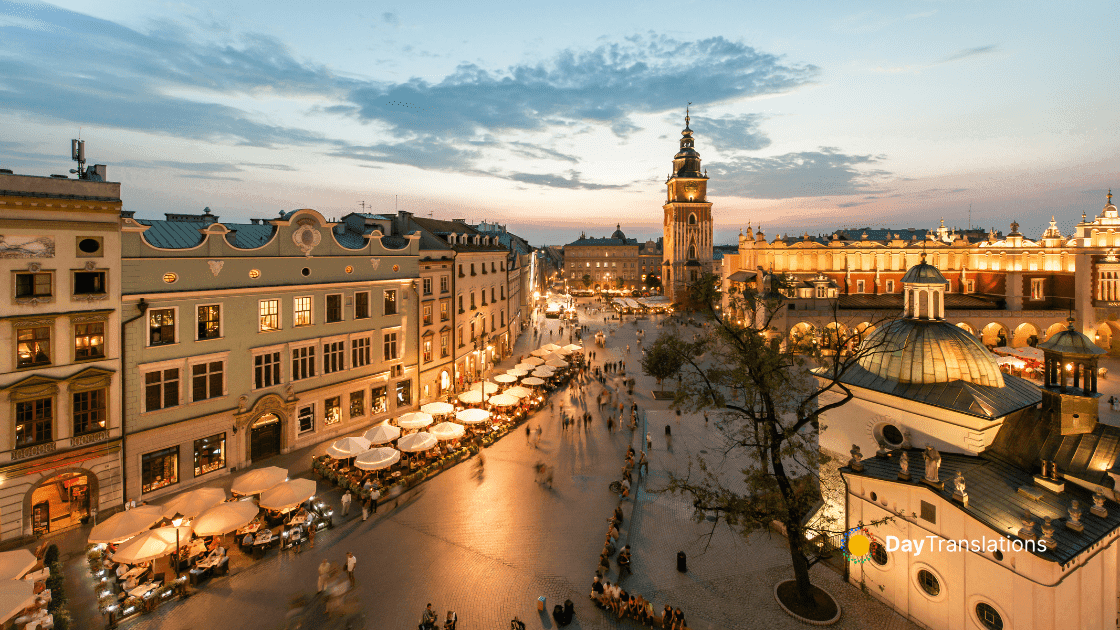
The Republic of Poland is a country in Central Europe bordered by Germany to the west; the Czech Republic and Slovakia to the south; Ukraine, Belarus and Lithuania to the east; and the Baltic Sea and Kaliningrad Oblast, a Russian exclave, to the north. The total area of Poland is 312,679 square kilometers (120,726 sq mi), making it the 69th largest country in the world and the 9th largest in Europe. Poland has a population of over 38 million people, which makes it the 34th most populous country in the world and the sixth most populous member of the European Union, being its most populous post-communist member.
The establishment of a Polish state is often identified with the adoption of Christianity by its ruler Mieszko I in 966, over the territory similar to that of present-day Poland. The Kingdom of Poland was formed in 1025, and in 1569 it cemented a long association with the Grand Duchy of Lithuania by signing the Union of Lublin, forming the Polish-Lithuanian Commonwealth.
The Commonwealth ceased to exist in 1795 as the Polish lands were partitioned among the Kingdom of Prussia, the Russian Empire, and Austria. Poland regained its independence as the Second Polish Republic in 1918. Two decades later, in September 1939, it was invaded by Nazi Germany and the Soviet Union, triggering World War II. Over six million Polish citizens died in the war. Poland reemerged several years later within the Soviet sphere of influence as the People’s Republic in existence until 1989.
During the Revolutions of 1989, communist rule was overthrown and soon after, Poland became what is constitutionally known as the “Third Polish Republic”. Poland is a unitary state made up of sixteen voivodeships (Polish: województwo). Poland is a member of the European Union, NATO, the United Nations, the World Trade Organization, and the Organization for Economic Co-operation and Development (OECD).
Poland’s high-income economy is considered to be one of the healthiest of the post-Communist countries and is currently one of the fastest growing within the EU. Since the fall of the communist government, Poland has steadfastly pursued a policy of liberalizing the economy and today stands out as a successful example of the transition from a centrally planned economy to a primarily market-based economy.
In this Country Profile
:: Background of Poland ::
Poland is an ancient nation that was conceived near the middle of the 10th century. Its golden age occurred in the 16th century. During the following century, the strengthening of the gentry and internal disorders weakened the nation. In a series of agreements between 1772 and 1795, Russia, Prussia, and Austria partitioned Poland amongst themselves. Poland regained its independence in 1918 only to be overrun by Germany and the Soviet Union in World War II. It became a Soviet satellite state following the war, but its government was comparatively tolerant and progressive. Labor turmoil in 1980 led to the formation of the independent trade union “Solidarity” that over time became a political force and by 1990 had swept parliamentary elections and the presidency. A “shock therapy” program during the early 1990s enabled the country to transform its economy into one of the most robust in Central Europe, but Poland still faces the lingering challenges of high unemployment, underdeveloped and dilapidated infrastructure, and a poor rural underclass. Solidarity suffered a major defeat in the 2001 parliamentary elections when it failed to elect a single deputy to the lower house of Parliament, and the new leaders of the Solidarity Trade Union subsequently pledged to reduce the Trade Union’s political role. Poland joined NATO in 1999 and the European Union in 2004. With its transformation to a democratic, market-oriented country largely completed, Poland is an increasingly active member of Euro-Atlantic organizations.
:: Geography of Poland ::
Location: Central Europe, east of Germany
Geographic coordinates: 52 00 N, 20 00 E
Area:
total: 312,685 sq km
land: 743,812 sq km
water: 8,430 sq km
Area – comparative: slightly smaller than New Mexico
Land boundaries: 3,047 km
Border countries: Belarus 605 km, Czech Republic 615 km, Germany 456 km, Lithuania 91 km, Russia (Kaliningrad Oblast) 432 km, Slovakia 420 km, Ukraine 428 km
Coastline: 440 km
Maritime claims:
territorial sea: 12 nm
exclusive economic zone: defined by international treaties
Climate: temperate with cold, cloudy, moderately severe winters with frequent precipitation; mild summers with frequent showers and thundershowers
Terrain: mostly flat plain; mountains along southern border
Elevation extremes:
lowest point: near Raczki Elblaskie -2 m
highest point: Rysy 2,499 m
Natural resources: coal, sulfur, copper, natural gas, silver, lead, salt, amber, arable land
Land use:
arable land: 40.25%
permanent crops: 1%
other: 58.75% (2005)
Irrigated land: 1,000 sq km (2003)
Total renewable water resources: 63.1 cu km (2005)
Freshwater withdrawal (domestic/industrial/agricultural):
total: 11.73 cu km/yr (13%/79%/8%)
per capita: 304 cu m/yr (2002)
Natural hazards: flooding
Environment – current issues: situation has improved since 1989 due to decline in heavy industry and increased environmental concern by post-Communist governments; air pollution nonetheless remains serious because of sulfur dioxide emissions from coal-fired power plants, and the resulting acid rain has caused forest damage; water pollution from industrial and municipal sources is also a problem, as is disposal of hazardous wastes; pollution levels should continue to decrease as industrial establishments bring their facilities up to EU code, but at substantial cost to business and the government.
Environment – international agreements: party to: Air Pollution, Antarctic-Environmental Protocol, Antarctic-Marine Living Resources, Antarctic Seals, Antarctic Treaty, Biodiversity, Climate Change, Climate Change-Kyoto Protocol, Desertification, Endangered Species, Environmental Modification, Hazardous Wastes, Kyoto Protocol, Law of the Sea, Marine Dumping, Ozone Layer Protection, Ship Pollution, Wetlands; signed but not ratified: Air Pollution-Nitrogen Oxides, Air Pollution-Persistent Organic Pollutants, Air Pollution-Sulfur 94
Geography – note: historically, an area of conflict because of flat terrain and the lack of natural barriers on the North European Plain
:: People of Poland ::
Population: 38,441,588 (July 2011 est.)
Age structure:
0-14 years: 14.7% (male 2,910,324/female 2,748,546)
15-64 years: 71.6% (male 13,698,363/female 13,834,779)
65 years and over: 13.7% (male 2,004,550/female 3,245,026) (2011 est.)
Median age:
total: 38.5 years
male: 36.8 years
female: 40.3 years (2011 est.)
Population growth rate: -0.062% (2011 est.)
Birth rate: 10.01 births/1,000 population (2011 est.)
Death rate: 10.17 deaths/1,000 population (July 2011 est.)
Net migration rate: -0.47 migrant(s)/1,000 population (2011 est.)
Urbanization:
urban population: 61% of total population (2010)
rate of urbanization: -0.1% annual rate of change (2010-15 est.)
Sex ratio:
at birth: 1.061 male(s)/female
under 15 years: 1.06 male(s)/female
15-64 years: 0.99 male(s)/female
65 years and over: 0.62 male(s)/female
total population: 0.94 male(s)/female (2011 est.)
Infant mortality rate:
total: 6.54 deaths/1,000 live births
male: 7.25 deaths/1,000 live births
female: 5.79 deaths/1,000 live births (2011 est.)
Life expectancy at birth:
total population: 76.05 years
male: 72.1 years
female: 80.25 years (2011 est.)
Total fertility rate: 1.3 children born/woman (2011 est.)
HIV/AIDS – adult prevalence rate: 0.1% note: no country specific models provided (2009 est.)
HIV/AIDS – people living with HIV/AIDS: 27,000 (2009 est.)
HIV/AIDS – deaths: fewer than 200 (2009 est.)
Nationality: noun: Pole(s) adjective: Polish
Ethnic groups: Polish 96.7%, German 0.4%, Belarusian 0.1%, Ukrainian 0.1%, other and unspecified 2.7% (2002 census)
Religions: Roman Catholic 89.8% (about 75% practicing), Eastern Orthodox 1.3%, Protestant 0.3%, other 0.3%, unspecified 8.3% (2002)
Languages: Polish (official) 97.8%, other and unspecified 2.2% (2002 census)
Literacy:
definition: age 15 and over can read and write
total population: 99.8%
male: 99.8%
female: 99.7% (2003 est.)
School life expectancy (primary to tertiary education):
total: 15 years
male: 15 years
female: 16 years (2008)
Education expenditures: 4.9% of GDP (2007)
Geography of Poland: Important Geographical Information about Poland
In this Country Profile
Poland is a country in Central Europe. Generally speaking, Poland is an unbroken plain reaching from the Baltic Sea in the north to the Carpathian Mountains in the south. Within that plain, terrain variations generally run in bands from east to west. The Baltic coast lacks natural harbors except for the Gdansk-Gdynia region and Szczecin in the far northwest. The northeastern region, called the Lake District, is densely wooded, sparsely populated and lacks agricultural and industrial resources. To the south and west of the lake district, a vast region of plains extends to the Sudetes on the Czech and Slovak borders to the southwest and to the Carpathians on the Czech, Slovak, and Ukrainian borders to the southeast.
The average elevation of Poland is 173 meters, and only 3 % of Polish territory, along the southern border, is higher than 500 meters. The highest elevation is Mount Rysy, which rises 2,499 meters in the Tatra Range of the Carpathians, 95 kilometers south of Kraków. About 60 square kilometers along the Gulf of Gdansk are below sea level. Poland is traditionally divided into five topographic zones from north to south.
The largest, the central lowlands or “Polish Plain” (Polish: Niz Polski or Nizina Polska), is narrow in the west, then expands to the north and south as it extends eastward. Along the eastern border, this zone reaches from the far northeast to within 200 kilometers of the southern border. The terrain in the central lowlands is quite flat, and earlier glacial lakes have been filled by sediment. The region is cut by several major rivers, including the Oder (Odra), which defines the Silesian Lowlands in the southwest, and the Vistula (Wisla), which defines the lowland areas of east-central Poland.
To the south of the lowlands are the lesser Poland uplands, a belt varying in width from 90 to 200 kilometers, formed by the gently sloping foothills of the Sudeten and Carpathian mountain ranges and the uplands that connect the ranges in southcentral Poland. The topography of this region is divided transversely into higher and lower elevations, reflecting its underlying geological structure. In the western section, the Silesia-Kraków Upthrust contains rich coal deposits.
The third topographic area is located on either side of Poland’s southern border and is formed by the Sudeten and Carpathian ranges. Within Poland, neither of these ranges is forbidding enough to prevent substantial habitation; the Carpathians are especially densely populated. The rugged form of the Sudeten range derives from the geological shifts that formed the later Carpathian uplift. The highest elevation in the Sudeten is 1,602 meters, in the Karkonosze Mountains. The Carpathians in Poland, formed as a discrete topographical unit in the relatively recent Tertiary Era, are the highest mountains in the country. They are the northernmost edge of a much larger range that extends into the Czech Republic, Slovakia, Ukraine, Hungary, and Romania. Within Poland the range includes two major basins, theOswiecim and Sandomierz, which are rich in several minerals and natural gas.
To the north of the central lowlands, the lake region includes the only primeval forests remaining in Europe and much of Poland’s shrinking unspoiled natural habitat. Glacial action in this region formed lakes and low hills in the otherwise flat terrain adjacent to Lithuania and the Baltic Sea. Small lakes dot the entire northern half of Poland, and the glacial formations that characterize the lake region extend as much as 200 kilometers inland in western Poland. Wide river valleys divide the lake region into three parts. In the northwest, Pomerania is located south of the Baltic coastal region and north of the Warta and Notec rivers. Masuria occupies the remainder of northern Poland and features a string of larger lakes. Most of Poland’s 9,300 lakes that are more than 10,000 square meters in area are located in the northern part of the lake region, where they occupy about 10 % of the surface area.
The Baltic coastal plains are a low-lying region formed of sediments deposited by the sea. The coastline was shaped by the action of the rising sea after the Scandinavian ice sheet retreated. The two major inlets in the smooth coast are the Pomeranian Bay on the German border in the far northwest and the Gulf of Gdansk in the east. The Oder River empties into the former, and the Vistula forms a large delta at the head of the latter. Sandbars with large dunes form lagoons and coastal lakes along much of the coast.
Nearly all of Poland is swirled northward into the Baltic Sea by the Vistula, the Oder, and the tributaries of these two major rivers. About half the country is drained by the Vistula, which originates in the Tatra Mountains located in far south-central Poland. The Vistula Basin includes most of the eastern half of the country and is drained by a system of rivers that mainly join the Vistula from the east. One of the tributaries, the Bug, defines 280 kilometers of Poland’s eastern border with Ukraine and Belarus. The Oder and its major tributary, the Warta, form a basin that drains the western third of Poland into the bays north of Szczecin. The drainage effect on a large part of Polish terrain is weak, however, especially in the lake region and the inland areas to its south. The predominance of swampland, level terrain, and small, shallow lakes hinders large-scale movement of water. The rivers have two high-water periods per year. The first is caused by melting snow and ice dams in spring adding to the volume of lowland rivers; the second is caused by heavy rains in July.
Poland’s long-term and short-term weather patterns are made transitional and variable by the collision of diverse air masses above the country’s surface. Maritime air moves across Western Europe, Arctic air sweeps down from the North Atlantic Ocean, and subtropical air arrives from the South Atlantic Ocean. Although the Arctic air dominates for much of the year, its conjunction with warmer currents generally moderates temperatures and generates considerable precipitation, clouds, and fog. When the moderating influences are lacking, winter temperatures in mountain valleys may drop to max -20 °C (-4 °F).
The spring arrives slowly in March or April, bringing mainly sunny days after a period of alternating wintry and springtime conditions. Summer, which extends from June to August, is generally less humid than winter. Showers and thunderstorms alternate with dry sunny weather that is generated when southern winds prevail. Early autumn is generally sunny and warm before a period of rainy, colder weather in November begins the transition into winter. Winter, which may last from one to three months, brings frequent snowstorms but relatively low total precipitation.
The range of mean temperatures is 6 °C (42.8 °F) in the northeast to 10 °C (50 °F) in the southwest, but individual readings in Poland’s regions vary widely by season. On the highest mountain peaks, the mean temperature is below 0 °C (32 °F). The Baltic coast, influenced by moderating west winds, has cooler summers and warmer winters. The other temperature extreme is in the southeast along the border with Ukraine, where the greatest seasonal differences occur and winter temperatures average 4.5 °C (40.1 °F) below those in western Poland. The growing season is about 40 days longer in the southwest than in the northeast, where spring arrives latest. The hottest cities in Poland are Tarnów, Wroclaw and Slubice.
The average annual precipitation for the whole country is 600 mm (23.6 in), but isolated mountain locations receive as much as 1,300 mm (51.2 in) per year. The total is slightly higher in the southern uplands than in the central plains. A few areas, notably along the Vistula between Warsaw and the Baltic Sea and in the far northwest, average less than 500 mm (19.7 in). In winter about half the precipitation in the lowlands and the entire amount in the mountains falls as snow. On the average, precipitation in summer is twice that in winter, providing a dependable supply of water for crops.
Information about the Polish Flag: Colors and Meaning of the Flag of Poland
In this Country Profile
The national flag of Poland contains two equal horizontal bands of white (top) and red.
Note: The Polish flag is similar to the flags of Indonesia and Monaco which are red (top) and white.
The colors white and red derive from the Polish emblem – a white eagle on a red field. They were officially adopted as national colors in 1831. They are of heraldic origin and derive from the tinctures (colors) of the coats of arms of the two constituent nations of the Polish-Lithuanian Commonwealth, i.e. the White Eagle of Poland and the Pursuer of Lithuania, a white knight riding a white horse, both on a red shield.
Extensive List of Languages of Poland: Spoken and Extinct Languages
In this Country Profile
:: List of Languages ::
Belarusan [bel] 220,000 in Poland (Johnstone and Mandryk 2001). Alternate names: Byelorussian, White Russian. Classification: Indo-European, Slavic, East
Esperanto [epo] About 115 countries, most widely in central and eastern Europe; east Asia: China and other countries; areas of South America; southwest Asia. Alternate names: La Lingvo Internacia, Eo. Classification: Constructed language
German, Standard [deu] 500,000 in Poland (1998). Silesia and elsewhere. Classification: Indo-European, Germanic, West, High German, German, Middle German, East Middle German
Kashubian [csb] 3,000 in Poland. Ethnic population: 100,000 or more (1993 T. Salminen). North central, near the Baltic coast, left bank of the Lower Vistula; west of the Bay of Gdansk; narrow strip inland, southwest of Gdynia. Also in Canada. Alternate names: Cashubian, Cassubian, Kaszubski. Dialects: Kashubian Proper, Slovincian. German influences on the language. Transitional dialects between Kashubian Proper, the Slovincian dialect, and Polish [pol]. Classification: Indo-European, Slavic, West, Lechitic
Polish [pol] 36,600,000 in Poland (1986). Population total for all countries: 39,990,670. Also in Australia, Austria, Azerbaijan, Belarus, Canada, Croatia, Czech Republic, Estonia, Finland, Germany, Hungary, Israel, Kazakhstan, Latvia, Lithuania, Romania, Russian Federation (Europe), Serbia, Slovakia, Ukraine, United Arab Emirates, United States. Alternate names: Polnisch, Polski. Dialects: Upper Silesian. Classification: Indo-European, Slavic, West, Lechitic. If you need to translate from Polish to Spanish, Day Translations can help.
Polish Sign Language [pso] 50,000 deaf, 25,000 members of Polish Association of the Deaf (Van Cleve 1986). Dialects: Various regional dialects. Not intelligible with American Sign Language [ase]. Classification: Deaf sign language
Prussian [prg] East Prussia, formerly in Germany. Alternate names: Old Prussian. Dialects: Other extinct Baltic languages are: Selonian, Yotvingian, Semigallian, Curonian. Classification: Indo-European, Baltic, Western
Romani, Baltic [rml] 30,000 in Poland. Population total all countries: 58,460. Central and south Baltic region. Also in Belarus, Estonia, Latvia, Lithuania, Russian Federation (Europe), Ukraine. Dialects: Latvian Romani (Lettish Romani), North Russian Romani, White Russian Romani, Estonian Romani, Polish Romani. Classification: Indo-European, Indo-Iranian, Indo-Aryan, Central zone, Romani, Northern
Romani, Carpathian [rmc] One dialect in south Poland, east Hungary, and Galicia; another in Transylvania, Romania; others in Czech Republic and Slovakia; Ukraine, USA. Dialects: Galician, Transylvanian. Classification: Indo-European, Indo-Iranian, Indo-Aryan, Central zone, Romani, Northern
Romani, Sinte [rmo] Alternate names: Sinti, Tsigane. Dialects: Manuche (Manouche). Classification: Indo-European, Indo-Iranian, Indo-Aryan, Central zone, Romani, Northern
Romani, Vlax [rmy] 5,000 in Poland. Dialects: Lovari. Classification: Indo-European, Indo-Iranian, Indo-Aryan, Central zone, Romani, Vlax
Silesian [szl] 60,000 (2002 census). Silesia. Alternate names: Szlonzokian. Classification: Indo-European, Slavic, West, Lechitic
Silesian, Upper [sli] 12,000 in Poland. Population total all countries: 22,900. Upper Silesia. Also in Czech Republic. Alternate names: Upper Schlesisch. Classification: Indo-European, Germanic, West, High German, German, Middle German, East Middle German
Ukrainian [ukr] 150,000 in Poland. Classification: Indo-European, Slavic, East
Wymysorys [wym] 70 (2006). Silisia and Lesser Poland border; Wilamowice village. Alternate names:Wilamowicean. Dialects: Wymysorys appears to derive from 12th century Middle High German, with strong influences from Low German, Dutch, Frisian, Polish, and Old English. Classification:Indo-European, Germanic, West, High German, German, Middle German, East Middle German Nearly extinct.
:: Reference ::
Gordon, Raymond G., Jr. (ed.), 2005. Ethnologue: Languages of the World, Fifteenth edition. Dallas, Tex.: SIL International. Online version: http://www.ethnologue.com/
Famous Polish People: Polish Artists, Scientists, Leaders, Musicians, Politicians and Athletes
In this Country Profile
Poland is home to outstanding individuals who made a difference with their remarkable achievements. Below you will find some brief stories of remarkable Polish people.
:: List of Famous People from Poland ::
Pope John Paul II
Karol Józef Wojtyla reigned as Supreme Pontiff of the Roman Catholic Church and Sovereign of Vatican City from 16 October 1978 until his death on 2 April 2005. His was the second-longest documented pontificate. John Paul II has been acclaimed as one of the most influential leaders of the 20th century.
Lech Walesa
Lech Walesa is a Polish politician, trade-union organizer, and human-rights activist. A charismatic leader, he co-founded Solidarity (Solidarnosc), the Soviet bloc’s first independent trade union, won the Nobel Peace Prize in 1983, and served as President of Poland between 1990 and 1995.
Ryszard Jerzy Kuklinski
Ryszard Kuklinski was a Polish colonel and Cold War spy. He passed top secret Warsaw Pact documents to the CIA between 1971 and 1981. Former United States National Security Advisor Zbigniew Brzezinski has described him as “the first Polish officer in NATO.”
Henryk Sienkiewicz
Henryk Sienkiewicz, also known as “Litwos”, was a Polish journalist and Nobel Prize-winning novelist. A Polish szlachcic (noble) of the Oszyk coat of arms, he was one of the most popular Polish writers at the turn of the 19th and 20th centuries, and received the Nobel Prize in Literature in 1905 for his “outstanding merits as an epic writer.”
Fryderyk Chopin
One of the great masters of Romantic music, Fryderyk (Frédéric) Chopin was a Polish composer, virtuoso pianist, and music teacher, of French–Polish parentage. All of Chopin’s works involve the piano. They are technically demanding but emphasize nuance and expressive depth. Chopin invented the musical form known as the instrumental ballade and made major innovations to the piano sonata, mazurka, waltz, nocturne, polonaise, étude, impromptu, and prélude.
Nicolaus Copernicus
Copernicus was a Renaissance astronomer and the first person to formulate a comprehensive heliocentric cosmology, which displaced the Earth from the center of the universe. Copernicus’ epochal book, De revolutionibus orbium coelestium (On the Revolutions of the Celestial Spheres), published just before his death in 1543, is often regarded as the starting point of modern astronomy and the defining epiphany that began the scientific revolution. His heliocentric model, with the Sun at the center of the universe, demonstrated that the observed motions of celestial objects can be explained without putting Earth at rest in the center of the universe. His work stimulated further scientific investigations, becoming a landmark in the history of science that is often referred to as the Copernican Revolution.
Marie Sklodowska Curie
Marie Curie was a Polish-born French physicist and chemist famous for her work on radioactivity. She was a pioneer in the field of radioactivity and the first person honored with two Nobel Prizes in physics and chemistry. She was also the first female professor at the University of Paris.
Irena Szewinska
Irena Szewinska was a Polish Jewish sprinter and one of the world’s foremost athletes for nearly two decades, in multiple events. Between 1964 and 1980, Irena participated in five Olympic Games, winning seven medals, three of them gold. She also broke six world records and is the only athlete (male or female) to have held a world record in the 100 m, 200 m and the 400 m events.
Roman Polanski
Polish-French film director Roman Polanski was raised and educated in Poland. Polanski’s first feature-length film, Knife in the Water (1962), made in Poland, was nominated for a United States Academy Award for Best Foreign Language Film. He has since received five more Oscar nominations, along with two Baftas, four Césars, a Golden Globe Award and the Palme d’Or of the Cannes Film Festival in France. In the United Kingdom he directed three films, beginning with Repulsion (1965). In 1968 he moved to the United States, and cemented his status by directing the Oscar winning horror film Rosemary’s Baby (1968).
Famous People from Poland: Famous Polish Footballers/Soccer Players
In this Country Profile
The following Polish athletes dedicated themselves in promoting and inspiring people about football, one of the most well-loved sports in the world.
Kazimierz Deyna
A supremely-talented midfielder, Deyna was the orchestrator of the famous 1974 Poland World Cup team that beat defending champions Brazil 1-0 for third place. However, Poland’s communist government didn’t allow players under thirty to move abroad, so Deyna remained in Poland until, aged 31, he moved to Manchester City. Deyna tragically died in a car accident in 1989, but is still regarded as Poland’s most gifted footballer, and is their third highest goal scorer
Zbigniew Boniek
The yin to Michel Platini’s yang at Juventus, Boniek thrilled fans with his searing pace and rampaging runs, lifting the Cup Winners’ Cup, European Super Cup and European Cup for the “Vecchia Signora” in the process. Although not a member of the legendary 1974 national team, Boniek still played a major role in Poland’s golden era. He led his countrymen to third place in the 1982 World Cup, capping a virtuoso display against Belgium with a brilliant hat-trick.
Grzegorz Lato
The 1974 Golden Boot winner with seven goals, Lato propelled Poland to the semi-finals where they lost 1-0 to eventual winners West Germany. Scorer of the winning goal for third place against Brazil, he was considered as one of the most underrated players in World Cup history; in 20 competition appearances Lato notched 10 goals and provided 7 assists.
Wlodzimierz Lubanski
An almost mythical player with an extraordinary eye for goal, Lubanski seemed destined for greatness. Making his international debut at 16, Lubanski won gold with Poland at the 1972 summer Olympics in Munich nine years later. Unlikely to move abroad due to the government’s restrictions, his form nevertheless alerted Manchester United and Real Madrid. However, seven minutes after scoring a goal in the 1973 World Cup qualifier against England, Lubanski was taken off injured and sidelined for two years. Despite five years passing before he represented his country again, Lubanski still became Poland’s all-time highest goal scorer with 48 goals from 75 games.
Ernest Wilimowski
Born in 1916 in Silesia, a Polish-German borderland, Wilimowski adopted Polish citizenship in 1922. The first truly great footballer in Poland’s history, he became the first player to score four goals in a World Cup match during Poland’s 5-6 loss to Brazil in 1938. Following the Nazi occupation of Poland, Wilimowski re-took German citizenship which enabled him to continue playing football (Poles were not allowed to play sports) and represented the German national side. He was labelled a traitor by the post-war Polish communist government and never set foot in his homeland again.
Jerzy Dudek
Currently playing for Real Madrid, Dudek was an instrumental force in Liverpool’s amazing victory in the 2005 Champions League final against AC Milan, and helped them lift the FA Cup in 2006. Whilst at Feyenoord, he became the Dutch league’s first ever foreign winner of the Goalkeeper of the Year award for the 1998-99 season – a title he re-claimed a year later.