
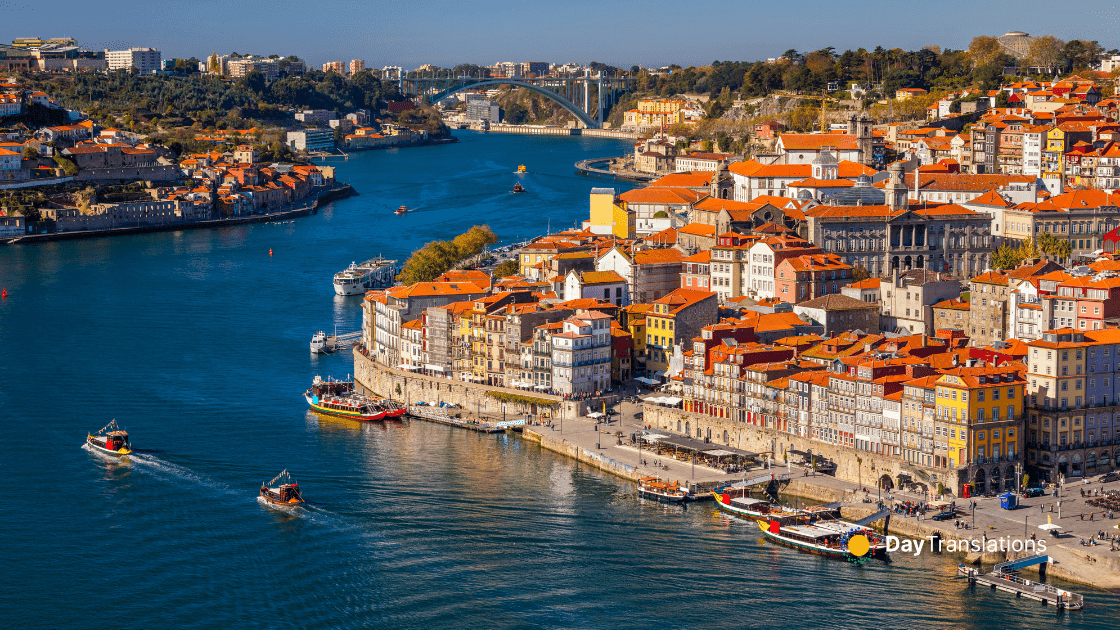
Standing at the crossroads of Europe, Africa and the Americas, Portugal has a strategic location in southwestern Europe, bordering the North Atlantic Ocean, west of Spain. It has a longstanding political, economic and commercial tradition worldwide. Portuguese is the official language of Portugal, but Arabic, Galician, Mirandesa, Calo are other languages spoken on a regular basis in Portugal. Moreover, Portuguese is the official language of Angola, Brazil, Cape Verde, Guinea-Bissau, Mozambique, São Tomé and Príncipe, and co-official with Chinese in the Chinese S.A.R. of Macau and Tetum in East Timor. Portugal is a developed country and has a high Human Development Index. It is the 7th most peaceful and the 13th most globalized country in the world, and has the world’s 19th highest quality of life. Portugal is a global leader in promoting renewable energy, including wind and solar power.
:: Background of Portugal ::
Following its heyday as a world power during the 15th and 16th centuries, Portugal lost much of its wealth and status with the destruction of Lisbon in a 1755 earthquake, occupation during the Napoleonic Wars, and the independence in 1822 of Brazil as a colony. A 1910 revolution deposed the monarchy; for most of the next six decades, repressive governments ran the country. In 1974, a left-wing military coup installed broad democratic reforms. The following year, Portugal granted independence to all of its African colonies. Portugal is a founding member of NATO and entered the EC (now the EU) in 1986.
In this Country Profile
Location: Southwestern Europe, bordering the North Atlantic Ocean, west of Spain.
Geographic coordinates: 39 30 N, 8 00 W
Area:
total: 92,391 sq km
land: 91,951 sq km
water: 440 sq km
note: includes Azores and Madeira Islands
Area – comparative: slightly smaller than Indiana
Land boundaries: total: 1,214 km, border countries: Spain 1,214 km
Maritime claims:
territorial sea: 12 nm
contiguous zone: 24 nm
exclusive economic zone: 200 nm
continental shelf: 200-m depth or to the depth of exploitation
Climate: maritime temperate; cool and rainy in north, warmer and drier in south
Terrain: mountainous north of the Tagus River, rolling plains in south
Elevation extremes: lowest point: Atlantic Ocean 0 m, highest point: Ponta do Pico (Pico or Pico Alto) on Ilha do Pico in the Azores 2,351 m
Natural resources: fish, forests (cork), iron ore, copper, zinc, tin, tungsten, silver, gold, uranium, marble, clay, gypsum, salt, arable land, hydropower.
Land use:
arable land: 17.29%
permanent crops: 7.84%
other: 74.87% (2005)
Natural hazards: Azores subject to severe earthquakes
Environment – current issues: soil erosion; air pollution caused by industrial and vehicle emissions; water pollution, especially in coastal areas.
Environment – international agreements: party to: Air Pollution, Biodiversity, Climate Change, Climate Change-Kyoto Protocol, Desertification, Endangered Species, Hazardous Wastes, Law of the Sea, Marine Dumping, Marine Life Conservation, Ozone Layer Protection, Ship Pollution, Tropical Timber 83, Tropical Timber 94, Wetlands, Whaling, signed, but not ratified: Air Pollution-Persistent Organic Pollutants, Air Pollution-Volatile Organic Compounds, Environmental Modification.
:: Geography of Portugal ::
Location: Southwestern Europe, bordering the North Atlantic Ocean, west of Spain.
Geographic coordinates: 39 30 N, 8 00 W
Area:
total: 92,391 sq km
land: 91,951 sq km
water: 440 sq km
note: includes Azores and Madeira Islands
Area – comparative: slightly smaller than Indiana
Land boundaries: total: 1,214 km, border countries: Spain 1,214 km
Maritime claims:
territorial sea: 12 nm
contiguous zone: 24 nm
exclusive economic zone: 200 nm
continental shelf: 200-m depth or to the depth of exploitation
Climate: maritime temperate; cool and rainy in north, warmer and drier in south
Terrain: mountainous north of the Tagus River, rolling plains in south
Elevation extremes: lowest point: Atlantic Ocean 0 m, highest point: Ponta do Pico (Pico or Pico Alto) on Ilha do Pico in the Azores 2,351 m
Natural resources: fish, forests (cork), iron ore, copper, zinc, tin, tungsten, silver, gold, uranium, marble, clay, gypsum, salt, arable land, hydropower.
Land use:
arable land: 17.29%
permanent crops: 7.84%
other: 74.87% (2005)
Natural hazards: Azores subject to severe earthquakes
Environment – current issues: soil erosion; air pollution caused by industrial and vehicle emissions; water pollution, especially in coastal areas.
Environment – international agreements: party to: Air Pollution, Biodiversity, Climate Change, Climate Change-Kyoto Protocol, Desertification, Endangered Species, Hazardous Wastes, Law of the Sea, Marine Dumping, Marine Life Conservation, Ozone Layer Protection, Ship Pollution, Tropical Timber 83, Tropical Timber 94, Wetlands, Whaling, signed, but not ratified: Air Pollution-Persistent Organic Pollutants, Air Pollution-Volatile Organic Compounds, Environmental Modification.
:: People of Portugal ::
Population: 10,676,910 (July 2008 est.)
Age structure:
0-14 years: 16.4% (male 912,995/female 835,715)
15-64 years: 66.2% (male 3,514,905/female 3,555,097)
65 years and over: 17.4% (male 764,443/female 1,093,755) (2008 est.)
Median age:
total: 39.1 years
male: 37 years
female: 41.3 years (2008 est.)
Population growth rate: 0.305% (2008 est.)
Birth rate: 10.45 births/1,000 population (2008 est.)
Death rate: 10.62 deaths/1,000 population (2008 est.)
Net migration rate: 3.23 migrant(s)/1,000 population (2008 est.)
Sex ratio:
at birth: 1.07 male(s)/female
under 15 years: 1.09 male(s)/female
15-64 years: 0.99 male(s)/female
65 years and over: 0.7 male(s)/female
total population: 0.95 male(s)/female (2008 est.)
Infant mortality rate:
total: 4.85 deaths/1,000 live births
male: 5.31 deaths/1,000 live births
female: 4.36 deaths/1,000 live births (2008 est.)
Life expectancy at birth:
total population: 78.04 years
male: 74.78 years
female: 81.53 years (2008 est.)
Total fertility rate: 1.49 children born/woman (2008 est.)
HIV/AIDS – adult prévalence rate: 0.4% (2001 est.)
HIV/AIDS – people living with HIV/AIDS: 22,000 (2001 est.)
HIV/AIDS – deaths: fewer than 1,000 (2003 est.)
Nationality: noun: Portuguese (singular and plural) adjective: Portuguese
Ethnic groups: homogeneous Mediterranean stock; citizens of black African descent who immigrated to mainland during decolonization number less than 100,000; since 1990 East Europeans have entered Portugal.
Religions: Roman Catholic 84.5%, other Christian 2.2%, other 0.3%, unknown 9%, none 3.9% (2001 census).
Languages: Portuguese (official), Mirandese (official – but locally used)
Literacy:
definition: age 15 and over can read and write
total population: 93.3%
male: 95.5%
female: 91.3% (2003 est.)
Geography of Portugal: Important Geographical Information about Portugal
In this Country Profile
Portugal, the westernmost country of mainland Europe, has an unexpected variety of landscapes: from the rugged countryside to the breathtaking coastline, the lovely Portuguese landscape seems to have a character that is both authentic and timeless.
Continental Portugal is split in two by its main river, the Tagus (Tejo). Northern Portugal, the area north of the Tagus River, is the most rugged part of the country with plateaus, cut by four breakings lines that allow the development of more fertile agricultural areas. The highest range is the Serra de Estrela, which runs northeast-southwest and reaches a maximum elevation of more than 6,500 feet (1,980 m). The south is made up primarily of coastal lowlands, broad river valleys, and low, almost flat plateaus. Other major rivers include the Douro, the Minho and the Guadiana.
The islands of the Azores and Madeira are located in the Mid-Atlantic Ridge, some of the islands had recent volcanic activity. Consisting of nine islands, the Azores divided into three groups: the eastern (Sao Miguel and Santa Maria islands), the central (Terceira, Graciosa, Sao Jorge, Pico and Faial islands), and the western (Flores and Corvo islands). Madeira can be divided into three main areas: the central mass, the western area and eastern area. The central area is volcanic in origin, with eruptions starting around 20 million years ago, they are thought to have finished 1.7 million years ago. Dom João de Castro Bank is a large submarine volcano that lies midway between the islands of Terceira and São Miguel and rises 14 m below the sea surface. Portugal’s highest point is Mount Pico, an ancient volcano, with 2,351 m.
The Portuguese Coast has a length of 943 km (586 mi) in continental Portugal, 667 km in the Azores, 250 km in Madeira and in the Savage Islands. The Portuguese coast developed fine beaches, the Algarve ones are worldwide famous. In Porto Santo Island, a dune formation is appealing to many tourists. An important feature in its coast is the Ria de Aveiro (near Aveiro, a town called “The Portuguese Venice”), a delta with 45 km in length and a maximum of 11 km width, rich in fish and sea birds. There are four main channels, between them several islands and islets, and it is where Vouga, Antuã, Boco, and Fontão rivers meet the ocean.
Professional Translation Organizations & Associations in Portugal
In this Country Profile
Below is a list of the major translation organizations and associations of Portugal.
:: List of Organizations ::
Associação Portuguesa de Tradutores
Escola Superior de Tecnologia e Gestão do Instituto Politécnico de Leiria
Faculdade de Letras, Universidade do Porto
Instituto Politécnico de Leiria
Instituto Superior de Contabilidade e Administração do Porto
Instituto Superior de Linguas e Administração
Portuguese Association of Translation Companies
Universidade Autónoma de Lisboa “Luis de Camoes”
Universidade de Coimbra, Faculdade de Letras
Universidade de Lisboa, Faculdade de Letras
Universidade do Minho, Instituto de Letras e Ciências Humanas
Universidade Lusófona de Humanidades e Tecnologias
Information about the Portuguese Flag: Colors and Meaning of the Flag of Portugal
In this Country Profile
:: Meaning of the Portuguese Flag ::
The Portuguese national flag is a 2:3 rectangle divided vertically into green at the hoist (2/5 of the flag’s length) and red at the fly (3/5). The Portuguese coat of arms is pictured where the two colors meet. The Portuguese flag was officially adopted in the year of 1911.
According to the constitution, the national flag is a symbol of Portugal’s independence, unity and integrity. A coat of arms with the country’s traditional shield is centered on the Portuguese flag where the two colors meet. The red section represents the Portuguese revolution of 1910 and the green represents hope.
:: Meaning of the Portuguese Coat of Arms ::
The five blue shields represents the five moor kings defeated by the first King of Portugal, D. Afonso Henriques, at the Battle of Ourique.
The dots inside the blue shields represent the five wounds of Christ when crucified.
Counting the dots and doubling those five in the center, there are thirty dots that represents the coins Judas received for having betrayed Christ.
The seven castles represents the fortified cities D. Afonso Henriques conquered from the moors.
The globe represents the world discovered by the Portuguese navigators in the fifteen and sixteenth centuries. The green strip is meant to symbolize the hope in the future and the red the blood of the nation’s heroes.
Extensive List of Languages of Portugal: Spoken and Extinct Languages
In this Country Profile
:: List of Languages ::
Asturian
[ast] 25,039 in Portugal. Miranda do Douro. Alternate names: Asturian-Leonese. Dialects: West Asturian, Central Asturian (Bable). Classification: Indo-European, Italic, Romance, Italo-Western, Western, Gallo-Iberian, Ibero-Romance, West Iberian, Asturo-Leonese
Caló
[rmr] 5,000 in Portugal. Alternate names: Calão, Gitano, Iberian Romani. Dialects: Spanish Calo, Portuguese Calão (Calão, Lusitano-Romani), Catalonian Calo, Basque Calo, Brazilian Calão. Classification: Mixed Language, Iberian-Romani
Galician
[glg] 15,000 in Tras Os Montes (1994 SIL). Northern provinces of Entre-Minho-e-Douro and Trazoz-Montes (Tras Os Montes). Alternate names: Galego, Gallego. Classification: Indo-European, Italic, Romance, Italo-Western, Western, Gallo-Iberian, Ibero-Romance, West Iberian, Portuguese-Galician
Miranda do Douro
[mwl] 15,000 (2000). 10,000 who use it regularly, 5,000 use it when they return to the area. Northeast Portugal, southeastern tip of Tras Os Montes area, on the Spain border, at the latitude of Zamora, city of Miranda. Alternate names: Mirandesa, Mirandese. Dialects: Related to Asturian and Leonés. Probably separated from them at the time of the invasion of the Moors. Classification: Indo-European, Italic, Romance, Italo-Western, Western, Gallo-Iberian, Ibero-Romance, West Iberian, Asturo-Leonese
Portuguese
[por] 10,000,000 in Portugal. Population total all countries: 177,457,180. Iberia, Azores, Madeira. Also spoken in Andorra, Angola, Antigua and Barbuda, Belgium, Brazil, Canada, Cape Verde Islands, China, Congo, East Timor, France, Germany, Guinea-Bissau, Guyana, India, Indonesia, Jamaica, Luxembourg, Malawi, Mozambique, Namibia, Oman, Paraguay, Saint Vincent and the Grenadines, São Tomé e Príncipe, South Africa, Spain, Suriname, Switzerland, United Kingdom, Uruguay, USA. Alternate names: Português. Dialects: Beira, Galician, Madeira-Azores, Estremenho, Brazilian Portuguese. Standard Portuguese of Portugal is based on Southern or Estremenho dialect (Lisbon and Coimbra). Classification: Indo-European, Italic, Romance, Italo-Western, Western, Gallo-Iberian, Ibero-Romance, West Iberian, Portuguese-Galician
Portuguese Sign Language
[psr] Used by a considerable portion of the 8,000 deaf persons; 1986 Gallaudet Univ. Alternate names: Lingua Gestual Portuguesa. Dialects: Lisbon, Oporto. Not derived from Portuguese. Different dialects in 2 different deaf schools in Lisbon and Oporto. Related to Swedish Sign Language. Classification: Deaf sign language
Romani, Vlax
[rmy] 500 Kalderash in Portugal. Dialects: Kalderash. Classification: Indo-European, Indo-Iranian, Indo-Aryan, Central zone, Romani, Vlax
:: Reference ::
Gordon, Raymond G., Jr. (ed.), 2005. Ethnologue: Languages of the World, Fifteenth edition. Dallas, Tex.: SIL International. Online version: http://www.ethnologue.com/
Famous Portuguese People: Portuguese Artists, Scientists, Leaders, Musicians, Politicians and Athletes
In this Country Profile
Daring dreamers are great achievers! This category of Portuguese daring dreamers changed the past, shaped the modern world and build the future! No matter if we speak about scientists who changed the way people understood the universe, past and present dynamic leaders, famous writers or artists, they are simply remarkable individuals!
:: List of Famous People from Portugal ::
Dulce Pontes
There are times when the meaning of words seem to fade away, they seem so poor, so entirely does our language fail to express the reality. It is almost impossible to describe the unique, majestic, powerful voice of Dulce Pontes and her divine music that conquered millions of people all over the world. Dulce Pontes (born March 8, 1969) is one of the most respected Portuguese artists: a musician, songwriter and singer who writes and performs in many music styles, including pop, folk and classical music.
Dulce Pontes is one of the finest, most gifted and most sensitive singers, her voice is absolutely outrageous. Dulce is a living proof that music is a universal language, she is a very different jewel in the crown of music. Her style is unique and beyond any comparison.
Dulce Pontes has collaborated with many international music stars, like Cesária Évora, Caetano Veloso, Marisa Monte, Carlos Nuñez, the Chieftains, Kepa Junkera, Eleftheria Arvanitaki,George Dalaras, Andrea Bocelli etc. Her song “A Canção do Mar” appeared on the soundtrack of Hollywood film Primal Fear. Her album “Focus” is the fruit of a collaboration with Italian composer Ennio Morricone with whom she has also performed live in concert.
Baruch Spinoza
Spinoza was a notable philosopher of Portuguese Jewish origin and is considered Europe’s first modern philosopher. He is one of the great rationalists of 17th-century philosophy, laying the groundwork for the 18th century Enlightenment. Moreover, he is considered one of the fathers of modern Biblical criticism.
In his magnum opus, The Ethics, Spinoza develops his philosophy in a very different way from Descartes Meditations, because he opposed Descartes’ mind–body dualism. Spinoza is considered to be one of Western philosophy’s most important philosophers.
Nelly Furtado
Nelly Furtado is a Grammy Award-winning Canadian singer of Portuguese ancestry. She is a singer-songwriter, record producer, and actress, one of the most beautiful women in the world. “Promiscuous”, “Maneater”, “All Good Things (Come to an End)”, and “Say It Right” are some of her hit singles. Nelly Furtado is considered to be one of the best singer/songwriter of the mainstream music industry.
“Furtado is known for experimenting with different instruments, sounds, genres, vocal styles and languages. This diversity has been influenced by her wide-ranging musical taste and her interest in different cultures.”
José Saramago
Jose Saramago is a Nobel-laureate Portuguese novelist, playwright and journalist.. Saramago was awarded the Nobel Prize for literature in 1998, the first writer in Portuguese to do so: “Jose Saramago, who with parables sustained by imagination, compassion and irony continually enables us once again to apprehend an elusory reality” Nobel Committee. José Saramago is considered today one of the most outstanding writers in the world. He has combined is his work myths, history of his own country, and surrealistic imagination.
Jose Saramago founded the National Front for the Defense of Culture (Lisbon, 1992) with Freitas-Magalhães among others. The possibility of the impossible, dreams and illusions, are the subject of my novels,” Saramago has said. “In one sense it could even be said that, letter-by-letter, word-by-word, page-by-page, book after book, I have been successively implanting in the man I was the characters I created. I believe that without them I wouldn’t be the person I am today; without them maybe my life wouldn’t have succeeded in becoming more than an inexact sketch, a promise that like so many others remained only a promise, the existence of someone who maybe might have been but in the end could not manage to be.” (from Nobel Lecture, 1998)
Luis Figo
Figo is a professional Portuguese football player. He was the 2000 European Footballer of the Year, the 2001 FIFA World Player of the Year, and was named amongst the FIFA 100. Figo is one of the few footballers to have played for both the Spanish rival clubs FC Barcelona and Real Madrid. In his homeland Luis Figo is considered by some second only to Eusebio as Portugal’s greatest player ever.
Egas Moniz
António Caetano de Abreu Freire Egas Moniz was born in Portugal, studied medicine in the University of Coimbra and neurology in Bordeaux and Paris. He was an ambitious and multitalented person: a neurologist, political figure, and man of letters. Moniz was the first Portuguese to receive a Nobel Prize, “for his discovery of the therapeutic value of leucotomy in certain psychoses.” He was also one of the earliest developers of the cerebral angiography, the technique of using x-rays to visualize arteries and veins that are transiently opacified with the injection of a high density agent.
Jose Manuel Barroso
Barroso is the 12th President of the European Commission. He served as Prime Minister of Portugal from 6 April 2002 to 17 July 2004. He assumed the position in the Commission 23 November 2004.
According to EurActive.com, European Commission President José Manuel Barroso is considered to be the most influential European leader by 8% of the French, 11% of the Germans, 6% of the Spanish and 11% of the Italians. 6% of the Americans see him as the most influential leader in Europe.
Paula Rego
Paula Rego started painting at the age of four and is now placed amongst the four best living painters in England. Paula was appointed the first associate artist of England’s National Gallery. According to NMWA, Rego uses her art to explore the precariousness of human emotions and the complexity of life’s experiences. Her work is acclaimed around the globe and is represented in leading contemporary art collections. Paula Rego uses her art as a “journey through the mind and through the complexity of life’s experiences.”
Manoel de Oliveira
Manoel de Oliveira is a notable Portuguese film director born in Cedofeita, Portom who is frequently cited as the oldest active film director in the world. Beginning with silent films, he has been directing up to the 21st century having earned a multitude of honors such as the Jury Prize in Cannes.
Vasco Da Gama
Vasco Da Gama was a Portuguese explorer who discovered an ocean route from Portugal to the East, one of the most successful in the European Age of Discovery and the commander of the first ships to sail directly from Europe to India. Vasco Da Gama is considered to be one of the major figures in the history of international trade in the Early Modern ages.
Ferdinand Magellan
(Portuguese: Fernão de Magalhães, Spanish: Fernando de Magallanes)
Magellan was a Portuguese maritime explorer who is credited with circumnavigating the earth. Like Columbus before him, Magellan believed he could get to the Spice Islands by sailing west. Magellan tried to find a westward route to the Spice Islands of Indonesia. He thereby became the first person to lead an expedition across the Pacific Ocean. This was also the first successful attempt to circumnavigate the Earth in history. His voyage provided clear proof that the Earth is round. Though Magellan didn’t complete the entire circumnavigation, as the expedition’s leader he is usually credited with being the first man to circle the globe.
Cristiano Ronaldo
Cristiano Ronaldo is a famous Portuguese footballer who plays as a winger for English Premier League club Manchester United and the Portuguese national team. He is considered one of the strongest players in the world. In 2008, Ronaldo won his first UEFA Champions League title, and was named the final’s man of the match. He was named the FIFPro World Player of the Year and the FIFA World Player of the Year, in addition to becoming Manchester United’s first Ballon d’Or winner in 40 years.