
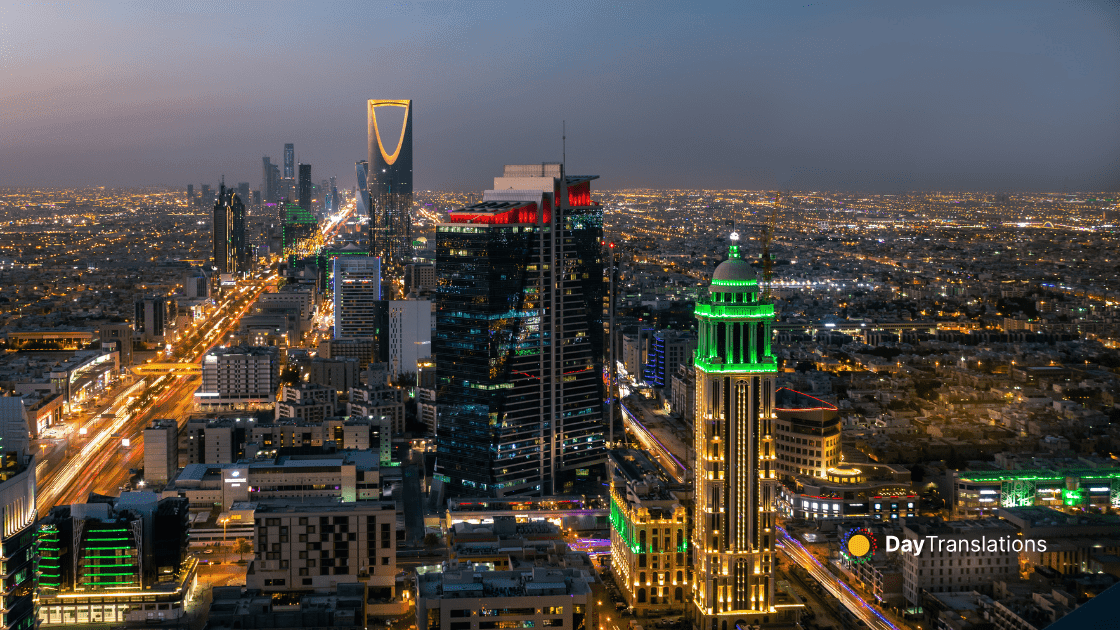
The Kingdom of Saudi Arabia is the largest country of the Arabian Peninsula. It is bordered to the northwest by Jordan, to the north by Iraq and Kuwait, to the west by the Red sea and to the east Qatar, the United Arab Emirates and Oman, and to the south by Yemen. The Kingdom’s geographic location makes it an easy passage for the markets of Europe, Asia and Africa. Saudi Arabia possesses 25% of the world’s proven petroleum reserves and plays a leading role in the Organization of Petroleum Exporting Countries (OPEC). Saudi Arabia is an important force for stability in its region and also in global energy markets.
In this Country Profile
:: Geography of Saudi Arabia ::
Location: Middle East, bordering the Persian Gulf and the Red Sea, north of Yemen.
Geographic coordinates: 25 00 N, 45 00 E
Area:
total: 2,149,690 sq km
land: 2,149,690 sq km
water: 0 sq km
Area – comparative: slightly more than one-fifth the size of the US
Land boundaries:
total: 4,431 km
border countries: Iraq 814 km, Jordan 744 km, Kuwait 222 km, Oman 676 km, Qatar 60 km, UAE 457 km, Yemen 1,458 km
Coastline: 2,640 km
Maritime claims:
territorial sea: 12 nm
contiguous zone: 18 nm
continental shelf: not specified
Climate: harsh, dry desert with great temperature extremes.
Terrain: mostly uninhabited, sandy desert
Elevation extremes:
lowest point: Persian Gulf 0 m
highest point: Jabal Sawda’ 3,133 m
Natural resources: petroleum, natural gas, iron ore, gold, copper
Land use:
arable land: 1.67%
permanent crops: 0.09%
other: 98.24% (2005)
Natural hazards: frequent sand and dust storms
Environment – current issues: desertification; depletion of underground water resources; the lack of perennial rivers or permanent water bodies has prompted the development of extensive seawater desalination facilities; coastal pollution from oil spills.
Environment – international agreements: party to: Biodiversity, Climate Change, Climate Change-Kyoto Protocol, Desertification, Endangered Species, Hazardous Wastes, Law of the Sea, Marine Dumping, Ozone Layer Protection, Ship Pollution- Signed, but not ratified: none of the selected agreements.
:: People of Saudi Arabia ::
Population: 28,146,656 note: includes 5,576,076 non-nationals (July 2008 est.)
Age structure:
0-14 years: 38% (male 5,458,023/female 5,245,911)
15-64 years: 59.5% (male 9,470,353/female 7,284,696)
65 years and over: 2.4% (male 356,910/female 330,764) (2008 est.)
Median age:
total: 21.5 years
male: 22.9 years
female: 19.8 years (2008 est.)
Population growth rate: 1.954% (2008 est.)
Birth rate: 28.85 births/1,000 population (2008 est.)
Death rate: 2.49 deaths/1,000 population (2008 est.)
Net migration rate: -6.82 migrant(s)/1,000 population (2008 est.)
Sex ratio:
at birth: 1.05 male(s)/female
under 15 years: 1.04 male(s)/female
15-64 years: 1.3 male(s)/female
65 years and over: 1.08 male(s)/female
total population: 1.19 male(s)/female (2008 est.)
Infant mortality rate:
total: 11.94 deaths/1,000 live births
male: 13.58 deaths/1,000 live births
female: 10.23 deaths/1,000 live births (2008 est.)
Life expectancy at birth: 3.89 children born/woman (2008 est.)
total population: 76.09 years
male: 74.04 years
female: 78.25 years (2008 est.)
Total fertility rate: 3.89 children born/woman (2008 est.)
HIV/AIDS – adult prévalence rate: 0.01% (2001 est.)
HIV/AIDS – people living with HIV/AIDS: NA
HIV/AIDS – deaths: NA
Nationality: noun: Saudi(s) adjective: Saudi or Saudi Arabian
Ethnic groups: Arab 90%, Afro-Asian 10%
Religions: Muslim 100%
Languages:. Arabic
Literacy:
definition: age 15 and over can read and write
total population: 78.8%
male: 84.7%
female: 70.8% (2003 est.)
Geography of Saudi Arabia: Important Geographical Information about Saudi Arabia
In this Country Profile
Saudi Arabia is divided into 13 provinces, each with its own capital city. The provinces are: Northern Border, Jouf, Tabuk, Hail, Qasim, Madinah, Makkah (Mecca), Riyadh, Eastern Province, Baha, Asir, Jizan, and Najran. The Kingdom of Saudi Arabia occupies the largest land area in the Middle East and may be divided into seven geographical regions regarding the physical features: The Empty Quarter (Al-Rub Al Khali) desert, The Western highlands, The Northern Mountains and plateaus, Widespread Mountain and desert valleys, The Eastern plateaus and plains, The “Najd” plateaus, Central Region, The “Tihama” plains, South West region.
The Arabian platform is generally mountainous, with its highest part in the extreme west, along the Red Sea, sloping gradually eastward to the Persian Gulf. These mountainous region is known as Hejaz in the north and Asir in the south. The peaks rise abruptly from a narrow coastal plain to heights of more than 3,000 m. Jabal Sawda (the Black Mountain) is Saudi Arabia’s highest elevation at 3,100 meters. East of the mountains lies the Nejd, a high central plateau with a relatively level surface. The lowlands in the country are located close to the Persian Gulf.
Saudi Arabia is the seat of the largest sand-mass in the world. Three of Saudi Arabia’s largest and most barren deserts are: the Nefud in the north, the Dahna in the east, and the Rub al Khali (Empty Quarter) in the south. The Rub al Khali covers an area about the size of Texas and is an almost continuous body of sand. There are no rivers or large standing bodies of water.
Information about the Saudi Arabian Flag: Colors and Meaning of the Flag of Saudi Arabia
In this Country Profile
:: Meaning of the Saudi Arabian Flag ::
The flag of Saudi Arabia has a green background featuring a white inscription above a white horizontal sword (the tip of the sword points to the hoist side of the flag). The text is known as Sahada or the Islamic statement of faith, “There is no God but Allah and Muhammad is his Prophet.” and the script is in Thuluth. The flag was officially adopted on March 15, 1973.
Each of the symbols of the Saudi Arabian flag has a significant meaning of its own. Green is the official color of Islam. The sword symbolizes both the importance of the Islamic statement of faith by underlining it and the victories and justice of Abdul Aziz Ibn Saud, the first Saudi King. Saudi Arabia is regarded as the ‘holiest land’ among the people of Islamic faith.
:: Meaning of the Saudi Arabian Coat of Arms ::
The Saudi Arabian Coat of Arms consists according to the Saudi Constitution of two crossed swords with a palm tree in the open upper space between the blades. The swords represent the justice and strength rooted in faith and the two houses which founded modern day Saudi Arabia, the House of Saud, and the House of Wahab. The date palm tree represents vitality and growth.
Extensive List of Languages of Saudi Arabia: Spoken and Extinct Languages
In this Country Profile
:: List of Languages ::
Arabic, Gulf Spoken [afb] 200,000 in Saudi Arabia. Northern and southern Eastern Province. Alternate names: Gulf Spoken. Dialects: Al-Hasaa. Classification: Afro-Asiatic, Semitic, Central, South, Arabic.
Arabic, Hijazi Spoken [acw] 6,000,000 in Saudi Arabia (1996). Red Sea coast and adjacent highlands. Also spoken in Eritrea. Alternate names: Hijazi, West Arabian Colloquial Arabic. Dialects: North Hijazi, South Hijazi, Valley Tihaamah, Coastal Tihaamah. North Hijazi has 4 subdialects, South Hijazi has 16. Classification: Afro-Asiatic, Semitic, Central, South, Arabic.
Arabic, Najdi Spoken [ars] 8,000,000 in Saudi Arabia. Population total all countries: 9,863,520. Also spoken in Canada, Iraq, Jordan, Kuwait, Syria, USA. Dialects: North Najdi (Shammari, Bani Khaalid, Dafiir), Central Najdi (Rwala, Haayil, Al-Qasiim, Sudair, Riyadh, Hofuf, Biishah, Najraan, Wild `Ali, `Awaazim, Rashaayda, Mutair, `Utaiba, `Ajmaan), South Anjdi (Aal Murrah, Najran). Some dialects are spoken by Bedouins. Classification: Afro-Asiatic, Semitic, Central, South, Arabic.
Arabic, Standard [arb] 206,000,000 first-language speakers of all Arabic varieties (1999 WA). Middle East, North Africa, other Muslim countries. Also spoken in Algeria, Bahrain, Chad, Comoros, Djibouti, Egypt, Eritrea, Iraq, Israel, Jordan, Kuwait, Lebanon, Libya, Morocco, Oman, Palestinian West Bank and Gaza, Qatar, Somalia, Sudan, Syria, Tanzania, Tunisia, United Arab Emirates, Yemen. Alternate names: High Arabic, Al Fus-Ha, Al Arabiya. Dialects: Modern Standard Arabic (Modern Literary Arabic), Classical Arabic (Koranic Arabic, Quranic Arabic). Preserves the ancient grammar. Classification: Afro-Asiatic, Semitic, Central, South, Arabic.
Saudi Arabian Sign Language [sdl] Classification: Deaf sign language
:: Reference ::
Gordon, Raymond G., Jr. (ed.), 2005. Ethnologue: Languages of the World, Fifteenth edition. Dallas, Tex.: SIL International. Online version: http://www.ethnologue.com/
Famous Saudi Arabian People: Saudi Artists, Scientists, Leaders, Musicians, Politicians and Athletes
In this Country Profile
:: List of Famous People from Saudi Arabia ::
Abdul Aziz Al-Saud, King of Saudi Arabia
Is the founder of the modern state of Saudi Arabia. Ibn Saud consolidated his control over the Nejd in 1922, conquered the Hejaz in 1925, and founded the unified nation of Saudi Arabia in 1932. His later reign saw the discovery of petroleum in Saudi Arabia in 1938, and the beginning of large-scale exploitation of that resource after World War II. He has performed the task of making the country politically, financially and socially stable and progressive. Abdul Aziz Al Saud can be regarded as a national hero considering his reformative strategies for the country. The sword on the national flag of Saudi Arabia symbolizes both the importance of the Islamic statement of faith by underlining it and the victories and justice of Abdul Aziz Ibn Saud, the first Saudi King.
Majed Abdullah
Majed Ahmed Abdullah Al-Mohammed is a former Saudi Arabian football striker, the all-time goals leader for the Saudi national team. He was nicknamed Arabian Pelé is the diamond of Asian football. Majed is arguably the best striker in the history of Saudi Arabia. He was named Asian Footballer of the Year in 1984, 1985, and 1986.
Scored 5 Goals in one international match against Qatar in 1979, still unbroken national record. In 1981. Majed scored 4 goals in just 15 minutes, against India, during a qualifier for the 1984 Summer Olympics, another national record.
Mohamed Abdo
Mohamed Abdo is a famous Arabic language singer and composer originally from Yemen but residing in Saudi Arabia. He has been described as “The Artist of Arabs” and an “esteemed Saudi singer.”
Prince Fahd Ibn Abdel Aziz al Saud
After becoming the pioneer Education Minister of Saudi Arabia in the year 1953, Prince Fahd Ibn Abdel Aziz al Saud took the leading step in spreading education in Saudi Arabia. His political sphere contained his involvement in serving the national interests relating to the growth and development of the country. Also his major role was appreciated when he remarkably brought a commendable metamorphosis in the entire political system of the country.