
Country Profile: Sweden
Interesting trivia: Three popular Swedes that graced Hollywood films – Max von Sydow, Greta Garbo and Ingrid Bergman.
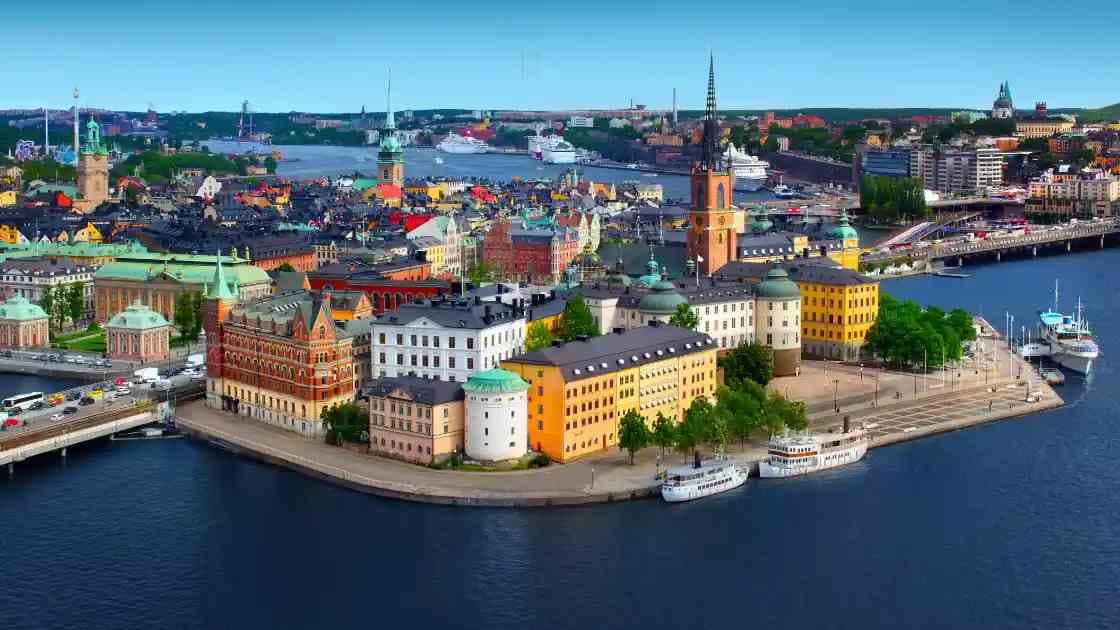
The Kingdom of Sweden, locally known as Konungariket Sverige, is a constitutional monarchy that is located in Northern Europe, along the Scandinavian Peninsula. Its largest city and the nation’s capital is Stockholm.
Sweden had its beginnings around 12,000 BC. The Swedes had been known to have powerful and fast longships that were capable of long journeys and manned by strong men. These men and their longships, called the Swedish Vikings or Rus, figured prominently in Nordic mythology. Their adventures and conquests were chronicled in runestones. The first piece of the literature of Sweden, the Rök Runestone, was discovered in a church in Östergötland in the 19th century and is on display near the church where it was found. While their ancestors may have been notorious in their voyages and conquest, today’s Swedes are peace-loving people. They have remained neutral in times of war.
The country is divided into 21 counties or län, which is govern by an appointed County Administrative Board or länsstyrelse. A Landshövding or Governor heads each county. The counties are further subdivided into “kommuner” or municipalities. These in turn are divided into parishes or församlingar in Swedish.
Sweden is known for its natural environment, its beautiful castles, its high standard of living, its powerful economy, its literature and music.
In this Country Profile
Foreign trade is the major backbone of Sweden’s economy, with the engineering sector accounting for almost half of the nation’s economy. Iron ore, hydropower and timber are major exports although telecommunications, pharmaceuticals and automotive industries are equally important. Volvo, IKEA, Sandvik, Ericsson, Electrolux, Atlas Copco and Sony Ericsson Mobile Communications AB are just some of the major companies operating in Sweden. Among developed countries, Sweden ranks third in having the lowest Gini coefficient, at 0.25, meaning low-income inequality is very minimal in the country. Its nominal GDP according to 2011 estimate was $538.237 billion, with an estimated GDP/PPP of $381.719 billion, giving a per capita GDP of $56,956 and $40,393, respectively. Its standard of living is enviable, assisted largely by the peace that prevails in the nation and its neutral position. It successfully combined extensive welfare benefits and highly technological capitalism. The country’s economy is supported by a distribution system that is very modern and efficient, its highly skilled labor force and its superior internal and external communication facilities and systems.
Music is a driving force in the arts scene of Sweden, with the likes of ABBA, Roxette, The Cardigans and Ace of Base being some of the highly recognized music sensations around the globe. Music producers like Max Martin created hits for Britney Spears, N’Sync and Backstreet Boys and had recently made a successful comeback producing hits for Katy Perry, Pink and Kelly Clarkson. Lady Gaga benefited from the genius of RedOne.
There were also several Swedes that graced Hollywood films, with the likes of Max von Sydow, Greta Garbo and Ingrid Bergman. Film producers include Lukas Moodysson, Ingmar Bergman and Lasse Hallström.
Sweden is the birthplace of Alfred Nobel, whose last name is carried by the coveted Nobel Prize. Swedish authors have received seven Nobel Prizes for Literature. Likewise, the country is the birthplace of widely known authors such as August Strindberg, Nobel laureate recipients Selma Lagerlöf, Pär Lagerkvist and Verner von Heidenstam. Emil and Pippi Longstocking, two famous children’s books, were written by Swedish author Astrid Lindgren and Millennium series author, Stieg Larsson also hailed from Sweden.
Sporting figures from Sweden include tennis stars such as Mats Wilander, Stefan Edberg, Björn Borg and Robin Söderling. Annika Sörenstam is a World Golf Hall of Fame member, while Ingemar Johansson belonged to the International Boxing Hall of Fame.
The country celebrates some unique traditions like the Midsummer to welcome the summer solstice; a spring festival called Walpurgis Night or Walpurgisnacht in Swedish, celebrated on April 30 or the first of May with the lighting of several bonfires and dancing; the feast day of Saint Lucia on December 13; 17 official flag days, several Namesdays every month throughout the year and kräftskivor or crayfish dinner parties in August.
Although more famous for nature tourism, Sweden does have its share of places to see. In Stockholm there is the Royal Palace or Kungliga Slottet, the Royal Chapel or Storkyrkan; the Nobel Museum, the Viking burial mounds in Gamla Uppsala and several memorials to the father of modern taxonomy, Carl von Linné. You could trace the Viking history and view over a hundred runestones in Sigtuna.
In the city of Gothenburg are several museums such as the Aeromuseum, the Gothenburg Museum of Art, the Röhskka Museum for European and Swedish handicraft and the Gothenburg City Museum where the focal point is the only surviving Viking ship in Sweden. If you are after some peace and quiet, the quaint fishing villages in Bohuslän provide the perfect atmosphere and plenty of picture-perfect photo opportunities.
Malmö is a modern city. This is where you would find the perfect view of the Öresund Bridge. The city is likewise the location of the 190-meter Turning Torso building, designed by Santiago Calatrava, which is a replica of his equally famous sculpture.
:: Brief History of Sweden ::
After the last glacial age, the ice that covered the area we now know as Sweden started to melt and evidence of human settlements were uncovered from the area showed their existent since 9000 BCE. From being hunters and fishermen, the settlers finally stayed and started agriculture as their primary source of income from the Stone Age, through the Bronze Age until the Iron Age.
Influences from neighboring countries shaped the culture of Sweden. The Hanseatic League of Germany influenced the trading system of the country. The court and the upper class society during the 18th century were heavily influenced by the French before Germany once again gained dominance in Sweden in the 19th century. Externally the country began its expansion when the Swedish Vikings started their explorations and trading. Their period lasted for 250 years.
In 1000 AD Christianity was introduced in the country as the provinces of Sweden became united into a single country. Pagan religions of the Nordic people were still tolerated for at least a century while Christianity gained a stronger foothold in Sweden.
Territorial expansion continued well into the 12th up to the 13th centuries and Sweden was able to take over Finland during this period. Under the rule of Queen Margareta of Denmark, Norway, Sweden as well as Denmark were united in 1389. The union lasted until 1521, when the Swedes rebelled because the Danish king of the union had 80 prominent Swedes executed due to political conflicts.
Sweden elected their own king, Gustav Vasa and their territorial expansion in the Baltic region made the country a mighty power to reckon with in the northern region of Europe. Things crumbled when Russia rose as a world superpower. It was able to take over Finland, which was originally a part of Sweden, and the other territories that Sweden conquered.
From being the conqueror, Sweden turned to peace and remained neutral during the course of the First and Second World Wars. It did provide support for Germany, Norway and Finland for rescue operations. A notable Swiss diplomat, Raoul Wallenberg, with the help of his colleagues was able to rescue more than 100,000 Hungarian Jews during the holocaust. Up to this day Sweden is known for the humanitarian efforts that it extends to those in need.
Modern agricultural systems were introduced during 1750 until about 1850. Before, a village consisted of properties close together, with a church, barns and houses. The cultivated farms belong to several families, some of them inherited from their parents and brought in by marriages. When modern agriculture was introduced, the farms were set farther apart and several villages had been split up. Farm lots became widely distributed. The method increased agricultural production but it did bring in another headache – increased population due to more people seeking employment in the farms. The dilemma soon escalated and some people were not lucky enough to own any farming land. Some were able to move to other areas that were being developed while others sought their luck abroad. From nearly 50% of the population engaged in farming activities, it lowered to 20% around the 1930s.
There was a mass exodus of Swedes in the latter part of the 19th century as well as the early part of the 20th century. It was however, countered by the number of immigrants who settled in Sweden, finding the area conducive to the way of life they were seeking and the availability of other jobs aside from agriculture. And they brought along their culture and traditions, which, through the years, were assimilated by the Swedes, creating a different brand of Swedish culture that we know today.
:: Geography of Sweden ::
Location
Sweden is strategically located in the Danish Straits that link the North and Baltic Seas. It is situated in Northern Europe and has the Gulf of Bothnia, the Baltic Sea, Skagerrak Strait and the Kattegat Sea among its coastal borders, with land borders shared with Norway and Finland and a bridge and tunnel in the Øresund connecting Sweden to Denmark.
Geographic Coordinates
The country lies 62° 00’ North latitude and 15° 00’ East longitude, with Treriksröset as its extreme point in the north. The harbor of the fishing village of Smygehuk is its southernmost point. A marker at the harbor that marks the exact spot is now a tourist attraction. The islet of Kataja is the most extreme point eastward while its westernmost point is the islet of Stora Drammen.
Area
Sweden, located in the Scandinavian Peninsula has a total area of 450,295 square kilometers, making the country marginally larger than the U.S. State of California. About 410,335 square kilometers is land while water surface covers 39,960 square kilometers. The country has close to 100,000 lakes.
Land Boundaries
Sweden’s longest land boundary is on its western side, which is shared with Norway. The total length is about 1,619 kilometers. The northeast is bounded by Finland for 614 kilometers.
Coastline
The country is near the Gulf of Bothnia and the Baltic Sea, giving Sweden a 3,218-kilometer coastline. The Gulf of Bothnia lies to the east of Sweden while the Baltic Sea covers its southern coast.
Maritime Claims
Sweden shares maritime borders with Germany, Russia, Latvia, Denmark, Poland, Estonia and Lithuania and is linked to Denmark via the Öresund Bridge on its southwest section. Its territorial sea boundary is 12 nautical miles, with an exclusive economic zone on the midlines that had been agreed upon with its maritime neighbors. Its continental shelf is up to a depth of 200 meters.
Climate
With its temperature affected by the warm Gulf Stream, Sweden’s climate is generally temperate in its southern part, characterized by winters that are cold and cloudy. Summers in the south could be partly cloudy. The northern part of the country typically has subarctic temperatures in winter, with cool summers.
Terrain
The Scandinavian mountain chain or the Skanderna is located in the western part of the country. Most of the land is heavily forested, with about 8% suitable for agricultural use. The rest of the country is composed of gently rolling flat and low lands. About 15% of the land in Sweden is located within the Arctic Circle, typical of those countries that are near or close to the North Pole.
Elevation Extremes
Mount Kebnekaise, which is part of the Scandinavian mountain chain, is the highest point in Sweden. It rises to a height of 2,111 meters or about 6,926 feet. It is located in Lapland and quite close to the Arctic Circle. On the other hand, the bay of Lake Hammarsjön in Scania, is the lowest point of the country at -2.41 meters or -7.91 feet.
Natural Resources
Uranium deposits in the country is believed to be equivalent to about 15% of the world’s total. The mineral-rich country also has large iron ore deposits as well as lead, gold, silver, zinc, feldspar, tungsten, copper and arsenic. With the numerous lakes and rivers in Sweden, it is also rich in hydropower. Majority of the land in Sweden is covered by thick forests, making timber one of its more valuable natural resources.
Land Use
With about 15% of its land within the Arctic Circle and about 78% covered with thick forests, the arable land available for agriculture is about 5.93%, of which 0.01% is planted with permanent crops. The rest of the land is allocated for other uses.
Natural Hazards
Being close to the North Pole, and its elevation, Sweden has icy winters with thick snow cover, freezing most of the bodies of water within the country as well as the Gulf of Bothnia. Ice floes are natural hazards and severely affect maritime traffic in the Gulf.
Current Environmental Issues
Pollution of the Baltic Sea and the North Sea is an environmental issue that currently affects Sweden. Add to that the acid rain that causes damage to its bodies of water as well as its soils.
International Environmental Agreements
Although Sweden has signed all the selected international environmental agreements it chose to be party to, the country has yet to ratify any of these agreements. Sweden had signed agreements for Organic Compounds, Antarctic Treaty, Antarctic-Marine Living Resources, Antarctic-Environmental Protocol, Biodiversity, Desertification, Endangered Species, Hazardous Wastes, Environmental Modification, Ozone Layer Protection, Tropical Timber 83 and 94, Whaling, Wetlands, Marine Dumping, Law of the Sea and Ship Pollution. The country likewise signed international environmental agreements on Climate Change, Climate Change-Kyoto Protocol, Air Pollution, Air Pollution-Sulfur 85 and 94, Air Pollution-Volatile, Air Pollution-Persistent Organic Pollutants and Air Pollution-Nitrogen Oxide.
:: People of Sweden ::
People residing in Sweden are called Swedes, which is used for both male and female persons. Swedish is used as an adjective when describing Swede nationals.
Population
According to official census done in 2011, the population of Sweden was 9,415,295. It has an annual population growth rate of 0.168% according to 2012 estimates. With its land area measuring close to 450,000 square kilometers making it the third largest country within the European Union, it has one of the smallest population densities. Accordingly, only about 21 residents live within a square kilometer. This translates to about 54 persons residing in each square mile of land space in Sweden. The country however has a net migration of 1.65 for every 1,000 residents, as of 2012 estimates.
Age Structure
People from ages 15 to 64 dominate in Sweden, holding a 64.8% share in the country’s population age structure. There are almost an equal number of males (2,982,268) and females (2,910,135) in the country. Those 65 years and over make up 19.7%, with 992,665 females against 800,169 males. The younger set, or those aged zero to 14 years make up the balance or 15.4%, with 722,558 males versus 680,933 females.
Median Age
The median age of the Swedes is quite mature. For the whole population, the average is 42.2 years. In 2012, it is estimated that the median age of male Swedes is 41 years while it is 43.3 years for the females.
Birth and Death Rates
As of the estimates done in 2012, the birth rate for every 1,000 residents is 10.24. On the other hand the death rate is almost the same, estimated to be 10.21 for every 1,000 inhabitants.
Sex Ratio
In the sex ratio department, the males slightly edge the females from age zero until age 64, with the females edging the males at age 65 years and over. At birth, there are 1.06 males over one female. The ratio is the same for those under 15 years of age. At the 15-64 age bracket, the ratio becomes lower, with 1.02 male over one female, while the ratio become 0.81 male for one female for those that fall within the 65 years and over age group. For the entire population, the sex ratio is 0.98 male over a female.
Infant and Maternal Mortality Rate
For the whole country of Sweden the infant mortality rate is placed at 2.74 deaths for every 1,000 live births. When broken down by gender, the rate is higher for male infants, measured at 2.89 deaths for every 1,000 live births and only 2.57 deaths for female infants. On the other hand, maternal mortality rate is quite low, with 4 deaths for every 100,000 live births recorded in 2010.
Total Fertility Rate
As of 2012, it has been estimated that fertility rate in the country is only at 1.67 children born/woman.
Life Expectancy at Birth
The Swedes have a long life expectancy. For the entire nation, it is placed at 81.18 years. The females, at 83.63 years outlive the males whose life expectancy at birth is pegged at 78.86 years.
HIV/AIDS
The occurrence of HIV/AIDS in Sweden, although still a problem is very low. Adult prevalence of the disease was estimated in 2009 to be 0.1%. According to the 2009 estimates, there are about 8,100 people living with HIV/AIDS while fewer than 100 deaths from the disease had been recorded that same year.
Ethnic Groups
Although Sweden does not have any official statistics regarding ethnicity, the indigenous population in the country is divided into Swedes with Sami and Finnish minorities and first-generation or foreign-born immigrants composed of Danes, Finns, Norwegians, Greeks, Turks and Yugoslavs.
Religions
Most Swedes belong to the Lutheran Church (The Church of Sweden), comprising 87%, even if attendance to Sunday services is very low, registering only at two percent. Other religions are also practiced, with 13% being members of Jewish, Muslim, Orthodox, Buddhist, Baptist and Roman Catholic churches.
Language
Swedish is the official language, spoken by about 87% of the population. It is similar to the Norwegian and Danish languages and the Swedes are able to easily understand these languages even if there are differences in orthography and pronunciation. Finnish, Romani, Sami, Yiddish and Meänkieli are recognized as minority languages. Spanish, German and French are taught or are beings studied as a second language in Sweden. Most of the older generation speak and understand English because of the frequency of foreign travel after the Second World War, their trade activities among English-speaking countries and the widespread use of English subtitles in foreign films. English is now a compulsory subject in school.
Literacy
Sweden has a very high literacy rate, measured at 99%. Children from age one to age five are guaranteed enrolment in the country’s public kindergarten. From age six until sixteen, all children attend the compulsory comprehensive school. Almost all graduates (90%) of the ninth grade continue to get a three-year gymnasium level or upper secondary school. After graduation, they could either get a job or continue with their university studies.
:: References ::
https://www.cia.gov/library/publications/the-world-factbook/geos/sw.html
http://www.sverigeturism.se/smorgasbord/smorgasbord/culture/short-history/
http://philip.greenspun.com/sweden/history
http://www.localhistories.org/sweden.html
http://www.dogsledding-adventures.com/About/Sweden.htm
http://en.wikipedia.org/wiki/Sweden
Geography of Sweden: Important Geographical Information about Sweden
In this Country Profile
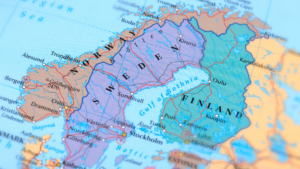
Sweden, located along the Scandinavian Peninsula in Northern Europe has an estimated population in 2011 of 9,453,000. Norway shares border with Sweden in the west while its eastern section is bordered by Finland. The Gulf of Bothnia and the Baltic Sea also share borders with Sweden. The largest city is Stockholm, its capital and Malmo and Goteborg are two other large cities of the country. Its total land area is 450,295 square kilometers or 173,860 square miles. It also has quite a long coastline measuring 3,218 kilometers or nearly 2,000 miles. Many smaller islands compose the country that is Sweden. The country is basically rectangular in shape, long and narrow. It is about 310 kilometers or 500 meters wide and 1,600 kilometers or 995 miles long. Lake Hammarsjon, at -2.4 meter or -7.8 feet below sea level is the lowest point of Sweden, in contrast to Kebnekaise, soaring 2,111 meters of 6,926 feet, which is the highest point in the country.
Sweden is known for its natural environment and has several dense forests, which cover about two-thirds of the whole country. A number of rivers run through Sweden, complemented by about ten thousand lakes. It is also rich in mineral deposits, including sizeable iron deposits and about 15% of the world’s uranium. With the various bodies of water running through it, the country is also rich in hydropower.
The country’s topography is characterized by gently rolling or flat plains although mountains exist on its western section, near its border with Norway. This is the location of the glacier-covered Mount Kebnekaise. Three rivers, Torne, Angerman and Ume flow into the Gulf of Bothnia on the east coast of Sweden. Vänern, the third largest lake in Europe and Western Europe’s largest, lies to the southwest of the country.
Sweden is divided into three regions. The northern part is Norrland. The area has plenty of reindeer, waterfalls, lakes, rivers, snow and thick forests. Norrland, which covers almost half of the country, is noted for the northern lights and the midnight sun, two exciting natural phenomena. Gotäland is the name given to the southern part of Sweden, where the rich soil is very suitable for agriculture. Svealand is the central region of the country. This region is the location of the Vänern Lake, other minor lakes, hills, forests and plains, providing the area with rich and fertile farming lands.
Climate
The Koeppen-Geiger classifies the climate in Sweden into three different zones. In the south the climate is warm temperate and humid, with the warmest month having an average temperature of 22 °C or nearly 72 °F, while four months of the year have an average of over 10 °C or 50 °F. The mountainous region has an ice climate, where the average temperature during the warmest times of the year is below 10 °C or just 50 °F. The northern and middle areas of Sweden have a snow climate with some humidity, where for about four months of the year experience temperatures that are above 10 °C (50 °F) on the average.
Generally the climate in Sweden is classified as subarctic in some parts and temperate in others. However it is milder compared to other countries that are located farther north. This is because Sweden’s climate is tempered by the warm Gulf Stream that comes from the western coast of Norway, further enhanced by the Gulf of Bothnia and the thousands of lakes found in the country. Its northern location however is also beneficial particularly during summer as the humidity levels are not very high and the temperature remains quite pleasant. While the summers may be cool up north, the winters in this region usually have lots of snow and could be very cold. In the southern part of Sweden, the summers are warmer although it is also the time for rain to pour. Milder winters are experienced in the south.
Northern Sweden is also in the Arctic Circle and the region experiences long periods of chilly winter. During winter up north, the region remains dark for about two months and receives more daylight hours continuously for two months in the summer. Hence, this region is called the Land of the Midnight Sun. A natural phenomenon, the multicolored, superb and intriguing displays of the Aurora Borealis, also called Northern Lights, is a fantastic winter night sky spectacle.
Stockholm, the nation’s capital enjoys a milder climate compared to the rest of the country because it is in the southern part of Sweden and is along the coast. The average low in January in the capital city is -5 °C or about 23 °F while the high temperature in July is just 22 °C or just 71.4 °F. Normally the average temperature in July ranges from 13 °C to 17 °C, which is about 55.4 °F to 62.3 °F. The coldest month is February, when temperatures go down from -22 °C or -7.6 °F to -3 °C or 26.6 °F. It is a regular sight to see the grounds in the southern section of Sweden covered in snow from December until April, while snowfall starts around October in the northern section of the country.
References
http://geography.about.com/od/swedenmaps/a/geography-of-sweden.htm
http://www.earthyfamily.com/S-geog.htm
http://www.weatheronline.co.uk/reports/climate/Sweden.htm
http://www.visitsweden.com/sweden/Sweden-Facts/Worth-knowing-about-Sweden/Weather/
http://www.dogsledding-adventures.com/About/Sweden.htm
Professional Translation Organizations & Associations in Sweden
In this Country Profile
Below is a list of the major translation organizations and associations of Sweden.
:: List of Organizations ::
Föreningen Auktoriserade Translatorer (Federation of Authorized Translators in Sweden)
Kammarkollegiet ( Legal, Financial and Administrative Services Agency)
Lund University
Stockholm University, Institute for Interpretation and Translation Studies
Sveriges Facköversättarförening (Swedish Association of Professional Translators)
Information about the Swedish Flag: Colors and Meaning of the Flag of Sweden
In this Country Profile
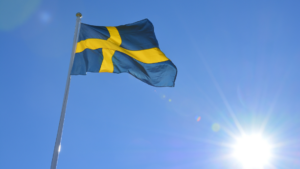
The Kingdom of Sweden, located in the eastern section of the Scandinavian Peninsula is bordered by Finland and Norway as well as the Baltic Sea and the North Sea. In Swedish, the official name of the country is Konungariket Sverige. Stockholm is the capital of Sweden. One of its national symbols, its flag displays a Scandinavian cross in yellow over a sky blue field.
:: History of the Swedish Flag ::
It is believed that the design of Sweden’s flag has been in effect since the reign of King John III in 1569. This means that the flag’s design was already in used long before the king’s reign. It is thought to have been in use as early as 1521. It was inspired by the 1442 Coat of Arms of the country, which has three yellow crowns over a background of blue. The Coat of Arms of Sweden was created in the 15th century during the reign of King Charles Knutsson. It was based on the flag of Denmark for its Scandinavian cross that is positioned off center. It was adopted as the national flag on June 22, 1906.
:: Meaning of the Swedish Flag ::
The national colors of the country of Sweden have traditionally been yellow or gold and blue and these colors are used on the country’s flag. The flag, with a 5:8 ratio uses a sky blue field on which an off-centered Scandinavian cross in yellow or gold color is superimposed. The vertical arms of the cross are placed more to the hoist side of the flag, with its horizontal section dividing the flag in half. The cross creates two blue square sections on the hoist side and two rectangular sections on its flying side.
The meaning of the Swedish flag colors is quite simple. The blue represents justice, loyalty, truth, vigilance and perseverance. The yellow or gold color used on the cross is a representation of generosity.
References :
http://www.norden.org/en/the-nordic-region/the-nordic-flags/swedens-flag/
http://www.worldflags101.com/s/sweden-flag.aspx
http://wiki.answers.com/Q/What_do_the_colours_on_the_Swedish_flag_represent#ixzz23FM0DOZJ
Extensive List of Languages of Sweden: Spoken and Extinct Languages
In this Country Profile
:: List of Languages ::
Kingdom of Sweden, Konungariket Sverige. 9,038,000. National or official language: Swedish. Literacy rate: 99%. Immigrant languages: Amharic, Assyrian Neo-Aramaic, Chaldean Neo-Aramaic, Danish (35,000), Eastern Yiddish (4,000), Estonian (1,560), Greek (50,000), Kirmanjki, Latvian (450), Lithuanian (310), Northern Kurdish (10,000), Serbian (120,000), Somali, Spanish (35,000), Tosk Albanian (4,000), Turkish (20,000), Turoyo (20,000), Western Farsi (35,000). Also includes Chinese, and languages of Iraq (6,000), Eritrea, North Africa. Information mainly from B. Comrie 1987; O. Dahl 1996; I. Hancock 1991; E. Haugen 1992; B. Winsa 1998. Blind population: 15,716. Deaf population: 8,000 to 532,210 (1998). Deaf institutions: 72. The number of individual languages listed for Sweden is 12. Of those, all are living languages.
:: List of Languages ::
Finnish
[fin] 200,000 in Sweden (1997 B. Winsa). 446,134 ‘Swedish-Finns’ in 1999, including those born in Finland and first generation born in Sweden, but not others, even if L1 is Finnish. Alternate names: Suomea, Suomi. Classification: Uralic, Finnic
Finnish, Tornedalen
[fit] 79,600 in Sweden (2000). 40,000 to 70,000 in the main region (1997), and including 20,000 who speak it in the home (1996). Population total all countries: 109,600. Northeast, Norrbotten County, Gällivare, Kiruna, Pajala, Övertorneä, and Haparanda municipalities. Also in Finland. Alternate names: Meänkieli, North Finnish, Torne Valley Finnish, Tornedalen, Tornedalsfinska. Dialects: Torne Valley Finnish, Vittangi Finnish, Gällivare Finnish. Standard Finnish [fin] not totally intelligible to speakers, especially abstract and complex discourse. Classification: Uralic, Finnic
Romani, Kalo Finnish
[[rmf] 1,590 in Sweden (2000). Alternate names: Fíntika Rómma. Classification: Indo-European, Indo-Iranian, Indo-Aryan, Central zone, Romani, Northern
Romani, Tavringer
[rmu] 25,000 in Sweden (1998 Hallman). Population total all countries: 31,000. Scattered. Also in Norway. Alternate names: Rommani, Svensk Rommani, “Tattare” , Traveller Swedish. Dialects: Independent language based on Swedish [swe] with heavy lexical borrowing from Northern Romani varieties. Not intelligible with Angloromani. Classification: Mixed language, Swedish-Romani
Romani, Vlax
[rmy] 1,500 in Sweden. 500 Kalderash, 1,000 Lovari. Alternate names: Zigenare. Dialects: Kalderash, Lovari. Classification: Indo-European, Indo-Iranian, Indo-Aryan, Central zone, Romani, Vlax
Saami, Lule
[smj] 1,500 in Sweden (Krauss 1995). Population total all countries: 2,000. Ethnic population: 6,000 in Sweden. Lapland, Gällivare and Jokkmokk, along Lule River. Also in Norway. Alternate names: “Lapp” , Lule, Saami. Dialects: Quite distinct from other Saami. Classification: Uralic, Sami, Western, Northern
Saami, North
[sme] 4,000 in Sweden (Krauss 1995). Ethnic population: 5,000 in Sweden (1994 SIL). Karesuando and Jukkasjärvi. Alternate names: “Lapp” , Northern Lappish, Northern Saami, Norwegian Saami, Saame, Same, Samic. Dialects: Ruija, Torne, Sea Lappish. Classification: Uralic, Sami, Western, Northern
Saami, Pite
[sje] 20 in Sweden (2000 T. Salminen). Ethnic population: 2,000 in Sweden (Krauss 1995). Lapland, Arjeplog and Arvidsjaur, along Pite River. Also in Norway. Alternate names: “Lapp” , Pite, Saami. Classification: Uralic, Sami, Western, Northern Nearly extinct.
Saami, South
[sma] 300 in Sweden (Krauss 1995). Population total all countries: 600. Ethnic population: 600 in Sweden. Lapland, Vilhelmina; Dalarna, Jämtland, Härjedalen, Idre. Also in Norway. Alternate names: “Lapp” , Southern Lapp. Classification: Uralic, Sami, Western, Southern
Saami, Ume
[sju] 20 (2000 T. Salminen). Probably no speakers in Norway. Ethnic population: 1,000 (Krauss 1995). Lycksele, Mala, Tärna, and Sorsele, along Ume River. Alternate names: “Lapp” , Saami, Ume. Classification: Uralic, Sami, Southern Nearly extinct.
Swedish
[swe] 7,910,000 in Sweden. 5,000 speakers of Gutniska (1998 S. Håkansson), and 30,000 of Jamtska. Population total all countries: 8,311,739. The Göta dialect group south, including parts of Småland, south Swedish provinces, Värmland, Västergvtland; Svea in north, including Hälsingland, parts of Östergötland and Uppland, and Swedish-speaking parts of Finland; Southern Swedish in Skåne, Blekinge, southern Småland, southern Halland; Northern Swedish in northern Hälsingland and Jämtland and north; Jamtska mainly in Jämtland; Eastern Swedish in Finland, Estonia, and Gammalsvenskby, Ukraine; Gutnic southeast Isle of Gotland and Fårö. Also in Canada, Denmark, Estonia, Finland, Norway, United Arab Emirates, United States. Alternate names: Ruotsi, Svenska. Dialects: Dalecarlian, Eastern Swedish (Finland Swedish), Estonian Swedish, Gutniska (Gutamal, Gotlandic, Gutnic), Jamtska, Northern Swedish (Norrland), Scanian, Svea. ‘Proper’ Swedish considered spoken in Svealand. Dialect investigation is needed in Gutniska, Överkalixmål, Nörpes, Pitemål, provinces around the Bothnic Sea (Västerbotten and Norbotten in Sweden, and Oesterbotten in Finland), and the island of Gotland. Gutniska descended from Forngutniska (Old Gotlandic). Rinkebysvenska, a mixed variety with Turkish influence, is used among immigrants. Classification: Indo-European, Germanic, North, East Scandinavian, Danish-Swedish, Swedish
Swedish Sign Language
[swl] 8,000 deaf primary users, and the L1 of many hearing children of deaf parents (VanCleve 1986). Dialects: No origins from other sign languages, but it influenced Portuguese [psr] and Finnish [fsl] sign languages. Intelligible with Norwegian [nsl] and Danish [dsl] sign languages with only moderate difficulty. Not intelligible with Finnish Sign Language [fsl]. Classification: Deaf sign language
:: Reference ::
Gordon, Raymond G., Jr. (ed.), 2005. Ethnologue: Languages of the World, Fifteenth edition. Dallas, Tex.: SIL International. Online version: http://www.ethnologue.com/
Famous Swedish People: Swedish Artists, Scientists, Leaders, Musicians, Politicians and Athletes
In this Country Profile
Sweden, a Nordic monarchy near Norway, Denmark and Finland, is a highly industrialized country. The peaceful nation is home to people who are very private and reserved on the outside but are very warm and friendly once they’ve gotten to know you. Sweden is home to a host of notable personalities who have made their mark in the international arena in the fields of science, music, film, literature, politics, medicine and sports. These groups and individuals standout because of the splendid and exemplary works they performed. Some of them have earned the highest international honor, emulating their fellow compatriot, Alfred Nobel, whose name had been given to the Nobel Prize. Read about some of the notable Swedes that made their country proud.
:: List of Famous People from Sweden ::
Greta Garbo
Her real name was Greta Lovisa Gustafsson and she was born on September 18, 1905 in Stockholm. She started her film career in 1924 and became an international star in silent and classic films. She made 27 movies during her career and had been nominated in the Oscars as best actress four times for the films Anna Christie, Romance, Camille and Ninotchka. She never won but her outstanding portrayals earned her a special Academy Award. She had been a star in several silent films such as The Torrent in 1926 and Love in 1927 before movie audiences finally heard her sultry voice in the 1930 film, Anna Christie. She retired in 1941 and lived a private life until her demise at the age of 94 in 1990.
August Strindberg
Johan August Strindberg was a native of Stockholm, where he was born on January 22, 1849. His short stories and novels were injected with psychology and naturalism. He was also a playwright who had written 70 plays. His works provided inspiration for other writers like Samuel Beckett, Tennessee Williams and Harold Pinter. Some of his notable works include plays such as Master Olof he created in 1872, Getting Married in 1884, The Father in 1887, Gustav Adolf in 1900. In 1907 he wrote After the Fire, The Pelican, The Spook Sonata and The Thunderstorm. He lost his mother when he was thirteen years old. He said that his mother resented his intelligence. Aside from being an author, he was also a painter, an alchemist, a photographer, theosophist, telegrapher and a polymath.
Ingrid Bergman
Swedish film actress Ingrid Bergman was born in Stockholm on August 29, 1915. The stunningly beautiful actress started her career in American films when she starred in the 1939 film, Intermezzo: A Love Story. Earlier, her first foray into acting came through a competition she entered at the Royal Dramatic Theater in her home city when she was seventeen. She gained fame in her own country with films like Munkbroggreven and Swedenheilms in 1935 and Intermezzo in 1936. Ingrid Bergman starred in classic films from 1941 to 1974, such as Rage in Heaven, Casablanca, For Whom the Bell Tolls, The Bells of St. Mary’s, Spellbound (Alfred Hitchcock), Notorious, Joan of Arc, Gaslight, Anastasia and The Murder on the Orient Express. She won the Best Actress Award in the Oscars for Gaslight and Anastasia, and an Academy award for Best Supporting Actress for her performance in The Murder on the Orient Express. Her last movie was Autumn Sonata, which was done in 1978. She starred in a TV mini-series entitled A Woman Called Golda chronicling the life of the late Prime Minister Golda Meir of Israel.
She was already sick during the filming of the TV series and departed four months after its completion. She was awarded her second Emmy Award for Best Actress posthumously for her performance in the series. Her daughter, Pia Lindström received the award on her behalf.
Astrid Lindgren
Astrid Anna Emilia Lindgren was a prolific writer of children’s books during her time. She was in Stockholm on November 14, 1907 but grew up in Näs, Småland. She was influential in spreading the interest in children’s literature not only in her home country but throughout Scandinavia as well. Most of her books were based on her childhood memories, her family and the landscape in the area where she grew up. Lindgren’s children’s books have sold about 145 million copies and she ranked 18th in the world as the most translated author. Some of her best-known book series are Six Bullerby Children, Karlsson-on-the-Roof and Pippi Longstocking. The latter was set in Gotland and was actually a story she invented to amuse her daughter when the latter got bed-ridden with illness. Lindgren was awarded the Hans Christian Andersen Award in 1958 and the Lewis Carroll Shelf Award in 1973, aside from the numerous other awards she had received. After her death in 2002, the Swedish government established the Astrid Lindgren Memorial Award for children’s and youth literature that carries the largest monetary award in the world. The award is worth five million Swedish krona, which is roughly about US$750,000. The collection of her original manuscripts is kept at the Royal Library or Kungliga Biblioteket in Stockholm. In 2005 the collection was declared as a World Heritage by UNESCO.
Selma Lagerlöf
Selma Ottilia Lovisa Lagerlöf was a Swedish author born on November 20, 1858 at Mårbacka, Värmland, which is located in western Sweden. Her original job was as a teacher and during her teaching days she was able to polish her skills in storytelling. She started her first novel entitled Gosta Berling’s Saga in 1891 while she was still a teacher. One of her famous books was about geography called The Wonderful Adventures of Nils, which she wrote in 1906. Her publications have been translated into 40 languages. These are still republished to this day. Lagerlöf was the first Swede and the first female author to receive the Nobel Prize for Literature in 1909. In 1895, she received the honor of being the first woman appointed to the Swedish Academy.
Björn Rune Borg
Björn Borg was once the number one tennis player in the world. He was born on June 6, 1956 in Södertälje, Stockholm. He was already playing in the professional tennis circuit when he was 14 years old and became a member of the 1972 Swedish Davis Cup team at age fifteen. He won his debut singles rubber match at that time. In that same year Borg won his first junior Wimbledon title. Throughout his career he amassed 101 career titles that include six French Open titles, five Wimbledon titles and was a finalist in the US Open for four seasons. He created a legend for remaining cool under pressure, earning him the nickname Ice-Man or Ice-Borg. Borg, a baseliner who prefers grass as his favorite playing surface has been credited in the development of the baseline game that is so popular with the tennis players of today.
Alfred Nobel
Alfred Bernhard Nobel, the inventor of the dynamite, was born in Stockholm on October 21, 1833. He was an innovator, engineer and chemist. He is also known for manufacturing armaments. He was the original owner of Bofors, originally related to the iron and steel industry in Sweden. Today, through an exchange of ownership, the company is now split into two major companies, Saab Bofors Dynamics and BAE Systems Bofors. Nobel held 350 different patents, although the most famous one was that for dynamite. As a chemist, he experimented on the works of the torpedo, the use of nitroglycerine and different ways to produce explosive materials. He later used his own funds to establish the Nobel Prize, leaving two million pound sterling in his will to provide for Nobel Prizes in five disciplines – Literature, Chemistry, Physics, Medicine and Peace endeavors.
Carl Larsson
Carl Larsson, an interior designer and painter was born on May 28, 1853 in Stockholm. He came from a very poor family wherein his mother was the principal breadwinner. It seemed that he inherited his artistic talent from his maternal grandfather. While in school he was encouraged by his teacher to apply to the Royal Swedish Academy of Arts at the age of thirteen. He worked as a book illustrator, a caricaturist and a graphic artist while still in school. He moved to Paris in 1877 but did not join the Impressionist movement. He met his wife while he was in Paris and started using watercolor for most of his paintings rather than oil, and most of his watercolor subjects were their eight children.
He gained popularity when color reproduction was introduced and the books he had illustrated and wrote were reproduced. One of his last large paintings, measuring 20 feet by 46 feet or 6 meters by 14 meters, entitled Midwinter Sacrifice or Midvinterblot is on display at the Swedish National Museum of Fine Arts.
Svante Arrhenius
Swedish scientist, chemist and physicist Svante August Arrhenius was a Nobel Prize recipient for chemistry in 1903. He is recognized as one of the founders of physical chemistry, which is the study of macroscopic, subatomic, atomic and particulate phenomena in chemical systems. He was born at Vik Castle in Sweden on February 19, 1859. He got fascinated with numbers while watching his father work on his account books and he became a prodigy in arithmetic. At age eight he entered school, starting his schooling on the fifth grade and quickly excelling in mathematics and physics and graduating as the youngest and ablest student. He became involved in setting up the Nobel Prizes and the Nobel Institutes. He was likewise a member of the Nobel Committee on Physics and Chemistry and was appointed as the rector of the Nobel Institute for Physical Research in 1905.
Ingmar Bergman
Ernst Ingmar Bergman is recognized as one of the most influential and accomplished film directors of all time. The Swedish writer, director and producer was born on July 14, 1918 in Uppsala. Throughout his career he directed 170 plays and about 60 films and documentaries for television and cinematic release. Most of his works were also written by him. He worked with noted film personalities such as Max von Sydow, Liv Ullman, Gunnar Björnstrand, Harriet Andersson, Erland Josephson and Bibi Andersson. His country’s landscape was his favorite set while his cinematic subjects range from death, faith, betrayal, insanity and illness. Some of his films include Smiles of a Summer Night, The Seventh Seal, Wild Strawberries, Persona, The Virgin Spring, Autumn Sonata and Saraband.
Anders Celsius
Swedish astronomer Anders Celsius was born on November 27, 1701 in Uppsala. He is most noted for his proposal regarding the Celsius temperature scale that bears his name, which he put forward in 1742. His father Nils Celsius was an astronomy professor while his grandfather was Magnus Celsius, a mathematician. Anders also became a professor of astronomy like his father and taught at the Uppsala University. He published several scientific papers throughout his career and was the first to observe the connection between the changes in the earth’s magnetic field and the aurora borealis. He joined several travels and expeditions to measure an arc of the meridian close to the equator and the pole. He achieved many firsts in his lifetime. He was the first to record the intensity of starlight by using colored glass plates. At the same time he carefully recorded his observations of various astronomical objects, star magnitudes and eclipses. He was also the first to perform careful experiments and publish the results for an international temperature scale, which later carried his name. Likewise, he was one of the first to observe and make note of the continuous rising of Scandinavia after the last ice age. Celcius was also credited for proposing the name of the Royal Swedish Academy of Sciences in 1739.
Carl von Linné
Carl Nilsson Linnæus, Swedish physician, zoologist and botanist was the father of modern taxonomy, modern ecology and binomial nomenclature. He was born in Småland on May 23, 1707. He was a professor of botany at Uppsala University when he was sent on journeys all over Sweden to look for and classify the country’s flora and fauna, leading to the publication of several volumes of his scientific observations and records. He was hailed by Swiss philosopher Jean-Jacques Rousseau and Johann Wolfgang von Goethe as the greatest man on earth. He was even called the Prince of Botany. He published several books, including Critica Botanica, Genera Plantarum, Flora Lapponica, Systema Naturae, Hortus Cliffortianus, Flora Suecica, Fauna Suecica, Philosophia Botanica and Species Plantarum.
Stieg Larsson
Karl Stig-Erland “Stieg” Larsson was the author of the Millennium series of crime stories. He was born on August 15, 1954 in Skelleftehamm. He was a Swedish journalist and writer whose series of crime novels, collectively called the Millennium series was published posthumously. This series has sold 65 million copies worldwide in 2011. The last part of the series, entitled The Girl Who Kicked the Hornets’ Nest was the most sold book in the U.S. in 2010.
Jenny Lind
Johanna Maria Lind, called the Swedish Nightingale, was an operatic singer. She was born in central Stockholm on October 6, 1820. Lind was one of the highly regarded opera singers of the 19th century and was in great demand in Europe as well as in Sweden. She was nine years old when a maid for the principal dancer of the Royal Swedish Opera, Mademoiselle Lundberg, heard her sing. Mademoiselle Lundberg arranged for her audition and admission into the Royal Dramatic Theater acting school where she had singing lessons with Karl Magnus Craelius. By age ten, Lind was already singing on stage and by age 20 she was a member of the Royal Swedish Academy of Music. She was also the court singer for the King of Norway and Sweden. Her performance in Der Freischütz in 1838 made her famous.
Her untrained singing technique and overuse caused her to damage her voice seriously but was saved and taught proper vocal technique by singing teacher Manuel Garcia while she was in Paris from 1841 until 1843. She auditioned for the Paris Opéra. Unfortunately she was rejected and this rebuff seemed to be the reason why she refused invitations by the said institution when she became internationally famous. Hans Christian Andersen fell in love with her and inspired three of his fairy tales – The Nightingale, The Angel and Beneath the Pillar. She was a protégée of German composer, conductor and pianist Felix Mendelssohn. She retired from the opera at the age of 29. By 1850 however, she was invited by P. T. Barnum and toured the United States, giving 93 large-scale concerts. She later toured with her own company.
Raoul Wallenberg
Architect, diplomat, humanitarian and businessman were the hats worn by Raoul Wallenberg, who was born on August 4, 1912 in the municipality of Lidingö. He became more famous in 1945 when he sheltered nearly one hundred thousand Jews in Hungary, which was occupied by the Nazis at that time. He was then working as a special envoy in Budapest. He provided shelter to Hungarian Jews in buildings that were assigned as Swedish territory and issued protective passports to them. His humanitarian feats earned him accolades from several countries and became an honorary citizen of Hungary, Israel, Canada and the United States, where one of the persons he saved, Congressman Tom Santos sponsored the bill to make him an honorary citizen of the U.S. in 1981. He was given the U.S. Congressional Gold Medal on July 26, 2012 for his exemplary and heroic deeds during the Holocaust.
Dag Hammarsköld
Dag Hjalmar Agne Carl Hammarskjöld, born in Jönköping on July 29, 1905 served as the second Secretary General of the United Nations from April 1953 until his untimely death from a plane crash while on his way to peace negotiations in New Rhodesia, now called Zambia on September 1961. His Nobel Peace Prize was given posthumously. He succeeded Trygve Lie of Norway who resigned from his position as UN Secretary General in 1953. Hammarskjöld established a secretariat with 4,000 administrators, defined their duties and created a meditation room at the UN Headquarters; negotiated with China in 1955 for the release of 15 U.S. pilots who rendered service in the Korean War and the creation of the UN Emergency Force. He was also involved in the intervention of the Suez Crisis in 1956 and the participation of the Holy See in the United Nations. He was considered as the “greatest man of our century” by U.S. President John F. Kennedy. He was the benchmark of the succeeding UN Secretary Generals, according to the Financial Times report published in 2011.
Isaac Hirsche Grünewald
Expressionist painter Isaac Hirsche Grünewald was born on September 2, 1889 in Stockholm. He studied under Henri Matisse when he went to Paris when he was 19 years old. It was in Paris where he met his wife, Sigrid Hjertén, a Fauvist painter. They were part of a group of Scandinavian artists who called themselves The Young Ones or De Unga. According to historians Grünewald and his wife were responsible for the introduction of modernism to Sweden where the husband and wife team exhibited their works together. They also exhibited abroad. He created stage designs for the Royal Swedish Opera and the Royal Dramatic Theater to supplement his income. The walls and ceilings of an auditorium of the Stockholm Concert Hall were decorated by Grünewald. He was honored for his work by naming the hall after him. The meeting room of the Matchstick Palace, the headquarters of Svenska Tändsticks AB or Swedish Match had paintings done by Grünewald. The Rörstrand Porcelain Factory where he worked during WWII produces vases in different shapes that carry Grünewald artworks.
Ingvar Kamprad
Ingvar Feodor Kamprad is a Swedish entrepreneur and the founder of global furniture and accessories manufacturer, IKEA. Born on March 30, 1926 in Älmhult, Kamprad is one of the richest men in the world. IKEA has more than 200 stores in 31 countries, providing employment to more than 75,000 people. The stores generate about $12 billion a year. IKEA is a combination of Ingvar’s initials plus the first letters of Elmtaryd and Agunnaryd where he grew up. Known for being very frugal, Kamprad started his business buying and selling matchsticks and invested his profits on other items, including school supplies, fish, seeds and Christmas decorations. He founded IKEA using the reward money his father gave him for doing well in school. For a time his store carried several different items, including smaller personal accessories but made a hit with his locally manufactured by very well made furniture. The furniture pieces that IKEA carries are all manufactured for flat packaging to save on shipment costs. It also helps lower the probability of damage to the items during shipment as well as give their customers the option to bring home the items immediately and assemble them on their own. The contemporary look of the stores, the innovative furniture designs and the very competitive price give IKEA the edge over their competitors. To this day IKEA remains a one of the very successful privately owned companies. It continues to be managed by members of his family.
Johan Helmich Roman
Considered the father of Swedish music, Johan Roman was a Baroque composer who was born on October 26, 1694. He hailed from Stockholm. He was a member of the Royal Swedish Chapel and was the oboist and violinist of the chapel when he was 17 years of age. He was allowed by the King to travel to London to study music in 1715 under the tutelage of Johann Christoph Pepusch. It was in London where he met composer that influenced him greatly such as George Frideric Handel, Giovanni Battista Bononcini and Francesco Geminiani. He was appointed as the deputy master of the Royal Chapel when he returned from London and in 1727 became the Swedish Royal Orchestra’s Chief Master. One of his finest works was Drottningholmsmusique, which he composed for the wedding of Sweden’s Crown Prince Adolf Frederich to Prussia’s Louisa Ulrika.
Arvid Carlsson
Swedish scientist Arvid Carlsson received the Nobel Prize for Medicine in 2000 for his work on dopamine, a neurotransmitter and its effects in Parkinson disease, a brain disorder characterized by difficulty in coordination, movement and walking as well as shaking of body parts. Carlsson was born in Uppsala on January 25, 1923.
ABBA
One of the most successful group that had been adored by millions of listeners around the world is Swedish group ABBA, which was formed in 1972. Members include Agnetha Fältskog, Björn Ulvaeus (Fältskog’s husband), Anni-Frid Lyngstad and her husband Benny Andersson. Their songs topped the international charts from 1972 up to 1982. They won the Eurovision top prize in 1974, the first time victory for Sweden. The group sold 370 million records around the world and their albums continue to sell to this day. They are one of the most successful groups from a non-English speaking country to have continued commercial success in English-speaking countries like Australia, South Africa, New Zealand, the United Kingdom, Ireland, Canada and the United States. They also recorded a Spanish version of some of their hit songs. Some of their hits include Chiquitita, Fernando, Dancing Queen, Gimme Gimme Gimme!, Knowing Me, Knowing You, I Have a Dream, Mamma Mia, Voulez-Vous, and Nina Pretty Ballerina.
Europe
Europe is a very successful heavy metal/hard rock band that originated from the Upplands Väsby in Sweden. The group started their career in 1979, using the name Force as their band name when they started and changing it to Europe two years later. Original members of the group are Joey Tempest, real name Rolf Magnus Joakim Larsson (vocalist), John Norum (guitarist), Peter Olsson (bassist), and Tony Reno, real name Tony Niemistö (drummer). Peter Olsson was replaced by John Levén as bassist while drummer Tony Reno was replaced by Ian Haugland. Their international success came during their third album with the single The Final Countdown, followed by Carrie and Rock the Night. The group, which is still active, had previously released nine studio albums. They had 29 singles, one extended play or EP, three live albums, nine video albums and 19 music videos. One of the most successful rock acts during the 1980s, Europe sold 20 million albums globally and had been in the Billboard 200 chart.
Sven-Göran Eriksson
Sven-Göran Eriksson, who goes by his nickname Svennis, was a former football manager that won 17 major football trophies when he managed football league clubs in Sweden, Italy and Portugal from 1979 until 2000. He also managed national teams in Mexico, Côte d’Ivoire and England. Eriksson was born in Sunne, Sweden on February 5, 1948. His career as a football player was unremarkable and he retired as a player in 1975 due to a knee injury. His move to being manager was propitious as he gained success in the field. He first joined local Swedish clubs like Degerfors IF then IFK Göteborg. He also had managerial stints in Benfica, Roma, Fiorentina, Sampdoria and Lazio. He later managed England’s national team, taking them to the FIFA World Cup in 1992, UEFA Euro 2004 and the qualifying rounds and finals of the FIFA World Cup in 2006. He later transferred to Manchester City. He was last linked to English club Leicester City in 2011.
References
http://www.europe-cities.com/en/658/sweden/history/famous-people/
http://www.biography.com/people/groups/swede-or-swedish/all
http://www.rankopedia.com/Most-famous-person-from-Sweden/Step1/12044/.htm
http://en.wikipedia.org/wiki/List_of_Swedish_people
http://www.deconet.com/decopedia/designer/1444/Isaac_Gr%C3%BCnewald