
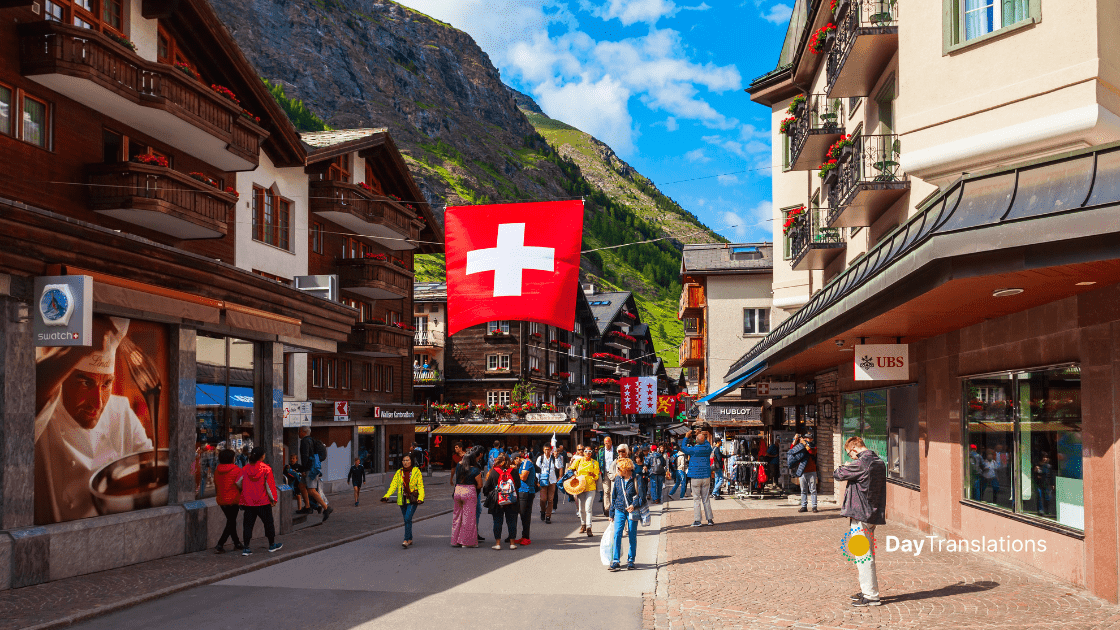
Switzerland, officially called Swiss Confederation retains its Latin name Confoederatio Helvetica, from the Latin word Helvetier. It is the name given to the group of people living in the area that became Switzerland. The country retained it and its abbreviation CH, which is still used in car plates and the country’s Internet address. Due to the four main languages spoken in Switzerland, the country has also has four formal names in each language. It is called Schweizerische Eidgenossenschaft in German. In Italian, it is called Confederazione Svizzera, Confederaziun Svizra in Romansch and Confédération Suisse if you want to say it in French. Switzerland is a federal republic with direct democracy and directorial system. Its capital city is Bern.
:: Background of Switzerland ::
A Celtic tribe known as Helvetians came to Switzerland around 500 B.C. and settled near a lake in Neuchâtel in western Switzerland. The country came under the rule of the Romans during the first century B.C. up to the 4th century A.D. The civilization and commerce flourished under Roman rule and military roads were created to link key cities like Basel, Zurich and Geneva and paved the way for trade between the tribes and Rome.
Germany invaded Switzerland when the Roman Empire begun to decline. Alamannen (German) tribes settled in the northeastern and central parts of Switzerland while the Burgundians (French) ruled the western parts. The country was annexed to Charlemagne’s empire in year 800 and again came under the rule of the Roman emperors. The settling of different tribes in different localities in Switzerland accounts for the language difference in the different regions of the country.
In this Country Profile
As new trade routes opened across the northern and southern sections across the Alps in the 13th century, the Roman emperors acknowledged the importance of the Swiss mountain valleys and granted autonomy of a lesser degree to the regions, which will still be under the direct rule of the emperor of Rome. At that time, there were already established ruling families, such as the Unterwalden, Schwyz and Uri and they signed a charter on August 1, 1291 to keep the peace and pledged their support for their autonomy following the death of the Roman emperor in 1291. Up to this day the anniversary of the signing of the charter is celebrated as a National Day in Switzerland.
The determination of the confederates to remain peaceful and autonomous strengthened their unity to defeat enemies who wanted to conquer the localities or cantons, as these are called now. And soon, other cantons joined the federation and continued to expand their military borders until they were able to gain complete independence from the Roman Empire by 1499. Their expansion was stopped by the Venetians and the French forces in 1515 but by then they already had formed a confederation composed of 13 localities and had been conducting regular diet conventions for administration. However, the reformation efforts divided the followers of different religions, leading to internal strifes, although the common interest of the Confederation prevailed and prevented the union from disintegrating. Switzerland remained neutral while the rest of Europe was engaged in wars. The Treaty of Westphalia signed in 1648 formally recognized this neutrality. However, it was not effective against Napoleon who was able to invade and annex a major part of the country to France for over a year between 1797 and 1798 and replaced the confederation with a centrally-governed single state.
The old confederation was re-established by virtue of the Congress of Vienna signed in 1815, and granted the permanent armed neutrality status of Switzerland in international law. Protestant liberals and conservative Catholics staged a civil war to decide which form of government to install around 1848 however the majority vote was for a Federal State, following the model of the Constitution of the United States, and retained cantonal or local autonomy in deference to the Catholics and introduced referendum democracy which is still enforced to this day.
Switzerland became highly industrialized and was in second place across Europe by 1850. Internal tensions among the Italian, German and French-speaking sections of Switzerland broke out and almost put the country’s neutrality to the test but it remained steadfast, and helped in relieving other internal strifes due to labor unrests in 1918. A large trade union was established in 1937 to resolve the issues and remains the governing body until today. The pressure from fascist powers during World War II again placed Switzerland’s neutral stance to the test but somehow they prevailed to keep that intact due to tactical accommodation and their unified demonstration to defend their country in case of foreign invasion.
During the Cold War, Switzerland’s neutrality its diplomatic isolation by their economic integration with the post-war order led by the United States. It was reluctant to join the United Nations after the war although Geneva became the host for the United Nations’ headquarters in Europe and supported many of the UN agencies’ efforts. It only joined the Council of Europe in 1963. It is still not part of the European Union but it helped form the European Free Trade Area in 1960. It joined the Bretton Woods institutions in 1992 and formally joined the United Nations only in 2002. The Bretton Woods system is an international monetary regulation system that obligates each member country to adopt a monetary policy that ties a member country’s exchange rate to the United States dollar. It also formulated the ability of the International Monetary Fund (IMF) to temporary bridge the imbalances of debt payments. The IMF was established by Bretton Woods as well as the International Bank for Reconstruction and Development, which is now under the World Bank group.
:: Geography of Switzerland ::
Switzerland lies in the crossroads of southern and northern Europe, landlocked by France, Italy, Germany and Austria. This rugged and scenic country has the highest elevations among the Alpine mountain ranges.
Location
Switzerland is a landlocked country located east of France and north of Italy in Central Europe. Its geographic coordinates are 47° 00’ 00” North latitude and 8° 00’ 00” East longitude.
Area
The country has a total landmass of 41,290 square meters, composed of 39,770 square kilometers of land and 1,580 square meters of land underwater. Switzerland is a bit smaller than two times the size of New Jersey in the United States.
Land Boundaries
With the country being landlocked, Switzerland has a long land boundary, totaling 1,852 kilometers. On its north side, Switzerland shares a border with Germany for 334 kilometers. On the eastern side, Austria borders Switzerland for 164 kilometers. France shares its border in the western side for 573 kilometers while Italy shares borders with Switzerland on its southern side for 740 kilometers. The western and southern parts of Switzerland also share a border with Liechtenstein for 41 kilometers.
Coastline and Maritime Claims
Due to Switzerland being a landlocked country, it does not have coastline nor does it have any maritime claims.
Climate
Switzerland in located in the Alpine region of Europe, with numerous Alps present in the whole country. Therefore the climate varies depending on the altitude but it is generally temperate. The winter months are characterized with cloudy, cold, rainy or snowy conditions. Summers vary from cool to warm and can also have cloudy skies. Some parts of the country may also experience humid summers and get occasional rainfall.
Terrain
About 60% of Switzerland is covered by the Alps, mostly located in the southern part of the country while the Jura mountain range is located in the northwest, covering about 30% of the land. The remaining 10 percent comprise the central plains or the Swiss plateau, not exactly flat land but a combination of flat areas and hilly portions where large lakes can be found. Basically the Alps are not habitable except for those regions that are being utilized as ski resort areas. The Jura region is sparsely inhabited although it is world-renown for their musical boxes, particularly the Sainte-Croix area. The Jura, meaning forest mountain is a mountain range that divides the Rhone River and the Rhine River.
Elevation Extremes
As characterized by its mountainous terrain, even Switzerland’s lowest elevation, Lake Maggiore, the largest lake in Switzerland located in the canton of Ticino in the southern part of the country is still 195 meters above sea level. Lake Maggiore is part of the larger body of water that originates from Italy. With several Alpine peaks, there are several tall mountains in the country, with Dufourspitze or Monte Rosa located in the canton of Valais, being the tallest at 4,634 meters.Dufourspitze is part of the Pennine Alps, and is the second tallest mountain in the Alps and in Western Europe, next to Mont Blanc.
Natural Resources
Switzerland has very limited natural resources. There are just a few deposits of manganese and iron in the Jura area although there are no deposits of coal. Some minerals worthy of commercial exploitation are salt, sand, lime, gravel and clay. Marble is also present. The mountains yield a variety of commercial grade timber. Its lack of mineral resources in made up by is hydropower potential.
Land Use
Typical of its Alpine terrain, only 9.91% of the total land area is arable, with 0.58% planted with permanent crops. The rest is mostly covered by mountains. Soil condition is poor although farming innovations lead to higher yields of wheat, maize, barley, rye, oat, potatoes and sugar beets. There are about 37,000 acres reserved for vineyards.
Natural Hazards
Flash floods, landslides and avalanches are the natural hazards that an Alpine region like Switzerland face annually.
Current Environmental Issues
Switzerland currently faces modern-day environmental issues such as and open-air burning and vehicles’ emissions polluting the air. It also faces water pollution caused by the increased reliance on chemical-based agricultural fertilizers, as well as loss of biodiversity and acid rain.
International Environmental Agreements
The agreement on law of the sea has been signed but has yet to be ratified by Switzerland. The country has also entered into several environmental agreements including hazardous wastes, marine life conservation, marine dumping, ship pollution, wetlands, whaling and ozone layer protection. It has also entered agreements concerning tropical timber 83 and 94, air pollution-sulphur 85 and 94, air pollution-persistent organic pollutants, air pollution-nitrogen oxides, air pollution-volatile organic compounds, and agreements on air pollution in general. It is also concerned with the Antarctic Treaty, climate change and climate change-Kyoto protocol, desertification, biodiversity, environmental modification and endangered species.
:: People of Switzerland ::
Citizens of Switzerland are called Swiss, and the term is used in singular and plural form. It is also used as an adjective to denote their nationality.
Population
As of the middle of 2010, the population in Switzerland is 7,800,000 according to the data published by the Population Reference Bureau, based on the World Population Data Sheet. The population growth rate, based on estimates done for 2011, is 0.21%. Net migration, according to the 2010 data is 5 per 1,000 inhabitants.
Age Structure
The bulk of the population of Switzerland is in the 15 to 64 age range at 67.8%, with the males slightly edging the females. Males number 2,612,557 while the females are not really that behind with 2,569,318. The younger age group belonging to the zero to 14 years age bracket is even lower than those that belong to the 65 years and over age bracket. The younger set is at 15.2%, with 602,894 males and 560,175 females. The older generation account for 17% of the population, with 543,074 males, overtaken by the females with 751,943 based on 2011 estimates.
Median Age
According to 2011 estimates, the median age for females in Switzerland stands at 42.8 years, while the males are younger, at 40.6 years. Out of the total population, the median age is placed at 41.7 years.
Birth and Death Rates
Based on the data included in the World Population Data sheet, the birth rate per 1,000 population is 10, while the death rate is 8 per 1,000 population, as of 2010 and remains current in 2011.
Sex Ratio
The average sex ratio of the total population is 0.97 males for every female. At birth, it is 1.054 males for very female, going up slightly in the under-15 years age range, with 1.08 males for every female. The figure goes down slightly at the 15 to 64 age group, with 1.02 males for every female. It decreases further in the 65 years and over age bracket, with only 0.72 male for every female in Switzerland.
Infant Mortality Rate
There is more male infant deaths for every 1,000 live births in Switzerland. It is placed at 4.53 deaths, while for the females the statistic is quite lower, with only 3.6 deaths for every 1,000 live births. With the total population, the average is 4.08 deaths for every 1,000 male or female live births.
Life Expectancy at Birth
The citizens of Switzerland live long lives, with the average life expectancy at birth at 81.07 for the entire population. Between genders, the women live up to 84.05 years according to 2011 estimates while the men live to an average of 78.24 years.
Total Fertility Rate
According to the estimates done in 2011, the fertility rate stands at 1.46 children born for every woman of child-bearing age in Switzerland.
HIV / AIDS
HIV/AIDS is a social and health issue in Switzerland where it is estimated that the disease is prevalent in 0.4% of adults aged 15 to 49, with about 18,000 adults living with HIV/AIDS. Deaths associated with the disease are estimated in 2009 to be less than 100.
Ethnic Groups
The majority of the population in Switzerland is of German ethnicity, placed at 65%. The rest of the population is made up of 18% French, 18% Italian and 1% Romansch. There is also about 6% other ethnic groups in Switzerland, mostly composed of foreign workers.
Religions
The population of Switzerland is predominantly Roman Catholic, with 41.8%. The Protestant religion is followed by 35.3% of the population while the Muslims number about 4.3%. The Orthodox religion has about 1.8% following while other Christian religions are practiced by 0.4%. A minority follow other unspecified religions.
Language
Switzerland has four official and national languages, spoken in different parts of the country. The majority or 63.7% speaks German. French speakers comprise 20.4% of the population. Another official language, Italian is spoken by 6.5% while Romansch is spoken by a minority or about 0.5% of the native Swiss. Other languages spoken are Serbo-Croatian with 1.5% speakers, Albanian, with 1.3% speakers, Portuguese with 1.2% and Spanish with 1.1%. English is a minority language in Switzerland, spoken by a least just 1% of the population.
Literacy
Literacy is very high I Switzerland with about 99% of the population age 15 years and over able to read and write. Schooling on the average is 16 years, with the males staying in school one year longer than the females.
Geography of Switzerland: Important Geographical Information about Switzerland
In this Country Profile
The productive land area in Switzerland is about 30,753 square kilometers. Switzerland is a small landlocked nation that measures just 350 kilometers from east to west and about 220 kilometers from north to south. There are three main geographic regions in Switzerland, the Plateau, located in the central parts of the country, the Jura and the Alpine region. Switzerland lies in the path that links southern Europe to northern Europe. What is very interesting is that when you travel across Switzerland you will be encountering language changes two to four times throughout your journey.
Contrasting landscapes greet visitors to Switzerland. Most of the country is dominated by towering and breathtaking Alps yet there are massive lakes, flat land and rolling hills and productive and lush valleys in between. Different climactic conditions a few dozen kilometers apart also distinguish Switzerland. Lake Maggiore in Ascona, located in the canton of Ticino has the lowest elevation in Switzerland, which is still 195 meters above sea level. The area has Mediterranean climate and palm trees can be found here.
The highest elevation in the country is the Dufour Peak or Dufourspitze, also called Monte Rosa, located in the canton of Valais in the south of Switzerland. It is the second highest peak in Western Europe and in the Alps and rises to a height of 4,634 meters. Valais is also the canton where Matterhorn, with a height of 4,478 meters, one of the deadliest peaks in the Alps is located. It is a very unique mountain, with four faces facing each point of the compass. Valais also has Aletsch, the longest glacier in the country which runs for 23 kilometers. The valleys here are very ideal for the production of tomatoes, grapes, apricots and cherries. To illustrate the dramatic climatic changes, Stalden, also in Valais receives very little rain, only amounting to about 20 inches annually, while about 40 kilometers away, in the region where the Dufour Peak is located, the area receives an average annual rainfall that can reach 156 inches.
The complexity of the country continues. On the southeast canton of Graunbünden, which is only 7,100 square kilometers in size, there are 150 valleys and its rivers flow either into the Black Sea, to the North Sea or to the Mediterranean Sea. Such a small place only has a total population of about 188,000 people yet three national languages are spoken in this canton.
Climate and Seasons
The presence of the Alps is an important factor in the climatic and seasonal changes in Switzerland. The Alpine regions work as a barrier, creating climactic differences between the northern and southern weather conditions. The northern part can have harsh winters while the south experiences milder winters. Differences in rainfall are also felt throughout the country.
March to May is spring time in Switzerland where the meadows and valleys are verdant and the trees are in full bloom. The summer is from June to August, where the temperature can be between 77 °F to 86 °F. Autumn, from September to November is harvest time in Switzerland and from December to February, the landscape is changed by the winter snow.
The Three Regions
The Swiss Plateau
The midland of Switzerland comprise the Swiss Plateau, from Lake Geneva in the southwest to the northeast location of Lake Constance, covering 30 % of the total land area of Switzerland with an average altitude of 580 meters. This section of the country is highly urbanized and densely populated, with about 450 people per square kilometer. It is also home to about two-thirds of the nation’s population. This is where most of the farmlands and industries in Switzerland are concentrated. Land is used extensively, and the fields are highly organized, following a strict pattern, and meadows alternate with fields where cereals and other crops are planted.
The Jura
The Jura lends its name to the Jurassic Period, as there were numerous dinosaur tracks and fossils found in this Swiss region that is mainly composed of limestone. Although rocks from the Jurassic period are found in different locations in the world, it was at the Jura Region that the rocks from the period were first studied toward the end of the 18th century. The Jura range stretches to the Rhine River from Lake Geneva, and covers about 12% of Switzerland’s land surface. It is a picturesque highland located 700 meters above sea level. Many river valleys cut through the landscape. The region is sparsely populated although there are several clock and watch makers in the Jura and the area of Sainte-Croix is very well known for their musical boxes.
The Alps
Spanning 200 kilometers at an average altitude of 1,700 meters, the Alps cover about two-thirds of Switzerland’s total land area. At the height of 2,500 to 2,800 meters, the snow line on the Alps begins. There are about 1,800 glaciers in the country and 48 mountains that are 4,000 meters or higher in height. As previously mentioned, the highest peak in Switzerland is the Dufourspitze.
The Alps provide a continental watershed that work in defining the climate and vegetation in the country. The Alps are what contribute to the international identity of Switzerland and provide an economic viability to an otherwise harsh region, with tourism development concentrated on its foothills and the Alps themselves.
Water Sources
Six percent of the fresh water stock of Europe is found in Switzerland. Its three rivers drain into different seas. The Rhine as well as its two tributaries, Thur and Aare drain 67.7% of their waters into the North Sea. On the other hand the Rhone River and the Ticino River, a tributary of the Po River located in Italy drain 18% of their waters to the Mediterranean Sea while the Inn River, a tributary of River Donau in Austria and Germany drain its excess water (4.4%) into the Black Sea.
Switzerland has more than 1,500 lakes, with Lakes Constance and Geneva being the two largest. Lake Geneva, which is shared with France, is also central Europe’s largest freshwater lake. Lake Constance is shared with Austria and Germany. The biggest lake within Switzerland is Lake Neuchâtel, which covers an area of 218.4 square kilometers. The most popular lake, Lake Lucerne is found in the central region of Switzerland. It measures 113.7 square kilometers.
There are seven waterfalls that can be found in Switzerland with the Rhine Falls located in Schaffhausen are the largest waterfall found in Europe. The waters from the falls cascade from a height of 23 meters and from a width of 150 meters.
Artificial channels
Due to the disparity in the availability of water and rainfall, the government of Switzerland had instituted measures to divert some of the abundant sources of water to provide water where it is scarce. Some villages have built channels called bisses (French) or suonen (German) to harness melting glacier water. Over the years, natural water courses were also corrected to re-direct the flow of water to the areas and fields that demand the precious resource the most.
Professional Translation Organizations & Associations in Switzerland
In this Country Profile
Below is a list of the major translation organizations and associations of Switzerland.
:: List of Organizations ::
Arabic Translation and Intercultural Dialogue
Association Suisse des Traducteurs Jurés
Association Suisse des Traducteurs, Terminologues et Interprètes
Dolmetscherschule Zürich
Ecole de traduction et d’interprétation
European Masters in Conference Interpreting
International Association of Conference Interpreters
International Association of Conference Translators
Localization Industry Standards Association
Schule für Angewandte Linguistik
Université de Genève, Ecole de traduction et d’interprétation
Zurich University of Applied Sciences – Institute of Translation and Interpreting (IUED)
Information about the Swiss Flag: Colors and Meaning of the Flag of Switzerland
In this Country Profile
:: Meaning of the Switzerland Flag ::
Switzerland comprises 26 cantons or federal states or localities. Each of these cantons has its own coat of arms or their own canton flag. In the olden times when the confederation of states was still loose, each canton will use its own coat of arms for identification when they fought several wars during the expansion of territory. However, a national flag was officially adopted in 1889, with a 1:1 proportion, bearing a white cross, identified as a Greek cross in the middle of a bright red field.
There is a bit of history attached to the national flag of Switzerland. When the regions that formed the old Swiss confederation went to war, each region will carry their own coat of arms. They fought several wars to keep their nation at peace and prevent invasion. The confederation particularly wanted to drive away the counts of Habsburg that were trying to exert more influence in the country. Switzerland was still under the German Empire until 1648 and the German Emperor usually carried two flags. One was a red flag, signifying power over life and death flag and another flag with a cross, to identify himself as Christianity’s protector. The Emperor sometimes granted the right to carry those flags to cities or regions as a special honor, such as direct immediacy or being directly under the jurisdiction of the Emperor and not through the counts.
Schwyz was granted immediacy in 1240 and used a red flag. When they supported Habsburg’s King Rudolf in his war against Burgundy, it gained recognition and was given the right to use a representation of Christ’s crucifixion and the torture tools used on Him on the top right canton of their own flag. As the membership of the confederacy increased, the more confusing it became for the different armies to recognize allies and foes. Starting in 1339, in the battle of Laupen, the confederate troops started placing white crosses on the visible areas of their uniforms as well as on their weapons and their hats and by the middle of the 15th century, the white cross was incorporated in the flag that the member states carried. Initially the white cross spanned the length and width of the red field.
The use of the white cross on the flag and troop uniforms did not sit well with some of the nation’s inhabitants however and the white cross on the troop uniforms disappeared, to be replaced by red armbands depicting a white cross is in the middle and were used until 1914 or the start of the First World War.
To resolve the issue of the crosses on the uniforms and the idea of having a single flag for the nation, the white cross, now called the Swiss cross was introduced in 1840 and supported by General Dufour, with the view of having a single national identity.
The flag used by the Red Cross is very similar to the flag of Switzerland, only in reverse. The Red Cross is a neutral institution, just like Switzerland is a neutral country. It was founded in 1864 by a merchant from Geneva, Henri Durant and General Dufour to provide medical assistance to military personnel and civilians imprisoned or wounded in wars. General Dufour proposed that the reverse of the Swiss flag be used as the emblem of the Red Cross and re-use the arm bands initially used by the Swiss troops. It gave birth to the Red Cross emblem of white field with a red cross in the middle, as the inclusion of the right to humanitarian treatment of war victims in the Geneva Conventions.
Initially the Swiss flag is meant to symbolize fidelity, honor and freedom with the white cross indicative of the Christian faith. In modern times, the flag of Switzerland became a symbol of a safe haven, peace, democracy and neutrality.
Extensive List of Languages of Switzerland: Spoken Languages
In this Country Profile
:: List of Languages ::
Franco-Provençal
[frp] 7,000 in Switzerland (1998). Valais, Fribourg, and Vaud French cantons. Alternate names: Patois. Dialects: Savoyard, Neuchâtelois, Valaisan, Vaudois. Classification: Indo-European, Italic, Romance, Italo-Western, Western, Gallo-Iberian, Gallo-Romance, Gallo-Rhaetian, Oïl, Southeastern
French
[fra] 1,490,000 in Switzerland (2000 census). West. Alternate names: Français. Dialects: Franche-Comtois (Jurassien, Fribourgois). Classification: Indo-European, Italic, Romance, Italo-Western, Western, Gallo-Iberian, Gallo-Romance, Gallo-Rhaetian, Oïl, French
German, Standard
[deu] Classification: Indo-European, Germanic, West, High German, German, Middle German, East Middle German
German, Swiss
[gsw] 4,640,000 in Switzerland (2000 census). Population total all countries: 6,469,000. Central, south central, north central, northeast, and east cantons. Also in Austria, France, Germany, Liechtenstein. Alternate names: Alemanic, Alemannisch, Schwyzerdütsch. Dialects: Bern (Bärndütsch), Zurich, Lucerne, Basel, Obwald, Appenzell, St. Gallen, Graubuenden-Grisons (Valserisch), Wallis. Most Swiss varieties are High Alemannisch and Highest Alemannisch (several in central Switzerland). Not functionally intelligible to Standard German speakers. Each canton has separate variety, many mutually unintelligible. Only a few of 20 to 70 varieties are listed above as dialects. Most similar to Schwäbian [swg] in south central Germany. Classification: Indo-European, Germanic, West, High German, German, Upper German, Alemannic
Italian
[ita] 471,000 in Switzerland (2000 census). Classification: Indo-European, Italic, Romance, Italo-Western, Italo-Dalmatian
Lombard
[lmo] 303,000 in Switzerland (1995). Central southeast, Mesolcina District, Ticino Canton, and Graubunden; 2 districts south of St. Moritz. Dialects: Ticinese (Ticino, Tessinian, Ticines, Ticinees). Classification: Indo-European, Italic, Romance, Italo-Western, Western, Gallo-Iberian, Gallo-Romance, Gallo-Italian
Romani, Sinte
[rmo] 21,000 in Switzerland (Johnstone 1993). Classification: Indo-European, Indo-Iranian, Indo-Aryan, Central zone, Romani, Northern
Romansch
[roh] 35,100 (2000 census). Southeast borders, Grisons Canton, Surselva valley (Vorderrhein), Hinterrhein valley; Engadine, Val Mustair. Alternate names: Rhaeto-Romance, Rheto-Romance, Romanche, Romansh. Dialects: Vallader (Lower Engadine), Puter (Upper Engadine), Sursilvan (Surselva, Vorderrhein), Sutsilvan (Hinterrhein), Surmiran (Albula). Friulian [fur], Ladin [lld], and Romansch [roh] are separate languages (1978 R. Hall, Jr.). Lexical similarity: 78% with Italian and French, 76% with Catalan [cat], 74% with Spanish, Sardinian [sdc], and Portuguese, 72% with Romanian [rom]. Classification: Indo-European, Italic, Romance, Italo-Western, Western, Gallo-Iberian, Gallo-Romance, Gallo-Rhaetian, Rhaetian
Swiss-French Sign Language
[ssr] 1,000 (Van Cleve 1986). Alternate names: Langage Gestuelle. Dialects: Regional lexical variations in French area tied to specific schools. Local Swiss signs, imported French signs. Classification: Deaf sign language
Swiss-German Sign Language
[sgg] 6,000 (Van Cleve 1986). Alternate names: Natürliche Gebärde. Classification: Deaf sign language
Swiss-Italian Sign Language
[slf] 200 (Van Cleve 1986). Classification: Deaf sign language
Walser
[wae] 10,000 in Switzerland (2004). Population total all countries: 22,780. Ethnic population: 21,900 (1980 C. Buchli). Canton Ticino, Bosco-Gurin; Wallis, Simplon; Graubünden, Obersaxen, Valsertal (Vals, St. Martin), Safiental (Valendas, Versam, Tenna, Safien), Rheinwald (Medels, Nufenen, Splügen, Sufers, Hinterrhein, Avers), Schanfigg (Arosa, Langwies), Albula (Mutten, Schmitten, Wiesen), Landquart (Davos, Klosters, Furna, Says, St. Antönien, Valzeina). 26 communities in Switzerland, and 7 former ones. Also in Austria, Italy, Liechtenstein. Alternate names: Walscher. Dialects: Similar to but different from Schwyzerdütsch [gsw] spoken in Wallis Canton in Switzerland. Different from Cimbrian [cim], Mocheno [mhn], or Bavarian [bar]. Classification: Indo-European, Germanic, West, High German, German, Upper German, Alemannic
:: Reference ::
Gordon, Raymond G., Jr. (ed.), 2005. Ethnologue: Languages of the World, Fifteenth edition. Dallas, Tex.: SIL International. Online version: http://www.ethnologue.com/
Famous Swiss People: Swiss Artists, Scientists, Leaders, Musicians, Politicians and Athletes
In this Country Profile
Switzerland despite being a small country known for its neutrality and the Alps have several distinguished men and women whose contributions not only made their country famous the world over but also brought goodwill to mankind. These famous people have excelled in the arts, in industry, in films and in sports.They are just some of many famous Swiss who have lifted Switzerland’s name worldwide and made a difference in our world. Their purpose and stories inspired awe if not greatness.
:: List of Famous People from Switzerland ::
Ursula Andress
She was the first Bond girl, in the first movie of the James Bond franchise, Dr. No that came out in 1962. She was Honey Ryder, a shell diver in that movie which made her famous. Her entrance, rising from the Caribbean Sea in a white bikini was considered classic and her role in that first Bond film won her a Golden Globe Award for New Star of the Year. She also starred in a Bond film parody, Casino Royale in 1967 where she played the role of Vesper Lynd. Ursula was born in Ostermundigen on March 19, 1936.
The white bikini she wore in Dr. No was sold at an auction in 2001 for £35,000. She was previously married to John Derek, and had dated James Dean, Jean Paul Belmondo, Marlon Brando and Harry Hamlin with whom she had a son. Ursula made 45 films in 52 years in the business.
Peter Rene Cipiriano Baumann
René Baumann is more popularly known as DJ Bobo, a singer/songwriter as well as a dancer and music producer who was born on January 5, 1968 in Kölliken, Aargau. He has released 10 studio albums and sold 14 million records around the world. Many of his singles made it high in the music charts now only in German-speaking countries but in other parts of Europe as well. René initially wanted to work in the bakery or confectionery industry but the pull of his desire to dance was stronger. Breakdance was popular during the time that he was joining dance competitions and his acrobatic style of dancing earned him many top honors. He was a runner up in the Swiss DJ Championships in 1985 and began to work at several nightclubs in Switzerland. After gaining a lot of experience he decided to come up with his own albums, releasing singles such as I Love You in 1989, Ladies in the House and Let’s Groove On in 1991. His single, Somebody Dance with Me, released in 1992 became a smash hit and started his career breakthrough. He continues to release albums and singles and amass several awards. In October 2006 he became the first Swiss celebrity to be named as a National Ambassador Against Hunger for the UN World Food Programme.
Johann Bernoulli
Johann Bernoulli was born on July 27, 1667 in Basel. He was one of the gifted mathematicians in the Bernoulli family. His father wanted him to have a degree in business to manage their spice business after his father but he wanted to study medicine. However, medicine did not actually interest him and he begun to study mathematics on the side together with Jacob, his older brother. He and his brother were the first to study infinitesimal calculus and the application of calculus to various mathematical problems. He taught mathematics at the Basel University, taking over the position his brother vacated when Jacob died of tuberculosis. One of his students who later rose to prominence as a mathematician and physicist was Leonhard Euler.
Daniel Bernoulli
Daniel Bernoulli, born on February 8, 1700 was the son of Johann Bernoulli. Daniel’s work is still lengthily studied in many science schools across the globe. He was famous for mechanical applications of mathematics, particularly fluid mechanics as well as for his work on statistics and probability. He made great inroads into the study of mathematics that even his father got jealous of his successes and even plagiarized Daniel’s work on his book on hydrodynamics. Johann came up with an antedated book on hydraulics just so he can surpass his son.
Ernesto Bertarelli
Ernesto Bertarelli and his family was ranked as the 81st richest people in the world in the 2001 ranking by Forbes magazine, with an estimated wealth of 10 billion US dollars. Bertarelli was born on September 22, 1965 in Rome before his family moved to Switzerland in 1977. His father was the founder of Serono, a pharmaceutical company. After his father’s death he and his sister changed the focus of their company to biotechnology, which increased their revenues and it became world-famous for its discovery of a natural hormone treatment for infertility in women. They sold the company to Germany’s Merck KGaA and formed the Merck-Serono Company.
They later diversified into investments ventures and asset management business, setting up Kedge Capital and Northill Capital and Ares Life Sciences to pour investments on biotechnology, pharmaceuticals, healthcare and medical technology. Their investment companies have interests in Euromedic, which specializes in clinical laboratory, cancer treatment, renal care and diagnostic imaging. They are also key investors in Esaote that specializes in diagnostic imaging such as MRI and ultrasound and in Stallergenes, a biopharmaceutical company that specializes in allergen immunotherapy.
Bertarelli founded Team Alighi, a yachting syndicate in 2000. Early successes came when they won the Louis Vuitton Cup in 2003 representing the Societe Nautique de Geneve or the Nautical Society of Geneva and beat the New Zealand team in Auckland to claim the America’s Cup.
Denise Biellmann
Denise Biellmann, a world-renown and multi-awarded figure skater was born in Zurich on December 11, 1962. She started winning medals representing Switzerland at age 8. She was 14 when she won silver in Free Skating during the European Championships where she was able to execute the triple Lutz and the accompanying spin that became her trademark and which was named after her. The Biellmann Spin is now part of the judging criteria in the International Skating Union Judging System. Denise won an Olympic Gold Medal in Free Skating in 1980. As a professional skater, Biellmann was also known for skating to live music performances of famous musical artists such as Vanessa Mae, En-Vogue, Chris de Burgh, Barry Manilow, Gloria Gaynor, Scorpions, Sarah Brightman and Udo Jürgens.
Mario Botta
Mario Botta, born on April 1, 1943 is a well-known architect, whose designs are usually stark, strong, tall and geometric in shape but creates lots of space. A lot of his architectural works can be seen around Ticino. Other examples of his work are the Museum of Modern Art in San Francisco in the United States, the Mediatheque located in Villeurbanne, Europa Park Dome and the Watari Museum of Contemporary Art in Shibuya-ku, Japan.
Jean Henri Dunant
Henri Dunant was born on May 8, 1828. He was a social activist as well as a businessman. He wrote a book entitled “A Memory of Solferino,” a personal memoir of what he witnessed and experienced while on a business trip in Solferino, a small town in Mantua, Lombardy where Dunant witnessed what happened to the 38,000 soldiers who died or left dying or wounded on the battlefield during the Battle of Solferino on June 24, 1859. It was part of the Second Italian War of Independence, where they were fighting the Austrians. He took it upon himself to organize the civilians and those who were able to help the wounded and the dying, erecting a makeshift hospital and buying the necessary supplies to tend to the soldiers. Dunant was instrumental in the establishment in 1863 of the International Committee of the Red Cross and in 1864 of the creation of the Geneva Convention. Dunant was awarded the first Nobel Peace Prize in 1901 together with Frederic Passy.
Alfred Escher
Politician and railway entrepreneur Alfred Escher was born in Zurich on February 20, 1819. He supported the idea of building and operating a privately owned railway system in Switzerland. In 1856, he founded what is now called Credit Suisse, together with other investors. It was originally called Schweizerische Kreditanstalt.
Leonhard Euler
Leonhard Euler, born on April 15, 1707, was one of the prominent students of Johann Bernoulli. He became a physicist and a mathematician whose works are still being utilized today. His forays into the science of mathematics were legendary and he made several important discoveries on graph theory and infinitesimal calculus, modern mathematical notation and terminology and mathematical analysis. For the latter, he was renowned for his contributions in fluid dynamics, optics, astronomy and mechanics.
Roger Federer
Considered to be one of the greatest tennis players of all time, Roger Federer was born on August 8, 1981. He broke and made several records in professional tennis. He held the number one spot in the Association of Tennis Professionals for 237 straight weeks. He is as to date ranked third (July 18, 2011) in the ATP ladder. He has 16 Grand Slam singles titles and 5 ATP World Tour titles tying his record with Pete Sampras and Ivan Lendl. He has 17 ATP Masters Series titles, equaling the record of Andre Agassi and an Olympic Gold Medal in doubles (2008 Summer Olympics) with Stanislas Wawrinka, another Swiss professional tennis player. He broke the 64 ATP tour singles title record set by Pete Sampras by winning 67 career titles. Federer married his long-time girlfriend, Mirka Warwinka, a retired WTA player from Slovakia whom Federer met in the 2000 Olympics in Sydney.The couple has twin daughters, born on July 23, 2009.
Hans Rudolf Giger
He is more known by his nickname Ruedi. Giger, born on February 5, 1940 is a surrealist painter. He is also a set designer and a sculptor. Most of his previous paintings were usually done with an airbrush, characterized by nightmarish and surrealistic dreamscapes in monochrome. Giger suffers from night terror and his experiences with his sleep disorder were usually depicted in his artworks. He also created biomechanical representations of humans and machines, evidenced by his Academy Award for Best Achievement for Visual Effects, an award he won for his visual design work on Alien, a science fiction horror film released in 1979 and starred Sigourney Weaver and Tom Skerritt. Giger’s art influences were Salvador Dali and Ernst Fuchs.
Martina Hingis
Martina Hingis, a retired women’s professional tennis player was born on September 30, 1980 in Slovakia. Dubbed the “Swiss Miss,” Martina was the youngest tennis player ever to win a Grand Slam match. Martina’s parents were both accomplished tennis players and her mother was determined to rear her to be a tennis star while when she learned that she was pregnant. They were both of Czech descent. Martina’s parents divorced when she was six years old and she and her mother relocated to Switzerland. She took up the tennis racket when she was only two years old and was already competing in a tennis tournament by age four. She claimed the French Open junior girls’ singles title in 1993 when she was 12 and won the junior girls’ singles title at Wimbledon the following year. At age 14 she was already a professional tennis player. Martina won the Australian Open three times, and the US Open and the Wimbledon once. She was a finalist in the French Open twice. She was also an accomplished doubles player and had won 38 titles, including winning in all the Grand Slam events several times. Martina retired from professional tennis on November 1, 2007. She married show jumper Thibault Hutin, 6 six years her junior in an intimate ceremony in Paris on December 10, 2010.
Claude Nicollier
Claude Nicollier, born on September 2, 1944 is the first Swiss astronaut. He hailed from Vevey, Switzerland. His first spaceflight was in 1992 and since then had three other spaceflights aboard the Space Shuttle and was part of the team that serviced the Hubble space telescope twice. His final flight was in 1999 where he also participated in a Space Shuttle mission spacewalk, a first achievement for a member of the European Space Agency. He was assigned to the branch of the Astronaut Office Extravehicular Activity in 2000 while also performing as lead European Space Agency (ESA) astronaut in Houston, Texas until his retirement in 2007.
Simone Niggli-Luder
Simone Niggli-Luder has set many records in the sport of orienteering. Born in Burgdorf, Bern on January 9, 1978, she has won the all four of the women’s events at the world championships in 2003 and 2005. She started competing in the sport when she was only 10 years old. Her list of achievements is truly impressive. Simone has 1 gold, 1 silver and 2 bronze medals in the Junior World Championships. At the Nordic Championships she had a total medal haul of 2 golds, 5 silvers and 1 bronze. She won 7 gold, 4 silver and 1 bronze medals in the European Championships. Her greatest accomplishments were in the World Championships where she has won a total of 17 gold, 2 silver and 5 bronze medals, including her winning in all four women’s competitions in Rapperswil, Switzerland in 2003 and in Aichi, Japan in 2005. She also has won gold medals at the World Games and the World Cup. She is married to Matthias Niggli, also an orienteering athlete from Switzerland.
Auguste Antoine Piccard
Born on January 28, 1884 in Basel, Auguste Piccard was an inventor, a physicist as well as an explorer. At an early age he showed great interest in science. He became a professor of physics at the Free University of Brussels. He became interested in ballooning and created a round, pressurized gondola made from aluminum. In it a person can ascend to a higher altitude without needing to don a pressure suit. With funding from the Belgian Fonds National de la Recherche Scientifique he was able to construct the gondola and together with Paul Kipfer ascended to the upper atmosphere from Augsburg, Germany on May 27, 1931. They reached a record height of 15,785 meters, gathering upper atmospheric data and cosmic ray measurements. He repeated the ascent on August 18, 1932, launching from Dübendorf, Switzerland with Max Cosyns and reached 16,200 meters. After 27 balloon flights, he was able to reach 23,000 meters. From his balloon design he began its application for a similar device that will make it possible to go deep down into the ocean in a capsule that will maintain normal air pressure. He was able to finish his design after World War II. The cockpit that he designed, called FNRS-2 made a series of unmanned dives in 1948 and was donated to the French Navy in 1950 where it was redesigned and four years later was able to take a man safely down into the ocean at a depth of 4,176 meters.
Jacques Piccard
Jacques Piccard was the son of Auguste Piccard. He was born in Brussels on July 28, 1922 where his father taught physics at the Free University of Brussels. He too, was interested in the sciences and became an engineer and oceanographer. His most notable contribution was the development of underwater vehicles that allow scientists to study ocean currents at great depths. He helped his father improve the submersible that his father started developing, called the bathyscaphe. They were able to build three of these submersible from 1948 to 1955 and were able to reach record depths of 4,600 feet and 10,000 feet. From teaching economics at the University of Geneva, Jacques eventually concentrated on the development of the submersible. He became one of only two people to have descended to the deepest part of the ocean, reaching the deepest location of the Earth’s crust surface at the Challenger Deep located in the Mariana Trench in the Pacific Ocean. Aboard the Bathyscaphe Trieste, Jacques and US Navy Lieutenant Don Walsh made the five-hour descent on January 23, 1960 and reached a depth they measured to be 10,916 meters. They only spent some twenty minutes on the ocean floor due a crack on the glass due to pressure and because there was almost zero visibility because they stirred silt during their landing. Their ascent took three hours and fifteen minutes. Further explorations of the Mariana Trench and the Challenger Deep are now unmanned.
Bertrand Piccard
Continuing the Piccard family’s tradition of exploration, Bertrand, the son of Jacques Piccard, born on March 1, 1958 is also a balloonist and a psychiatrist. He was born in Lausanne in the canton of Vaud in Switzerland. He rose to fame, together with Brian Jones of England when they completed the first non-stop balloon flight around the globe on March 1, 1999 aboard the Breitling Orbiter 3. They took off from Chateau d’Oex in Switzerland, circumnavigated the globe and landed in Egypt after 19 days, 21 hours and 47 minutes, a flight that was 45,755 kilometers long. Their remarkable feat was duly recognized and they received the Charles Green Salver, the FAI Gold Air Medal and the Harmon Trophy.
Peter Sauber
Peter Sauber was born on October 13, 1943 in Zurich. He built his first Sauber C1 car in the basement of his parent’s house. The “C” stands for Christine, the name of Peter’s wife. The tubular framed car with a Ford Cosworth engine featured in the Swiss hillclimb championships in 1970, with Peter driving the car himself. This first racing car was used for 10 years, handled other racing drivers. Friedrich Hürzeler won the racing crown in 1974 with the Sauber C1. He went on to build racing cars for other clients while building his own Sauber C cars up to model C5. In 1979 he focused his attention to building Lola F2 car chassis. In 1980 and 1981 he started building BMW M1 sportcars and won the 1000-kilometer Nürburgring race in 1981. The following year he received sponsorship funding from BASF and created the C6 car and marked his return to sports car racing, with the Sauber C6 being their first car to be tested in a windtunnel. His partnership with BMW led to Sauber to focus his attention on Formula One and launched the career of Michael Schumacher and Karl Wendinger, Sauber’s own protégé.
Johanna Lousie Heusser Spyri
Johanna Spyri was best known as the author of Heidi, a very popular children’s book. She was born on June 12, 1827 in Hirzel, a rural area in Switzerland. Many settings of her novels were around Chur, where she spent many summers during her childhood. Johanna wrote Heidi in four weeks. It is a story revolving around Heidi, an orphan girl who lived with her grandfather in the Alps. The story was made more significant by Johanna’s vivid description of the Swiss Alps landscape and of Heidi becoming their personification.
Jean Tinguely
Jean Tinguely, born in Fribourg on May 22, 1925 was a sculptor and painter, best known for his kinetic art in the Dada tradition. The art is officially named metamechanics, and his works were often satires of what he deemed were the “mindless overproduction of material goods” which became very common in industrialized societies. He created the Homage to New York in 1960. It was a self-destructing sculpture but it only partially self-destructed while on display at New York’s Museum of Modern Art. Another work of Tinguely entitled Study for an End of the World No. 2 which he created in 1962 successfully detonated in the Las Vegas desert in from of an audience.
Nicholas Von Der Flue
He was born on March 21, 1417 in the canton of Unterwalden. He was a soldier who was known to fight with a rosary in his hand while holding a sword on the other. His parents were wealthy peasants and at age 30 he married Dorothy Wiss, a farmer’s daughter who bore him 10 children. He continued his military service until he was 37 with the rank of captain and became a councilor and judge for his canton.
He reportedly had a mystical vision of a white lily eaten by a horse which he interpreted as his worldly life represented by the horse taking over his spiritual life, represented by the lily. With the consent of his wife, he left his family and set up to become a hermit in the Ranft chine, establishing a chantry with his own money and survived for 19 years on the Eucharist, according to legend. His reputation for piety and wisdom became known across Europe and he was sought after for advice by European personalities who called him Brother Klaus. Pope Paul II granted the first indulgence to the Ranft sanctuary in 1470. It became a pilgrimage site and Brother Klaus became honored by Catholics and Protestants.
Saint Nicholas of Flüe was beatified in 1669 and canonized in 1947 by Pope Pius XII. He became the patron saint of Switzerland and his feast day is celebrated on March 21, following the Roman Catholic Church calendar. In Switzerland and Germany his feast day is celebrated on September 25.
Carl Gustav Jung
Carl Jung was born in July 26, 1875. He was a psychiatrist and known as the founder of analytical psychology. He was also the best-known pioneers of dream analysis and also delved into Western and Eastern philosophies, astrology, alchemy and sociology, which he used for his studies on the symbols and processes of the human psyche that come out in dreams and other unconscious states. He considered the process of individuation, the central concept in analytical psychology as a necessary process in order for a person to become whole – integrating the conscious with the unconscious while maintaining each state’s autonomy. Many of his pioneering theories on psychological concepts led tot eh development of the Myers-Briggs Type Indicator, a psychometric instrument.
Alberto Giacometti
Alberto Giacometti was born on October 10, 1901 in the canton of Graubünden. He is a renowned painter, printmaker, draftsman and sculptor. He became very popular for his surrealist sculptures, featuring figures that are almost reed thin and elongated due to overworking, due mainly to his obsession on how he views reality. In one of his artistic phases, his creations grew larger, except that as the larger the artwork grew, the thinner they become.
Paul Klee
Paul Klee was born on December 18, 1879 in Münchenbuchsee. He had an individual style that is quite hard to distinguish, as his works were a combination of cubism, surrealism and expressionism. He painted in isolation most of the time and usually had his own way of interpreting new trends in art. He was quite inventive and used often combined different media, using ink, water color, pastel and oil paint with etching on burlap, muslin, canvas, linen, gauze, metal foils, newsprint and cardboard. He also created art works using stamping, glazing, impasto techniques as well as spray paint and applying colors with a knife. Zentrum Paul Klee, built by Italian architect Renzo Piano was erected in Bern and opened in 2005. The museum showcases more than 4,000 works of Paul Klee.
Carl Franz Bally
Born in October 24, 1821, Carl Franz Bally founded the Bally Shoe Company when he was 30 years old. His grandfather was an Austrian immigrant who worked as a mason at a ribbon factory in the canton of Solothurn. Later his grandfather was able to start his own ribbon manufacturing company where Carl worked at when he was 17, handling new products. He was on a business trip to Paris where he visited a shoe manufacturing company, which spurred his idea to start one of his own, which he did in 1851. He established sales organizations in Uruguay, Paris and Argentina. In less than 30 years, Carl was able to transform the village of Schönenwerd where his shoe factory was located into an industrial center.
He established schools, old-age homes and parks and even built homes for his workers. He filled the gaps for additional workers by opening several smaller factories nearer to the workforce.
Francois-Louis Cailler
Francois Cailler born in 1796 was the first producer of Swiss chocolate. His first taste of Italian chocolate was during a local fair. His fascination with the delicacy led him to learn the art of making chocolates in Turin, Italy for four years. When he got back to Switzerland he established his first factory near Vevey in 1819, and opened a second factory six years later. His chocolate became a Swiss trademark, smooth chocolate that can be formed into bars.
Daniel Peter
Daniel Peter, born in 1836 was a son-in-law of Francois Cailler. He was credited for being the first person to make a milk chocolate bar. He had that idea of combining chocolate with condensed milk, produced by his neighbor, Henri Nestle. He enlisted the help of Henri, a baby food manufacturer to help remover the water from the mil, thus inventing a new process. Peter and his father-in-law’s company, Cailler’s merged with Charles-Amedee Kohler, the inventor or hazelnut chocolate to form the Peter, Cailler, Kohler Company. In 1879, Peter and Henri Nestle formed the Nestle Company. The firm Peter, Cailler, Kohler was acquired by Nestle in 1929.
Georges Edouard Piaget
In 1874, Georges Edouard Piaget was 17 years old when he set up his first workshop in Jura, in the village of La Côte-aux-Fées. It was initially founded to manufacture watch movements. They were also known to manufacture high quality pocket watches as well clock movements of very high precision for established and well-known brands. And their fame spread beyond the Neuchâtel. Soon they were designing their own watches and became very popular for their designs of luxury watches and jewelry.
Philippe Suchard
Philippe Suchard, a Swiss chocolatier was born on October 9, 1797. He was born in the village of Boudry. He was already dreaming of having a chocolate =manufacturing company when he was 12 years old. He apprenticed in his brother’s Konditorei when he was 18 and went to the United States in 1824 specifically to learn the process of chocolate making. After his less than a year visit to the United States he opened a confectioner’s shop in Neuchâtel. His business grew and by 1826 he was able to open the Chocolat Suchard, with only two people. He employed the use of hydropower to run his mills while be used a grinding mill with a heated granite plate and several granite rollers moving to and fro, a design that is still in use today for grinding cocoa into paste. His business took a turn for the better in 1842 when he received a bulk order from the King of Prussia, Frederick William IV. King Frederick was also the prince of Neuchâtel at that time. Others followed and Suchard’s chocolates became a boom and gained wide recognition as they joined several exhibitions and expositions. Suchard became the first to open a branch abroad, establishing a factory in Lörrach, Germany in 1880. Suchard became the largest chocolate producer by the end of the 19th century and the world-famous Milka chocolate was produced 17 years after his death on January 14, 1884.