Your queue just took a ticket in Vietnamese. Two minutes later, one in Polish. Then a voicemail in Brazilian Portuguese from a customer whose subscription renews tomorrow morning. You have four agents on shift. All of them work in English, and maybe one gets by in Spanish on a good day.
This is the moment most support teams reach for the obvious fix; hire a native speaker for every language. It feels responsible. It is also the most expensive way to solve a problem that doesn’t actually require it. You can build a multilingual customer support workflow that covers 30 or 40 languages without putting 40 salaries on your organizational chart. The trick is to stop thinking about languages and start thinking about routing.

Here is the part everyone gets wrong. The pressure to support customers in their own language is real, and the data backs it up. CSA Research, in its “Can’t Read, Won’t Buy” study of 8,709 consumers across 29 countries, found that 40% of people will never buy from a website that isn’t in their native language. 75% say they are more likely to buy from a brand again when post-sales support comes in their language. Even among the consumers most confident reading English, 60% still prefer customer care in their mother tongue. So, ignoring the problem costs you renewals and expansion revenue. But the standard response, one fluent agent per language, quietly breaks the math.
The headcount trap, with the math done
Run the numbers before you commit to hiring. Say you want to support 25 languages with live coverage. A single agent does not give you a language. They give you one time zone, eight hours a day, minus lunch, minus the days they are sick or on holiday. To cover business hours across regions, plus weekends, plus turnover, you need roughly three to five people per language. That is 75 to 125 hires for 25 languages. Now layer on the reality that volume is wildly uneven. Your Spanish queue might justify five full-time agents. Your Finnish queue produces nine tickets a week.
What do you do with a fluent Finnish agent who has nine tickets to answer? You either pay a full salary for a few hours of work, or you give them a second job they are not trained for, or you let the queue sit and your response time in Finnish drifts to two days. None of those are good answers. And the moment that agent leaves, your Finnish coverage drops to zero overnight, with a three-month rehire cycle to fix it.
Low-volume languages are where the in-house model falls apart first. They are also the languages where a single bad interaction does the most damage, because the customer already feels like an afterthought. So, you end up overspending on the languages that don’t need it and underserving the ones that do. The headcount model optimizes the wrong thing. It treats every language as a hiring decision when most of them are really a routing decision.
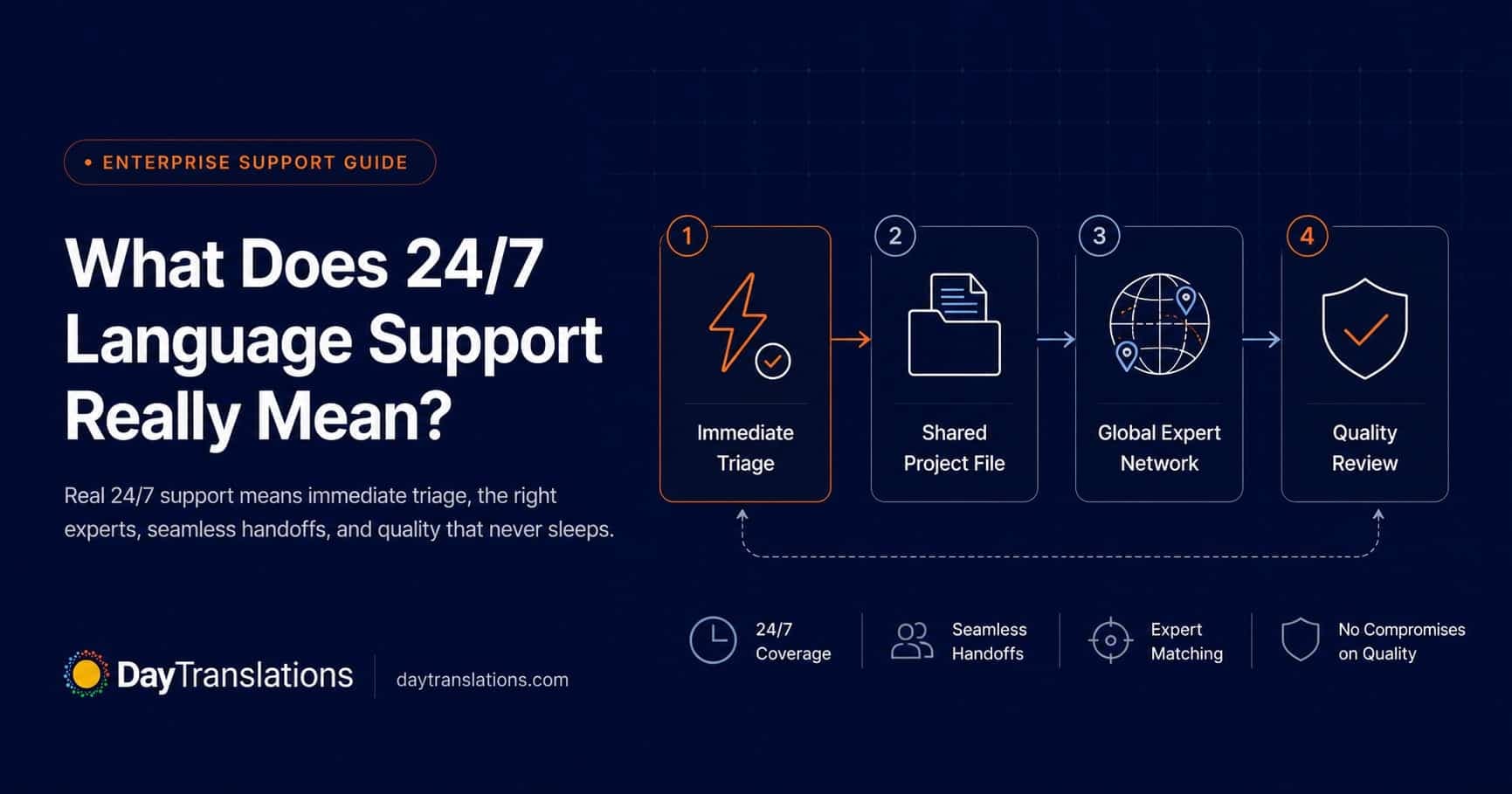
There is a better frame. Most support tickets are not linguistically hard. A password reset is a password reset. “Where is my order” needs an accurate tracking number, not a literature degree. The skill needed for a great multilingual support workflow is not 40 fluent humans on payroll. It is a system that sends each conversation to the best layer that can resolve it correctly and escalates only when the situation genuinely calls for a human who speaks the language.
Route by resolution tier, not by language
Picture your support volume as a pyramid. The wide bottom is high-volume, low-complexity contacts: order status, returns, basic how-to, account access. The middle is moderate complexity: a billing dispute, a configuration problem, a feature that isn’t working as expected. The narrow top is high-stakes and high-nuance: an angry enterprise account, a medical or legal question, a contract clause, a phone call where tone and trust decide whether the customer stays.
Each tier wants a different language solution, and that is the whole insight. You do not need native human fluency at the bottom of the pyramid. You need accurate language and a correct answer, delivered fast. You absolutely do need a real human who speaks the language at the top, because that is where machine translation gets you in trouble and where a mistranslated sentence can cost you the account or trigger a compliance problem.
So instead of hiring per language, you staff per tier. A small core team. Smart automation in the middle. On-demand professional linguists at the top, available across hundreds of languages without one of them sitting on your payroll. Let’s build it layer by layer.

Layer 1: Detect the language and triage before anything else
Everything downstream depends on knowing two things the instant a contact arrives: what language is this, and how hard is it likely to be. Get language detection wrong and you route a French complaint to a Spanish queue, which is worse than no routing at all.
Detection should run on the first inbound message, the email body, or the caller’s menu selection, and it should write the result into the ticket as a field your routing rules can read. Do not rely on the customer account’s country. People travel, immigrate, and set their phone to English while thinking in Tagalog. Detect from the actual text or speech and let the customer override it with a clear “change language” option.
Triage runs alongside detection. Tag the intent, the product area, and the urgency. A renewal-tomorrow voicemail and a “how do I change my avatar” chat are not the same priority, and your workflow should know that before a human ever sees either one. This first layer is unglamorous, and it is where most multilingual workflows fail silently. Build it carefully.
Layer 2: Let customers solve it themselves, in their language
The lowest cost ticket is the one that never reaches a human. For multilingual support, that means a help center, FAQ, chatbot flows, and responses that exist in your customers’ languages, not just in English with a Google Translate widget bolted on the corner.
This is a localization job, not a translation job, and the difference matters. Translation turns your English article into Japanese words. Localization makes sure the Japanese article uses the right date format, the right currency, the right honorifics, and screenshots that show the Japanese version of your interface. It also catches the things that quietly break. A help center built in English assumes English string lengths, and German runs about 15% longer on average, with individual UI labels expanding far more than that. Your tidy English button label becomes a German phrase that overflows its container and makes your self-serve page look broken in exactly the market you were trying to win.
Done well, a localized self-serve layer absorbs a large share of your bottom-tier volume in every language you publish it in, at near-zero marginal cost per contact. This is where professional localization services earn their keep: not by translating one article, but by adapting your entire support knowledge base, macros, and bot scripts so they read like they were written for that market, then keeping them in sync as your product changes. A self-serve layer that is 80% accurate, and three versions out of date does more harm than good, so treat localization as an ongoing process, not a one-time project.
Layer 3: Put AI and machine translation on the front line, with a human nearby
Now the middle of the pyramid. This is where you handle the live conversational volume that gets past self-serve, and it is where AI plus machine translation genuinely changes the economics. A single English-speaking agent, working through a real-time translation layer, can hold a competent text conversation with a customer typing in Korean. The customer writes in Korean, your agent reads English, replies in English, and the customer reads Korean.
For routine tickets, this works well and it scales. But here is the rule you do not break; machine translation gets a human in the loop, and the riskier the content, the closer that human sits. For a “reset my password” exchange, raw machine translation with a confidence check is fine. For anything touching money, health, legal terms, or a visibly upset customer, you route to a person, and you do not let the machine run free.
Why so cautious? Because machine translation fails in ways that look fluent. It produces a grammatical, confident sentence that means the wrong thing, and neither your agent nor your customer can see the error, because both read one side of it. A mistranslated dosage instruction or a flipped “you are not eligible” versus “you are now eligible” reads perfectly smooth on the way out. Smoothness is not accuracy. Build your routing so that machine translation handles the easy majority and hands off the moment a ticket crosses into stakes that punish a quiet error.
A practical setup: machine translation drafts the reply; a human agent reviews it for anything sensitive, and your highest-risk categories skip the machine entirely and go to the next layer. This is roughly what the translation industry calls human-in-the-loop, and it is the single most important design choice in the whole workflow.
Layer 4: Bring in professional humans for the moments that earn it
The top of the pyramid is where you spend your real language budget, and where you should. These are the conversations that decide retention, that carry legal or medical weight, or that simply need the warmth and judgment a machine cannot fake. And critically, this is where you do not need anyone in-house. You need them on demand.
Two services cover most of this layer. The first is live interpreting, for phone and video. When a customer calls in distress, or when a sales-critical account wants to talk through a problem in real time, you connect with a professional interpreter into the call within seconds. Your English-speaking agent and the customer each speak their own language, and the interpreter carries the meaning, the tone, and the nuance between them. Good interpreting services give you on-demand access to hundreds of languages over the phone or by video, which means your nine-tickets-a-week Finnish customer gets a fluent, fully human phone conversation without you ever hiring a Finnish agent. You pay for the minutes you use, and only for them.
The second is professional human translation for anything written that must be exactly right; a formal complaint response, a legal or compliance reply, a contract clarification, a sensitive account escalation in writing. This is the work to send to certified linguists who follow a standard like ISO 17100, where a second qualified linguist reviews the first one’s work before it goes out. That second pair of eyes is the difference between a translation that is fluent and a translation that is correct, and it is exactly the safeguard machine translation cannot offer.
Notice what this does to your staffing. The languages that are too low-volume to ever justify a hire are precisely the ones where on-demand interpreting and translation shine. You get genuine native-quality coverage in Finnish, Amharic, Khmer, and 200-plus other languages, paid by the minute or by the word, with no recruiting, no idle salaries, and no single point of failure.
Layer 5: Close the loop with a glossary and real QA
A workflow without quality control degrades. Multilingual workflows degrade faster, because the people approving the output often cannot read it. So, you build feedback deliberately.
Start with a term-base; a shared glossary of your product terms, brand names, and the phrases that must never be mistranslated. Feed it to your machine translation engine, your human translators, and your interpreters alike. When your product calls a feature “Workspaces,” you want that word to stay “Workspaces” or use one agreed translation in every language, not three different inventions across three vendors. A consistent glossary is the best quality lever you have, and most teams skip it.
Then measure per language, not just in aggregate. Track CSAT, resolution time, and escalation rate broken out by language. A blended 92% CSAT can easily hide a 70% score in Turkish that nobody noticed because it is a small slice of volume. Per-language metrics are how you find the leaks. Sample real conversations for back-translation review, where a separate linguist checks what your machine translation actually said. And give your customers an easy way to flag “this reply didn’t make sense,” because they are your best detectors of quiet translation failure.
The technical traps nobody warns you about
Even a well-staffed workflow breaks on details that have nothing to do with hiring. These are the ones that bite teams in the second month.
String expansion is the classic: The same UI label, the same automated email, the same chatbot button takes up different space in different languages. German and Finnish run long. Chinese and Japanese run short but tall. If your support templates were laid out for English, they will overflow or truncate in production, and your carefully translated message will look careless.
Pluralization is sneakier: “You have 1 message” and “You have 3 messages” is trivial in English, which has two plural forms. Arabic has six. Russian has four. Polish changes the noun ending based on the last digit of the count. If your automated notifications build sentences by gluing a number next to a word, they will be grammatically wrong in most of the world’s major languages, and no error will ever be thrown to warn you. The industry solved this with the ICU Message Format standard, which keeps all the plural and gender variants of a message in one translatable string and applies the correct one per language using Unicode CLDR rules. If your support tooling sends dynamic messages, insist on ICU-style formatting rather than string concatenation. It is the difference between “1 results found” embarrassing you in five locales and a message that is simply correct everywhere.
Right-to-left layout is its own project: Arabic, Farsi, and Urdu do not just translate, they mirror. The entire interface flips: navigation, icons, progress bars, etc. A chat widget or help center that was never designed for RTL will render Arabic as a visually broken mess even when the translation itself is perfect.
And then the small things that erode trust. A date written 03/04 means March 4th in the United States and April 3rd almost everywhere else, so an automated “your refund arrives 03/04” message creates a support ticket instead of preventing one. Currency symbols, address formats, name order, and number separators all carry the same risk. None of these is hard on its own. Together they are the reason “we translated everything” still produces a support experience that feels foreign in the worst way.
A simple way to decide what goes where
You do not need a 40-page routing document. You need a default and a few escape hatches. Here is a workable starting rule.
Send everything to self-serve first in language. Whatever isn’t resolved there, flows to your AI and machine translation layer with a human reviewing anything sensitive. From there, escalate to a live interpreter or a professional human translator whenever any one of these is true:
- The contact is a phone or video call where the tone matters.
- The content touches money, health, legal, or safety, the customer is clearly upset or at risk of churning, or it is a high-value account.
- Everything else stays in the automated middle.
That single rule covers most of your volume cleanly. The high-frequency, low-stakes majority get fast in-language service. The rare, high-stakes minority gets a fully human, native-quality experience. And you never paid for a full-time hire in a language that sends you a handful of tickets a week.
What your actual staffing model looks like
Put it together and the organizational chart is surprisingly lean. You keep a small core team of agents who work in your primary languages, the ones with enough volume to justify dedicated headcount, often English plus two or three others. You give them real-time translation tooling so each of them can serve far more languages than they personally speak. You invest in localization, so your self-serve layer carries weight in every market you operate in. And you partner with an on-demand language provider for interpreting and professional translation, so the entire long tail of languages is covered the moment a customer needs it, with zero idle cost.
This is how a team of eight supports customers in forty languages without anyone pretending to be fluent in a language they don’t speak. The core team handles the bulk. The automation extends their reach. The professional partners handle the moments that earn a human, across every language, billed by use.
If you are weighing where to start, start with the two layers that move the needle fastest: localize your self-serve content in your top markets, and set up on-demand interpreting, so no phone call ever dies for lack of a shared language. Those two changes alone will take pressure off your queue and out of your hiring plan immediately. You can see how both fit together, and get help mapping your own tiers, at Day Translations.
The goal was never to hire every language. It was to make sure every customer feels spoken to in theirs. Those are very different problems, and only one of them requires you to grow your headcount.